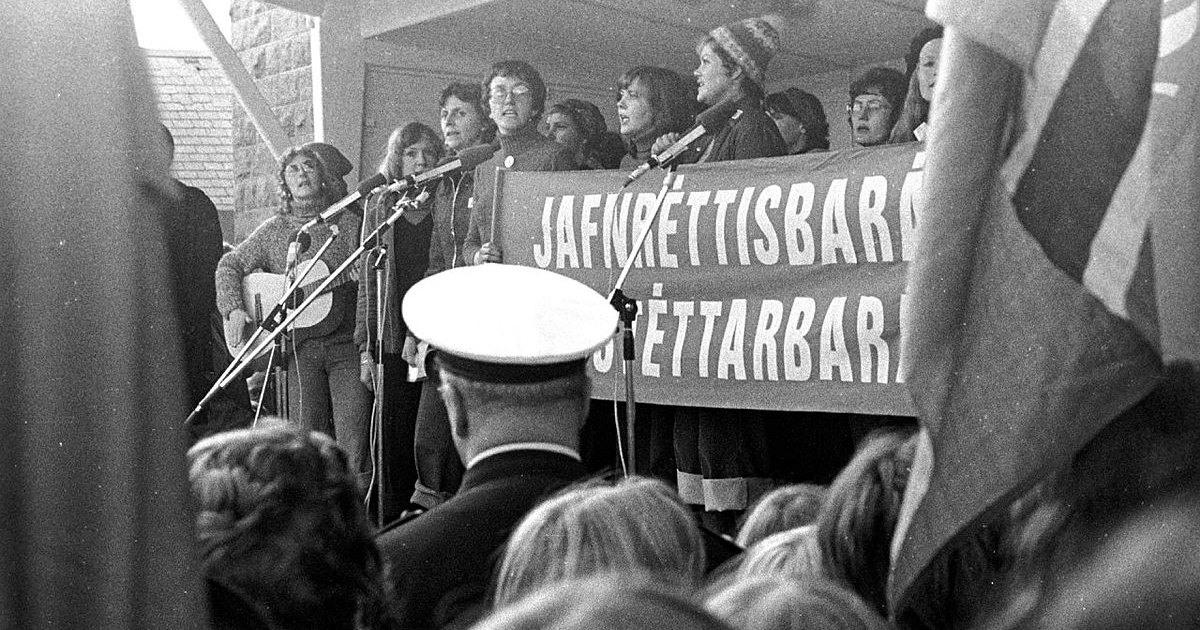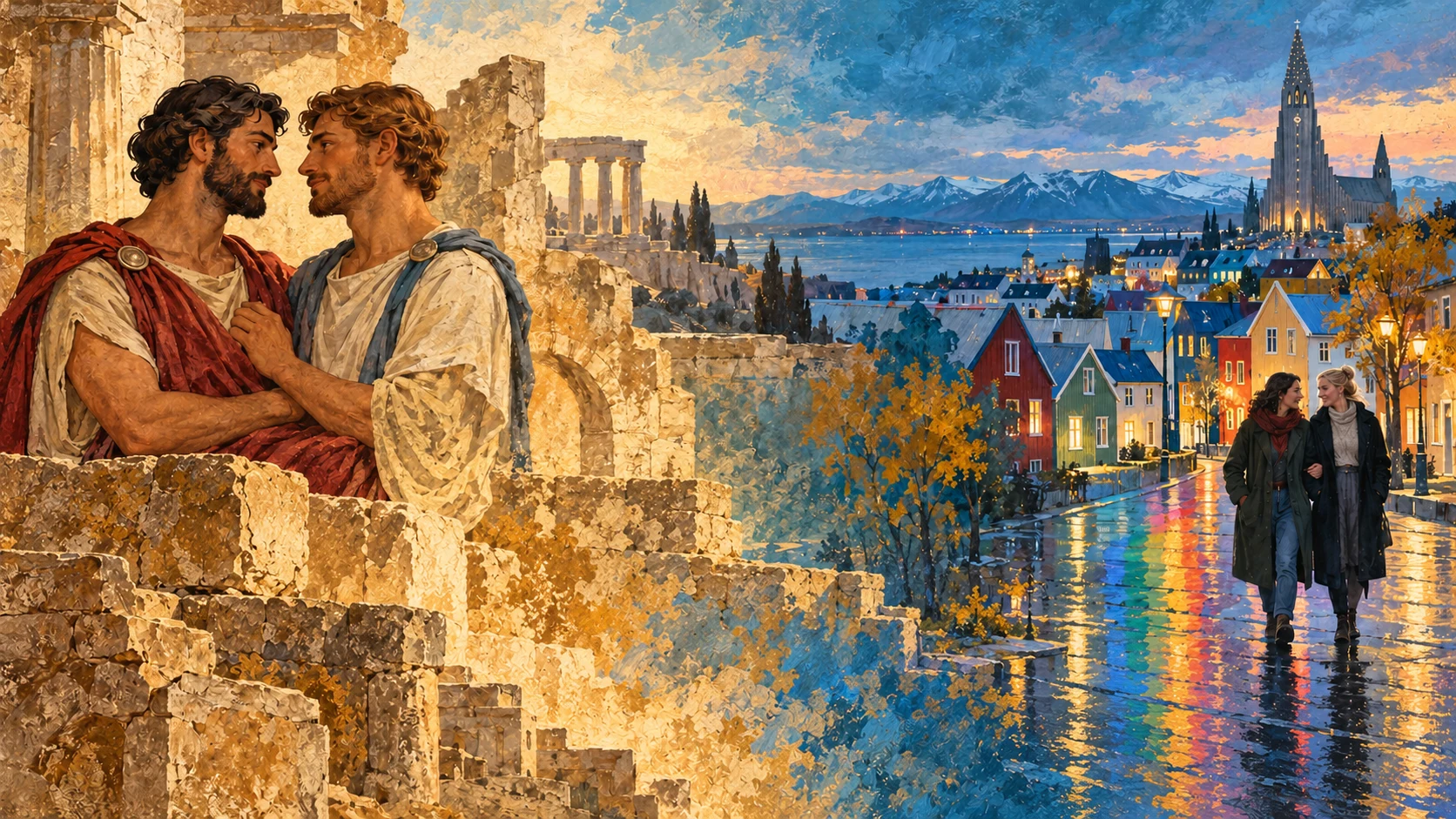
In Iceland in 1975, a singer’s public disclosure that he was gay could lead him to leave the country for his safety. Thirty-five years later, the prime minister married her female partner on the day marriage equality took effect. The distance between Hörður Torfason’s experience and Jóhanna Sigurðardóttir’s marriage in 2010 is more than the story of two individuals. It is a story of a society changed through visibility, organising and law. Samtökin ’78’s history, report from 2010
Where does that story begin? Did homosexuality emerge in a particular place? Has there been an era when humanity was most sexually free?
The historical record supplies neither a single starting point nor a golden age that included everyone. Instead, it shows comparable forms of intimacy lived under different names, rules and inequalities.
The first record is not the first person
A wall painting, poem or law is a surviving trace. A documented relationship does not prove that it was the first of its kind in human history. There were also lives that were never recorded, whose records did not survive, or whose traces researchers have yet to find.
The British Museum explores same-sex love and desire through objects from different periods and places. They do not identify a moment of invention; they reveal the historical variety of human experience. British Museum: Desire, love and identity
Desire, a relationship and the identity someone uses to describe themselves are also distinct things. Applying today’s categories of homosexual, heterosexual and bisexual directly to people who lived thousands of years ago can distort their world.
The use of the German word “Homosexualität” in a pamphlet in 1869 marks a milestone in the modern concept’s history. It does not mean that same-sex desire began then. Journal of Homosexuality: Kertbeny and the Nameless Love, abstract
Two men in Egypt: a powerful trace, a disputed interpretation
The shared tomb of Niankhkhnum and Khnumhotep, from Egypt’s Fifth Dynasty, is a frequently discussed example. The two men appear in poses that have been compared with depictions of intimacy between spouses.
Greg Reeder’s study in World Archaeology examines those features in relation to same-sex desire and partnership. A study by Richard B. Parkinson held in Oxford’s repository discusses the scenes’ significance for modern LGBTQ history while acknowledging uncertainty over the relationship. Reeder, abstract, Oxford repository
Calling them definitively “the world’s first gay couple” would therefore claim more than the evidence can establish. The tomb is an important source for thinking about representations of intimacy between men; it is not personal testimony explaining every aspect of their relationship.
Ancient Greece and Rome: visibility was not equality
Ancient Greece and Rome are often idealised in discussions of sexual freedom. The British Museum’s exhibition material describes acceptance of relationships between males in some Greek cities, but within particular boundaries and age-based roles. Roman objects also show male same-sex relations within visual culture. British Museum audio-guide transcript
Depiction, or acceptance in some circles, does not establish that both people had equal power and freedom of choice. Historical relationships involving adults and young people must not be equated with consensual relationships between adults today. Historical acceptance does not remove present-day standards of consent and child protection.
The limits of the sources become more apparent when considering women. The museum notes that Greek and Roman objects largely reflect male perspectives; evidence of women’s own experiences of sexuality is harder to find. Sappho’s poetry therefore has particular significance: it voices female desire and left a literary legacy that influenced later generations. Reliable details of her life nevertheless remain limited. British Museum: exploring LGBTQ histories
The question is not simply which relationships existed. Who could speak, who could choose, and whose experience was recorded are equally important questions.
This history extends beyond Europe
Objects from Japan’s Edo period show relationships between males represented outside modern European identity categories. The Metropolitan Museum of Art’s account of an early eighteenth-century handscroll describes their visibility and acceptance in that cultural setting. It also points to asymmetries involving age and social roles. The Met: work by Miyagawa Chōshun
This makes it inadequate to portray homosexuality as solely a feature of recent Western societies. It does not turn Edo Japan into a paradise of equal freedom. Cultural acceptance and individual rights are different measures.
The Egyptian, Mediterranean and Japanese examples in this feature do not represent the entire world history of sexuality. They demonstrate how different kinds of evidence need to be read.
The 1960s: major change, unfinished liberation
The “sexual revolution” often evokes Western societies in the 1960s and 1970s. Approval of the contraceptive pill in the United States in 1960 was an important development in people’s ability to plan pregnancy. Access remained unequal, however, and legal and social barriers persisted. Technology alone did not give everyone the same freedom. Smithsonian collection record, Associated Press on the pill’s social impact
Resistance following the police raid on New York’s Stonewall Inn on 28 June 1969 became a symbol of another transformation. The US National Park Service describes a turning point that strengthened the struggle for rights, while placing the movement in a history longer and more complex than one night. Stonewall history, NPS: The Second Revolution
Rather than years in which everyone became free, this was a period of intense struggle over whose lives were criminalised and who could make decisions about their bodies.
Medical classifications changed too. The World Health Organization identifies 17 May 1990 as the date when the World Health Assembly stopped classifying homosexuality as a mental disorder. Homosexuality is not a disease. WHO statement, 2025
Iceland: from discreet meetings to legal recognition
Iceland’s transformation challenges the assumption that it has always been equally accepting. According to Samtökin ’78’s own history, before the organisation’s foundation, gay men and lesbians met in small, secret groups, and some chose to live abroad. Hörður Torfason’s coming out in 1975 helped break that silence. Founded in 1978, the organisation turned information-sharing and equal rights into public demands. Samtökin ’78
Legal milestones did not arrive all at once:
| Year | Change | Why it matters |
|---|---|---|
| 1940 | Earlier provisions criminalising same-sex relations between men were removed | Decriminalisation was not the same as the equal rights achieved later. |
| 1996 | Registered partnerships for same-sex couples | Relationships gained legal recognition; the original arrangement was not identical to marriage in every respect. |
| 2010 | Marriage law extended to same-sex couples | Couples moved from a separate relationship status into a shared marriage framework. |
| 2018 | Consent placed at the centre of the definition of rape | Sexual freedom includes the right to refuse unwanted sexual activity. |
| 2019 | Gender Autonomy Act | Legal recognition of gender adopted an approach grounded in a person’s own identity. |
Table sources: ILGA World legal database, Council of Europe historical legal study, Iceland’s report to the UN, Gender Autonomy Act.
Sexual orientation and gender identity are distinct concepts. They appear together here because struggles for equality and control over one’s life intersect, not because they mean the same thing.
When the marriage reform took effect on 27 June 2010, Prime Minister Jóhanna Sigurðardóttir and Jónína Leósdóttir converted their registered partnership into a marriage. That change in a prime minister’s private life became a visible example of a legal reform available to other couples too. The Reykjavík Grapevine, 28 June 2010
Why is the picture still unfinished in Iceland today?
ILGA-Europe’s 2026 review of Iceland covers developments during 2025. It reports that all municipal swimming pools in Reykjavík received Rainbow Certification, intended to improve inclusion. Staff training and reviews of workplace policies illustrate how legal equality can translate into everyday services.
The same review summarises research whose results appeared in 2025, finding disadvantages in the health and wellbeing of LGBTI people compared with non-LGBTI people. This is ILGA-Europe’s account of that research, not an independent reanalysis of the original study. Marriage equality does not, by itself, establish equal conditions in every part of life. ILGA-Europe: Iceland, 2026 review
Legal and policy protections measured by tools such as Rainbow Map do not answer every question about sexual freedom. Law, implementation, access to healthcare and social experience require separate consideration. It would therefore be misleading to use a legal ranking to declare Iceland the world’s most sexually free country.
Which questions help us assess freedom?
The WHO’s approach to sexual health combines a positive, respectful approach to sexuality with freedom from coercion, discrimination and violence. Sexuality involves more than sexual behaviour; it also relates to intimacy, orientation, identity and reproduction. WHO: Sexual health
Drawing on that approach, this feature uses the following questions:
- Can people choose an adult partner capable of consenting without fear of punishment or violence?
- Can they refuse an unwanted relationship and leave it?
- Can they access healthcare and reliable information without discrimination?
- Are their relationships and families equally protected by law?
- Do these rights reach different social groups, rather than only a privileged few?
These questions are an interpretive framework, not an official historical index. They clarify what we mean when applying the same word to different periods.
Which era was the freest?
The sources examined cannot establish a single period for all humanity. Same-sex relationships could be more visible in some ancient societies than in later periods. Visibility, however, did not necessarily mean equal citizenship, freely given consent or bodily autonomy for everyone.
Iceland has made substantial recent gains in marriage equality, consent-centred law and gender autonomy. That conclusion follows from documented legal changes. It does not follow that everyone’s everyday life is perfect or equal.
Perhaps the most revealing question to ask of the past is not when people were less restrained, but this: Who could live their life without needing other people’s permission?
Iceland’s recent history shows that the answer did not change by itself. People who dared to be visible, communities that organised and laws that were changed redrew the boundaries of personal life.
Sources
- Samtökin ’78’s history
- report from 2010
- British Museum: Desire, love and identity
- Journal of Homosexuality: Kertbeny and the Nameless Love, abstract
- Reeder, abstract
- Oxford repository
- British Museum audio-guide transcript
- British Museum: exploring LGBTQ histories
- The Met: work by Miyagawa Chōshun
- Smithsonian collection record
- Associated Press on the pill’s social impact
- Stonewall history
- NPS: The Second Revolution
- WHO statement, 2025
- ILGA World legal database
- Council of Europe historical legal study
- Iceland’s report to the UN
- Gender Autonomy Act
- ILGA-Europe: Iceland, 2026 review
- WHO: Sexual health
Spotted a mistake? info@izlandapedia.com · Instagram @izlandapedia