
Literature · Mythology · Iceland
Völuspá
Last updated:
A voice that remembers before the world.
A woman speaks. A god listens. A world is born, burns, and grows green again. Enter The Seeress’s Prophecy.
Enter the story ↓Read the poem ↗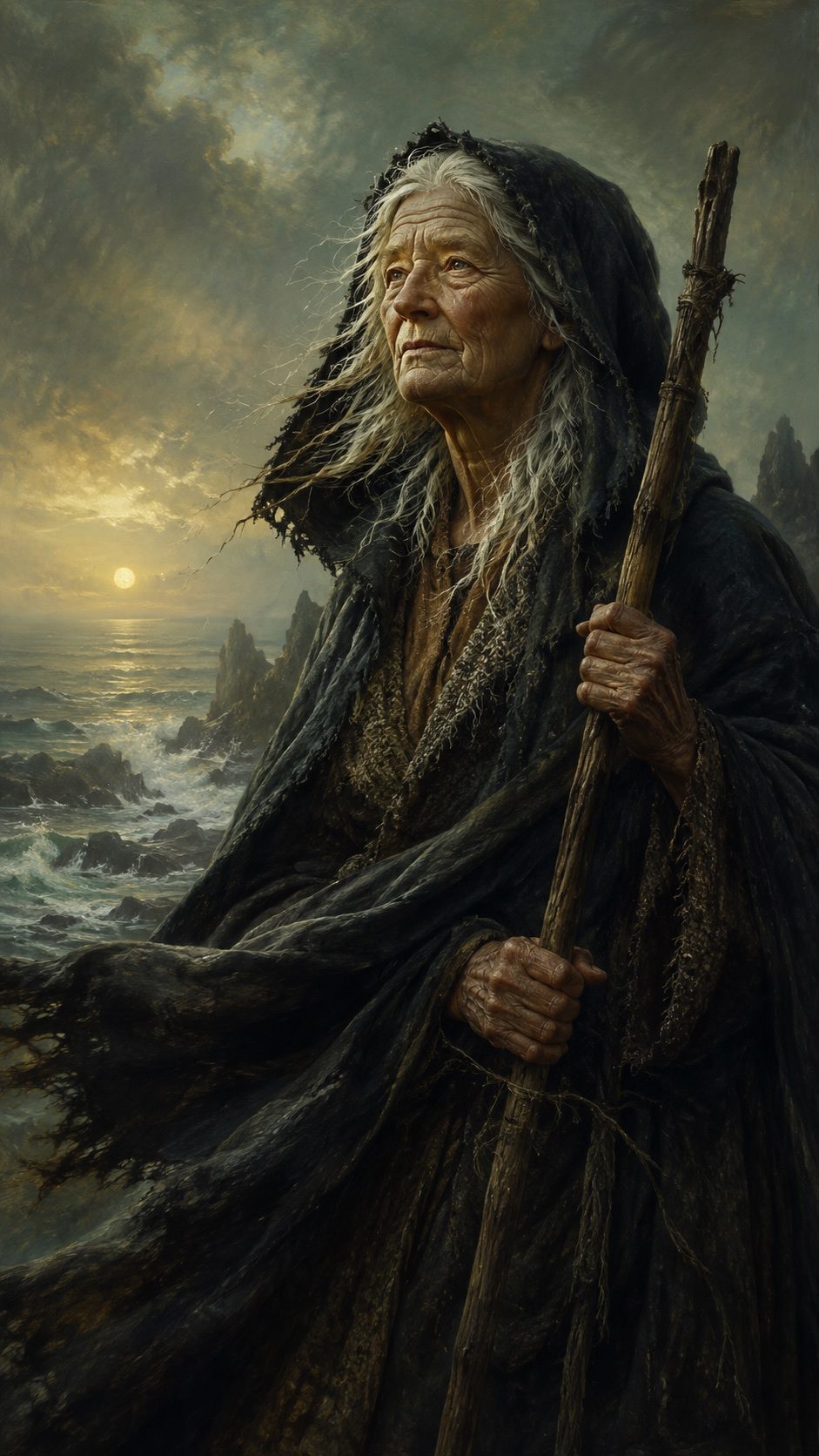
Choose your way in.
Meet the voice that remembers
Follow the seeress, Odin, Ragnarök and renewal through four illustrated chapters.
Enter the story →THE FULL POEMSpend time with the verses
Read the 66-stanza sequence used here, from Bellows’s historic English edition.
Open the poem →A READING KEYKnow what you are looking at
Separate the medieval poem from later translation, interpretation and illustration.
Read the context →Before you read
One prophecy. An entire world.
Völuspá is among the best-known poems of the Old Norse Poetic Edda tradition. Its title means “The Seeress’s Prophecy.” A völva remembers the past and sees the future; Odin listens. This is mythological poetry about creation and the world’s end, not a historical chronicle. [1]
One poem. More than one textual tradition.
Völuspá belongs to the Poetic Edda. The complete text on this page follows Henry Adams Bellows’s 1923 English edition and its stanza order. Its 66-stanza sequence is not a universal count across editions. The images are literary interpretations rather than evidence of how medieval people or events looked.
The listening feature introduces modern Icelandic words connected with the poem. It is not a recording of the complete Old Norse text.
01 / The remembering voice
Unnamed.
Older than the world.
Völva is a word for a seeress, not her personal name. The poem gives no complete biography. We know her through her voice: she remembers giants, creation, and the ending the gods fear. [1]
Hearing I ask from the holy races,
From Heimdall’s sons, both high and low;
Thou wilt, Valfather, that well I relate
Old tales I remember of men long ago.Stanza 1 · Henry Adams Bellows, 1923
This portrait fills the poem’s silences imaginatively. Neither the face nor the clothing represents a documented individual.
02 / The listener
Not all-knowing.
Still seeking.
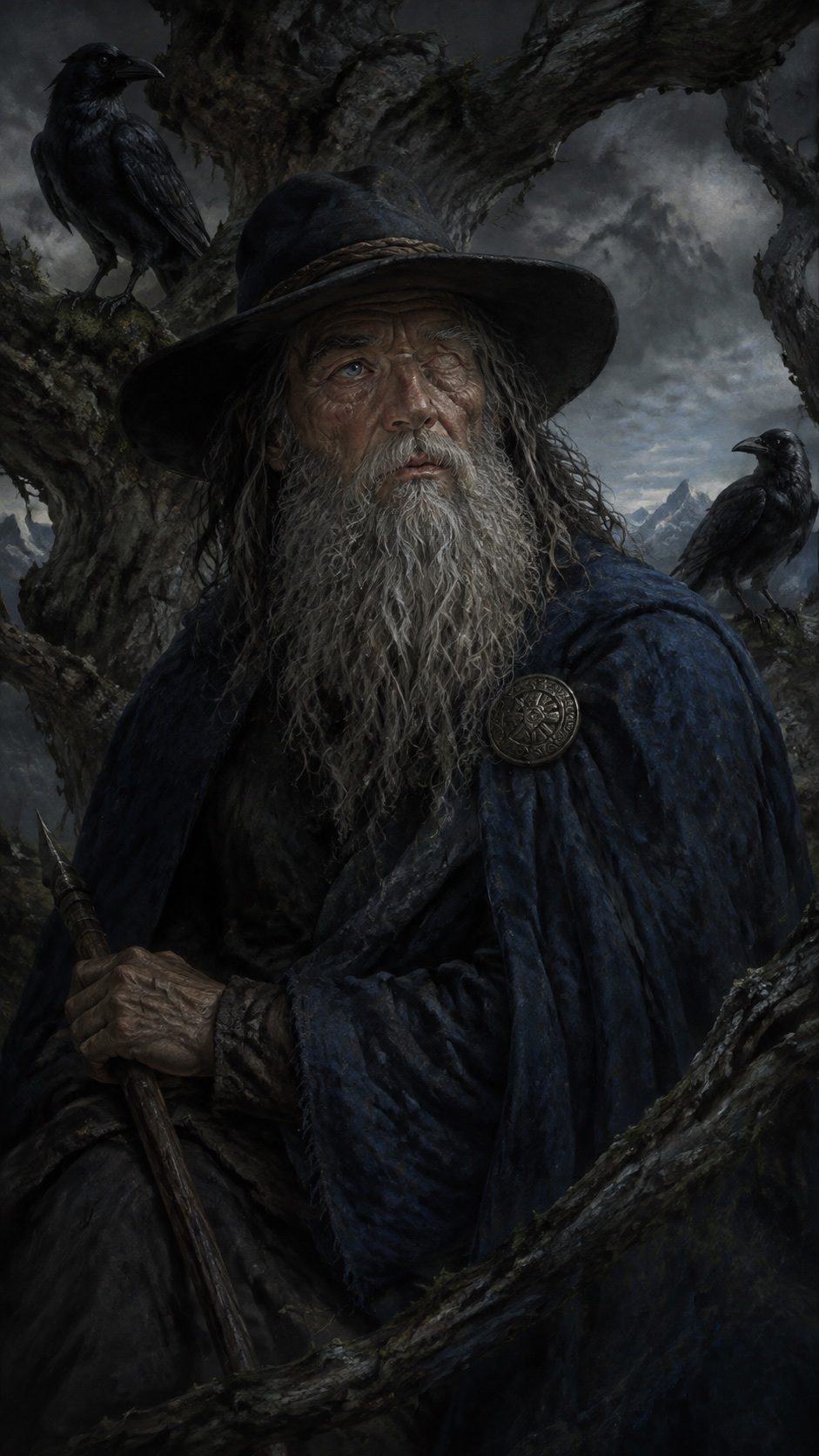
Odin is associated with wisdom, poetry, war and magic in Norse mythology. Here, what matters is not that he knows every answer, but that he asks. The seeress knows of the eye he left in Mimir’s well. Knowledge has a price. [1] [2]
Alone I sat when the Old One sought me,
The terror of gods, and gazed in mine eyes:
“What hast thou to ask? why comest thou hither?
Othin, I know where thine eye is hidden.”Stanza 28 · Henry Adams Bellows, 1923
The two ravens refer to Odin’s wider mythological tradition; they are not a scene described in this stanza. [2]
03 / The unravelling world
The sun darkens.
Order gives way.
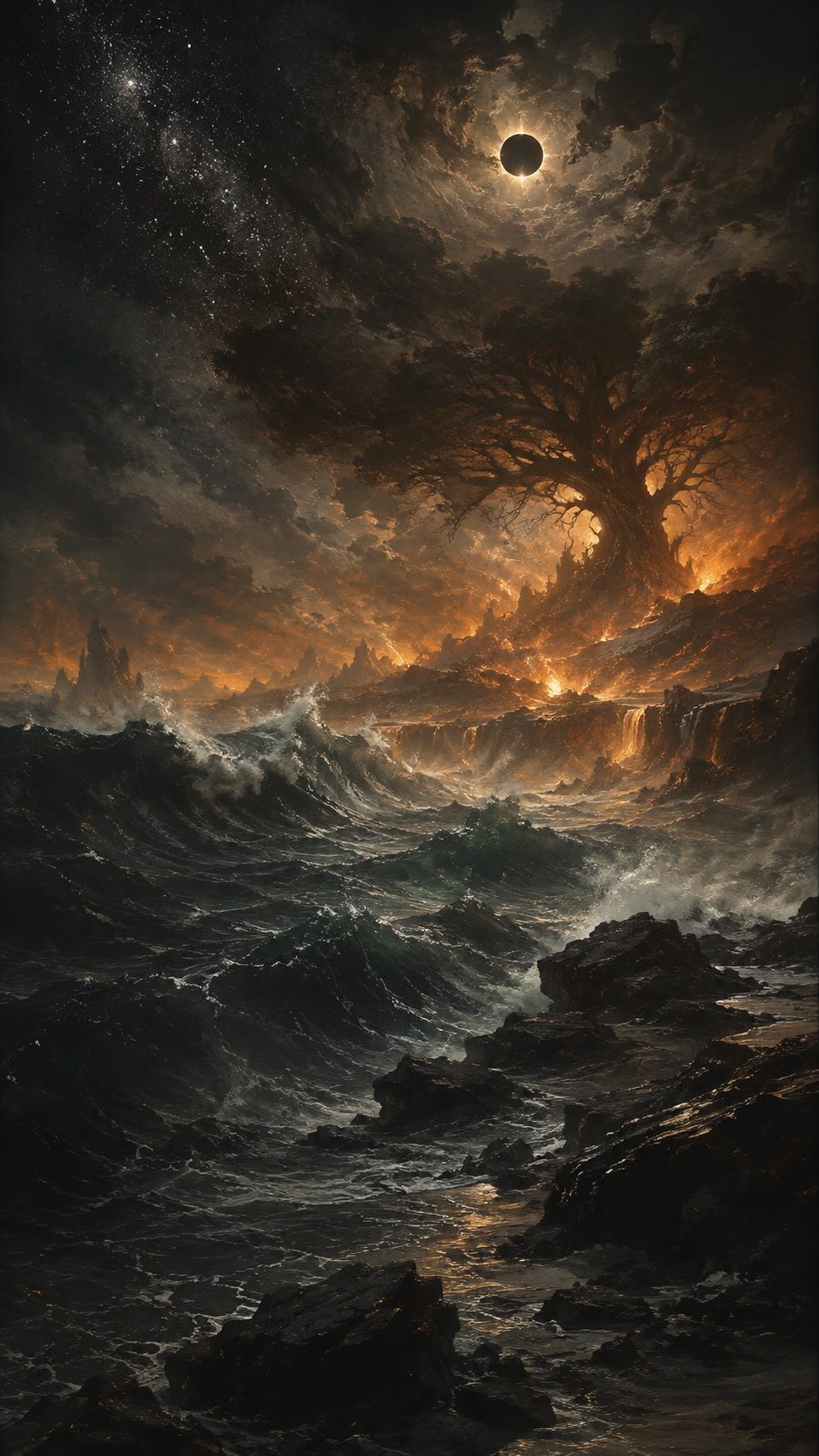
Ragnarök names the gods’ fate and their great final conflict. Human bonds break before the cosmic order collapses. Odin faces the wolf; Thor fights the serpent. Destruction is not merely scenery: even the gods cannot escape it. [1]
The sun turns black, earth sinks in the sea,
The hot stars down from heaven are whirled;
Fierce grows the steam and the life-feeding flame,
Till fire leaps high about heaven itself.Stanza 57 · Henry Adams Bellows, 1923
The image is a mythological interpretation, not a scientific reconstruction of a Katla eruption.
04 / Fire is not the last word
And the world grows green again.
Now do I see the earth anew
Rise all green from the waves again;
The cataracts fall, and the eagle flies,
And fish he catches beneath the cliffs.
Stanza 59 · Henry Adams Bellows, 1923
A new world rises from the water. Yet the dark dragon at the poem’s end resists an uncomplicated happy ending. Renewal and uncertainty remain together. [1]
The reading room
Alone with the poem.
The stanzas above were a selection. Open all 66 stanzas from Bellows’s 1923 edition below. Stanza order and numbering vary between editions.
The English text follows Henry Adams Bellows’s public-domain 1923 translation, with typographical spacing simplified. Editorial gaps remain visible. This is one historical edition, not a definitive reconstruction of an unchanging original.
The gaps marked in the source edition are gaps within its text, not stanzas omitted from this page. The English poem is Bellows’s historic translation, not a modern scholarly edition of the Old Norse original.
Open the complete poem · Bellows, 66 stanzas
STANZA 01
Hearing I ask from the holy races,
From Heimdall’s sons, both high and low;
Thou wilt, Valfather, that well I relate
Old tales I remember of men long ago.
STANZA 02
I remember yet the giants of yore,
Who gave me bread in the days gone by;
Nine worlds I knew, the nine in the tree
With mighty roots beneath the mold.
STANZA 03
Of old was the age when Ymir lived;
Sea nor cool waves nor sand there were;
Earth had not been, nor heaven above,
But a yawning gap, and grass nowhere.
STANZA 04
Then Bur’s sons lifted the level land,
Mithgarth the mighty there they made;
The sun from the south warmed the stones of earth,
And green was the ground with growing leeks.
STANZA 05
The sun, the sister of the moon, from the south
Her right hand cast over heaven’s rim;
No knowledge she had where her home should be,
The moon knew not what might was his,
The stars knew not where their stations were.
STANZA 06
Then sought the gods their assembly-seats,
The holy ones, and council held;
Names then gave they to noon and twilight,
Morning they named, and the waning moon,
Night and evening, the years to number.
STANZA 07
At Ithavoll met the mighty gods,
Shrines and temples they timbered high;
Forges they set, and they smithied ore,
Tongs they wrought, and tools they fashioned.
STANZA 08
In their dwellings at peace they played at tables,
Of gold no lack did the gods then know,—
Till thither came up giant-maids three,
Huge of might, out of Jotunheim.
STANZA 09
Then sought the gods their assembly-seats,
The holy ones, and council held,
To find who should raise the race of dwarfs
Out of Brimir’s blood and the legs of Blain.
STANZA 10
There was Motsognir the mightiest made
Of all the dwarfs, and Durin next;
Many a likeness of men they made,
The dwarfs in the earth, as Durin said.
STANZA 11
Nyi and Nithi, Northri and Suthri,
Austri and Vestri, Althjof, Dvalin,
Nar and Nain, Niping, Dain,
Bifur, Bofur, Bombur, Nori,
An and Onar, Ai, Mjothvitnir.
STANZA 12
Vigg and Gandalf, Vindalf, Thrain,
Thekk and Thorin, Thror, Vit and Lit,
Nyr and Nyrath,— now have I told—
Regin and Rathsvith— the list aright.
STANZA 13
Fili, Kili, Fundin, Nali,
Heptifili, Hannar, Sviur,
Frar, Hornbori, Fræg and Loni,
Aurvang, Jari, Eikinskjaldi.
STANZA 14
The race of the dwarfs in Dvalin’s throng
Down to Lofar the list must I tell;
The rocks they left, and through wet lands
They sought a home in the fields of sand.
STANZA 15
There were Draupnir and Dolgthrasir,
Hor, Haugspori, Hlevang, Gloin,
Dori, Ori, Duf, Andvari,
Skirfir, Virfir, Skafith, Ai.
STANZA 16
Alf and Yngvi, Eikinskjaldi,
Fjalar and Frosti, Fith and Ginnar;
So for all time shall the tale be known,
The list of all the forbears of Lofar.
STANZA 17
Then from the throng did three come forth,
From the home of the gods, the mighty and gracious;
Two without fate on the land they found,
Ask and Embla, empty of might.
STANZA 18
Soul they had not, sense they had not,
Heat nor motion, nor goodly hue;
Soul gave Othin, sense gave Hönir,
Heat gave Lothur and goodly hue.
STANZA 19
An ash I know, Yggdrasil its name,
With water white is the great tree wet;
Thence come the dews that fall in the dales,
Green by Urth’s well does it ever grow.
STANZA 20
Thence come the maidens mighty in wisdom,
Three from the dwelling down ’neath the tree;
Urth is one named, Verthandi the next,—
On the wood they scored,— and Skuld the third.
Laws they made there, and life allotted
To the sons of men, and set their fates.
STANZA 21
The war I remember, the first in the world,
When the gods with spears had smitten Gollveig,
And in the hall of Hor had burned her,—
Three times burned, and three times born,
Oft and again, yet ever she lives.
STANZA 22
Heith they named her who sought their home,
The wide-seeing witch, in magic wise;
Minds she bewitched that were moved by her magic,
To evil women a joy she was.
STANZA 23
On the host his spear did Othin hurl,
Then in the world did war first come;
The wall that girdled the gods was broken,
And the field by the warlike Wanes was trodden.
STANZA 24
Then sought the gods their assembly-seats,
The holy ones, and council held,
Whether the gods should tribute give,
Or to all alike should worship belong.
STANZA 25
Then sought the gods their assembly-seats,
The holy ones, and council held,
To find who with venom the air had filled,
Or had given Oth’s bride to the giants’ brood.
STANZA 26
In swelling rage then rose up Thor,—
Seldom he sits when he such things hears,—
And the oaths were broken, the words and bonds,
The mighty pledges between them made.
STANZA 27
I know of the horn of Heimdall, hidden
Under the high-reaching holy tree;
On it there pours from Valfather’s pledge
A mighty stream: would you know yet more?
STANZA 28
Alone I sat when the Old One sought me,
The terror of gods, and gazed in mine eyes:
“What hast thou to ask? why comest thou hither?
Othin, I know where thine eye is hidden.”
STANZA 29
I know where Othin’s eye is hidden,
Deep in the wide-famed well of Mimir;
Mead from the pledge of Othin each morn
Does Mimir drink: would you know yet more?
STANZA 30
Necklaces had I and rings from Heerfather,
Wise was my speech and my magic wisdom;
. . . . . . . . . .
Widely I saw over all the worlds.
STANZA 31
On all sides saw I Valkyries assemble,
Ready to ride to the ranks of the gods;
Skuld bore the shield, and Skogul rode next,
Guth, Hild, Gondul, and Geirskogul.
Of Herjan’s maidens the list have ye heard,
Valkyries ready to ride o’er the earth.
STANZA 32
I saw for Baldr, the bleeding god,
The son of Othin, his destiny set:
Famous and fair in the lofty fields,
Full grown in strength the mistletoe stood.
STANZA 33
From the branch which seemed so slender and fair
Came a harmful shaft that Hoth should hurl;
But the brother of Baldr was born ere long,
And one night old fought Othin’s son.
STANZA 34
His hands he washed not, his hair he combed not,
Till he bore to the bale-blaze Baldr’s foe.
But in Fensalir did Frigg weep sore
For Valhall’s need: would you know yet more?
STANZA 35
One did I see in the wet woods bound,
A lover of ill, and to Loki like;
By his side does Sigyn sit, nor is glad
To see her mate: would you know yet more?
STANZA 36
From the east there pours through poisoned vales
With swords and daggers the river Slith.
. . . . . . . . . . . . . . . .
. . . . . . . . . . . . . . . .
STANZA 37
Northward a hall in Nithavellir
Of gold there rose for Sindri’s race;
And in Okolnir another stood,
Where the giant Brimir his beer-hall had.
STANZA 38
A hall I saw, far from the sun,
On Nastrond it stands, and the doors face north;
Venom drops through the smoke-vent down,
For around the walls do serpents wind.
STANZA 39
I saw there wading through rivers wild
Treacherous men and murderers too,
And workers of ill with the wives of men;
There Nithhogg sucked the blood of the slain,
And the wolf tore men; would you know yet more?
STANZA 40
The giantess old in Ironwood sat,
In the east, and bore the brood of Fenrir;
Among these one in monster’s guise
Was soon to steal the sun from the sky.
STANZA 41
There feeds he full on the flesh of the dead,
And the home of the gods he reddens with gore;
Dark grows the sun, and in summer soon
Come mighty storms: would you know yet more?
STANZA 42
On a hill there sat, and smote on his harp,
Eggther the joyous, the giants’ warder;
Above him the cock in the bird-wood crowed,
Fair and red did Fjalar stand.
STANZA 43
Then to the gods crowed Gollinkambi,
He wakes the heroes in Othin’s hall;
And beneath the earth does another crow,
The rust-red bird at the bars of Hel.
STANZA 44
Now Garm howls loud before Gnipahellir,
The fetters will burst, and the wolf run free;
Much do I know, and more can see
Of the fate of the gods, the mighty in fight.
STANZA 45
Brothers shall fight and fell each other,
And sisters’ sons shall kinship stain;
Hard is it on earth, with mighty whoredom;
Axe-time, sword-time, shields are sundered,
Wind-time, wolf-time, ere the world falls;
Nor ever shall men each other spare.
STANZA 46
Fast move the sons of Mim, and fate
Is heard in the note of the Gjallarhorn;
Loud blows Heimdall, the horn is aloft,
In fear quake all who on Hel-roads are.
STANZA 47
Yggdrasil shakes, and shiver on high
The ancient limbs, and the giant is loose;
To the head of Mim does Othin give heed,
But the kinsman of Surt shall slay him soon.
STANZA 48
How fare the gods? how fare the elves?
All Jotunheim groans, the gods are at council;
Loud roar the dwarfs by the doors of stone,
The masters of the rocks: would you know yet more?
STANZA 49
Now Garm howls loud before Gnipahellir,
The fetters will burst, and the wolf run free;
Much do I know, and more can see
Of the fate of the gods, the mighty in fight.
STANZA 50
From the east comes Hrym with shield held high;
In giant-wrath does the serpent writhe;
O’er the waves he twists, and the tawny eagle
Gnaws corpses screaming; Naglfar is loose.
STANZA 51
O’er the sea from the north there sails a ship
With the people of Hel, at the helm stands Loki;
After the wolf do wild men follow,
And with them the brother of Byleist goes.
STANZA 52
Surt fares from the south with the scourge of branches,
The sun of the battle-gods shone from his sword;
The crags are sundered, the giant-women sink,
The dead throng Hel-way, and heaven is cloven.
STANZA 53
Now comes to Hlin yet another hurt,
When Othin fares to fight with the wolf,
And Beli’s fair slayer seeks out Surt,
For there must fall the joy of Frigg.
STANZA 54
Then comes Sigfather’s mighty son,
Vithar, to fight with the foaming wolf;
In the giant’s son does he thrust his sword
Full to the heart: his father is avenged.
STANZA 55
Hither there comes the son of Hlothyn,
The bright snake gapes to heaven above;
. . . . . . . . . .
Against the serpent goes Othin’s son.
STANZA 56
In anger smites the warder of earth,—
Forth from their homes must all men flee;—
Nine paces fares the son of Fjorgyn,
And, slain by the serpent, fearless he sinks.
STANZA 57
The sun turns black, earth sinks in the sea,
The hot stars down from heaven are whirled;
Fierce grows the steam and the life-feeding flame,
Till fire leaps high about heaven itself.
STANZA 58
Now Garm howls loud before Gnipahellir,
The fetters will burst, and the wolf run free;
Much do I know, and more can see
Of the fate of the gods, the mighty in fight.
STANZA 59
Now do I see the earth anew
Rise all green from the waves again;
The cataracts fall, and the eagle flies,
And fish he catches beneath the cliffs.
STANZA 60
The gods in Ithavoll meet together,
Of the terrible girdler of earth they talk,
And the mighty past they call to mind,
And the ancient runes of the Ruler of Gods.
STANZA 61
In wondrous beauty once again
Shall the golden tables stand mid the grass,
Which the gods had owned in the days of old,
. . . . . . . . . . . . . . . .
STANZA 62
Then fields unsowed bear ripened fruit,
All ills grow better, and Baldr comes back;
Baldr and Hoth dwell in Hropt’s battle-hall,
And the mighty gods: would you know yet more?
STANZA 63
Then Hönir wins the prophetic wand,
. . . . . . . . . . . . . . . .
And the sons of the brothers of Tveggi abide
In Vindheim now: would you know yet more?
STANZA 64
More fair than the sun, a hall I see,
Roofed with gold, on Gimle it stands;
There shall the righteous rulers dwell,
And happiness ever there shall they have.
STANZA 65
There comes on high, all power to hold,
A mighty lord, all lands he rules.
. . . . . . . . . . . . . . . . . .
. . . . . . . . . . . . . . . . . .
STANZA 66
From below the dragon dark comes forth,
Nithhogg flying from Nithafjoll;
The bodies of men on his wings he bears,
The serpent bright: but now must I sink.
From poetry to Iceland
Could the fire hold a memory?
A 2018 study dates the Eldgjá eruption, associated with Katla’s system, to 939–940 and proposes that some of the poem’s disaster imagery may preserve memories of it. This is an interpretation, not proof that Völuspá describes Katla. Nor can the poem predict volcanic activity. [3]
← Return to the Katla guideLearn Icelandic from this page
Three words from the landscape
The poem is in Old Norse. These recordings teach everyday modern Icelandic; they are not a reading of the poem.
Sources and artwork note
- Henry Adams Bellows (1923), The Poetic Edda — Voluspo.American-Scandinavian Foundation. Digital text at Project Gutenberg. Source for the 66 stanzas and numbering; the introduction’s historical scholarship is not treated as current consensus.
- Snorri Sturluson, The Younger Edda — Rasmus B. Anderson (1879; 1901).Gylfaginning: wider mythological context for Odin, his eye and ravens. A historical public-domain English translation.
- Oppenheimer et al. (2018), The Eldgjá eruption: timing, long-range impacts and influence on the Christianisation of Iceland.Climatic Change 147, 369–381. Eruption dating and the proposed Völuspá connection.
- Árni Magnússon Institute: Konungsbók (GKS 2365 4to).Manuscript context for the Poetic Edda. Reading guidance reviewed on 3 October 2026.
The images are original literary interpretations made for İzlandapedia, not historical artworks, portraits of real people or archaeological reconstructions. This page is an illustrated reading experience, not a scholarly critical edition.