Late August to late April
The viewing season described by Iceland’s official tourism guide. Suitable dates do not guarantee a display.

You need a dark night, a clear patch of sky and enough aurora activity. Opportunities may arise from late August to late April, but no month or tour can guarantee a sighting.
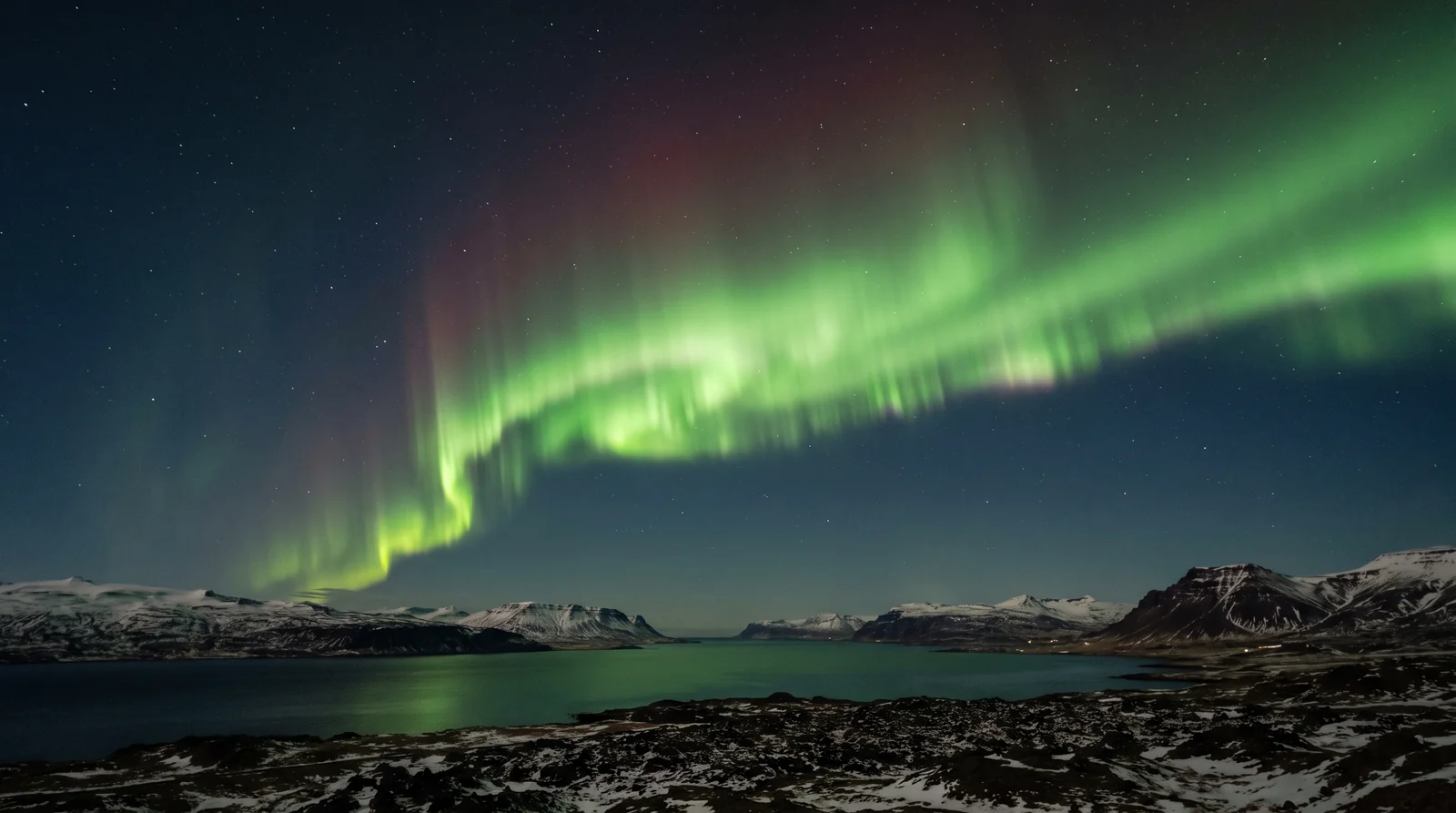
The viewing season described by Iceland’s official tourism guide. Suitable dates do not guarantee a display.
Veður’s green means cloud. NOAA’s green oval represents an auroral region.
It does not measure your local cloud or the brightness you will see. A clear view and safe access still matter.
Start with the viewing chapter for a practical evening plan. Continue to camera settings and the field notebook, then explore the physics of the light. Poetry, literature and a creative workshop follow later. Use the contents to jump to the part that interests you.
The northern lights are not sunlight reflected from ice. They are emissions produced when energetic particles excite atoms and molecules in the upper atmosphere. Aurora borealis is the northern name, aurora australis the southern one; in Icelandic, norðurljós. Energy travels through space, but most of the light we watch is generated in Earth's atmosphere.
The apparent curtain is not a nearby green cloud. It is a distant emission region, projected along your line of sight. Three perspectives complement one another: a traveller assesses observing conditions, a physicist follows the energy, and an artist explores the experience. This guide brings them together without confusing a metaphor with a measurement.
Sources: NASA — Auroras · Veðurstofa Íslands — Aurora and the magnetic field
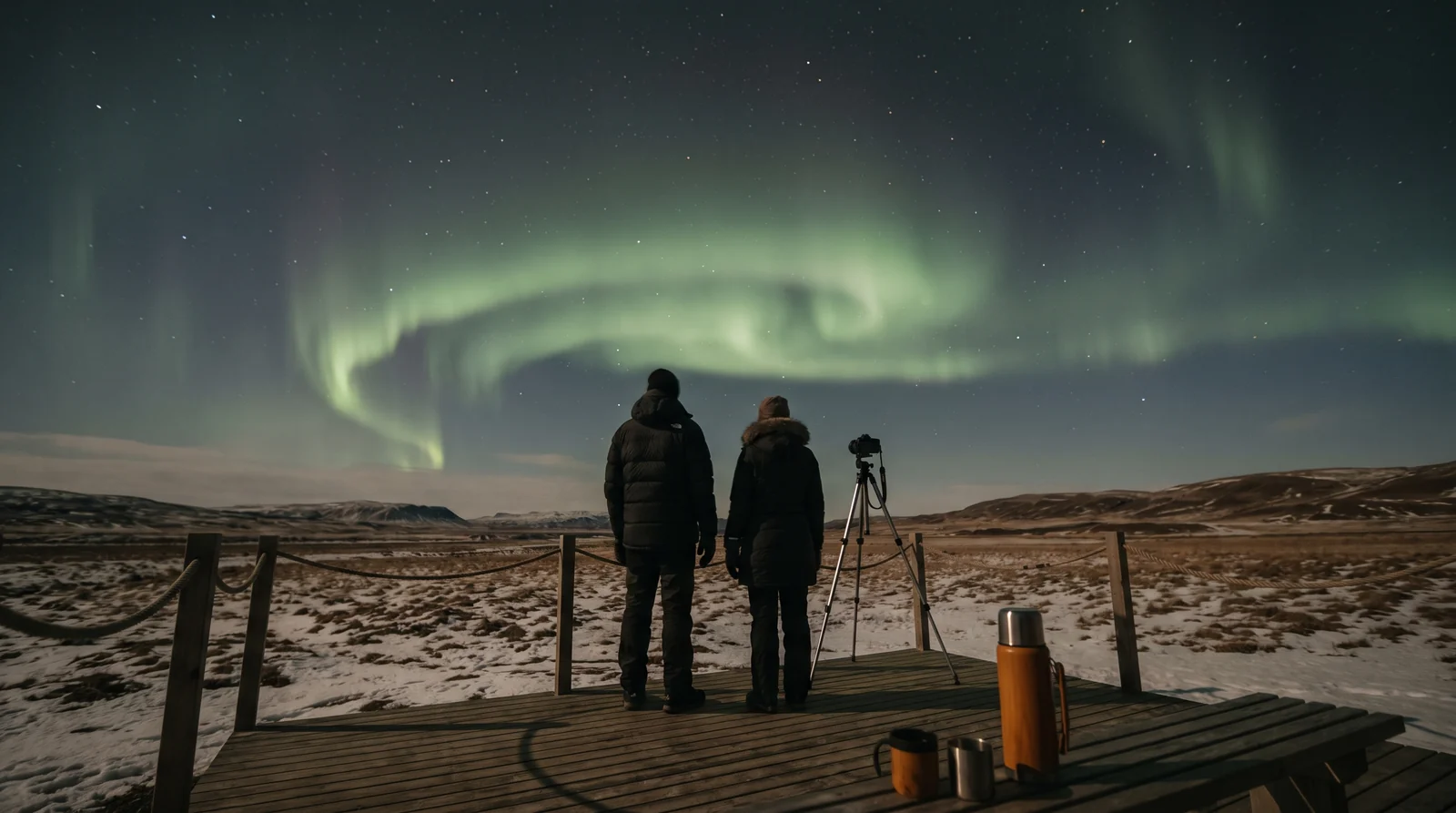
Iceland's official tourism guide describes a viewing season from late August to late April. That does not promise a display every night. Bright nights in May–July make ground viewing difficult even when auroral activity exists. “Aurora does not occur” and “we cannot see it” are different claims.
September–October and March–April can combine daytime travel with darkness. November–February offers longer dark periods but introduces short days, ice and storms. Statistical geomagnetic tendencies around equinox do not guarantee a clear sky on your chosen date. Weigh budget, winter-driving experience, daytime interests and flexibility rather than declaring one universally best month. Several nights allow more opportunities to encounter changing conditions, not a defensible invented success percentage.
Sources: Visit Iceland — The Auroras · University of Alaska Fairbanks — Aurora questions
On the Icelandic Met Office aurora page, green areas over Iceland indicate forecast cloud cover; white indicates clearer sky. Green on that map does not mean green aurora. Inspect the cloud layer, selected day and time. The activity indicator on the same page describes another variable.
Check weather warnings and roads first, darkness and cloud gaps second, then auroral activity. NOAA's green oval belongs to a different product and represents the auroral region. Do not confuse the two colour keys. Sunset and moonrise information on the Met Office page is for Reykjavík, not automatically every point in Iceland. We link to the current products rather than presenting a static picture as a live forecast.
Sources: Veðurstofa Íslands — Aurora forecast · NOAA — OVATION forecast and limitations
A legal, safely accessible spot with less direct light around Reykjavík may be a better choice than a remote closed road. Þingvellir, Snæfellsnes, the south coast and northern Iceland offer different landscape settings, but mentioning them does not certify tonight's access, weather or opening status. Check route and site information before choosing.
Ask four questions: can I park legally and safely; is enough sky visible; can I return to warmth; and can I wait without chasing a cloud gap into greater risk? Lagoons, cliffs and black-sand beaches can look compelling in photographs. Approaching their edges in darkness is not a requirement for a successful observation. Permission, closures and safe ground always outrank the composition.
Sources: Visit Iceland — The Auroras · Umferðin — Road conditions · SafeTravel — Driving in Iceland
During daylight, identify a primary site and a nearby alternative within a reasonable return journey. Check parking, return access and phone coverage. Recheck weather and road warnings in the evening; cancel if conditions are unsuitable. A safe place to stop matters more than distance travelled.
Start with unaided observation, then make a short photographic test and reassess cloud periodically. This is an attention-management routine, not a celestial timetable. Return early if cold, fatigue or poor visibility becomes a problem. Keep an alternative such as stargazing or a verified open exhibition in your wider itinerary. Before paying for a tour, read cancellation, refund and repeat-trip terms: a commercial rebooking offer is not a guarantee from nature.
Sources: SafeTravel — Driving in Iceland · Umferðin — Road conditions · 112 Iceland
0 / 4 preparation steps checked.
These ticks track your preparation; they do not confirm a sighting or certify that conditions are safe.
Do not stop on the carriageway, a bridge or an unsuitable shoulder for a picture. The driver watches the road; park in a safe permitted place before looking up. Respect closed roads and do not drive off-road. Vehicle suitability is more than a 4×4 badge, and the return conditions matter as much as the outward journey.
Bring insulating layers, wind and rain protection, gloves, a hat, suitable footwear, a charged phone and backup power. Avoid dazzling other observers, without sacrificing safe footing. Plan waiting limits for children and people with reduced mobility. In an emergency call 112 and communicate your location. Visible aurora is not itself a special radiation alarm for a ground observer; nearby hazards usually involve weather, traffic and terrain.
Sources: SafeTravel — Driving in Iceland · 112 Iceland · Umferðin — Road conditions
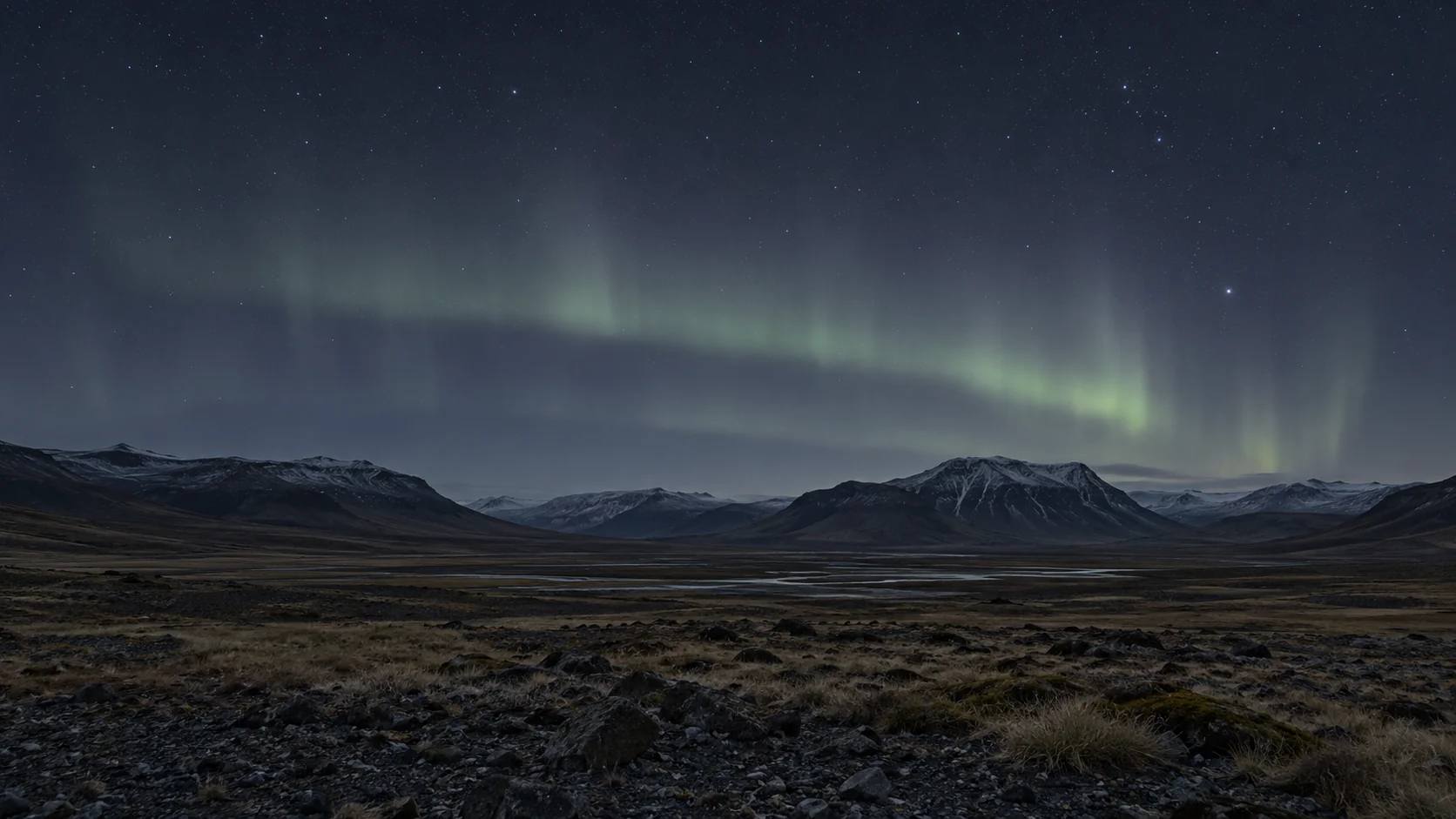
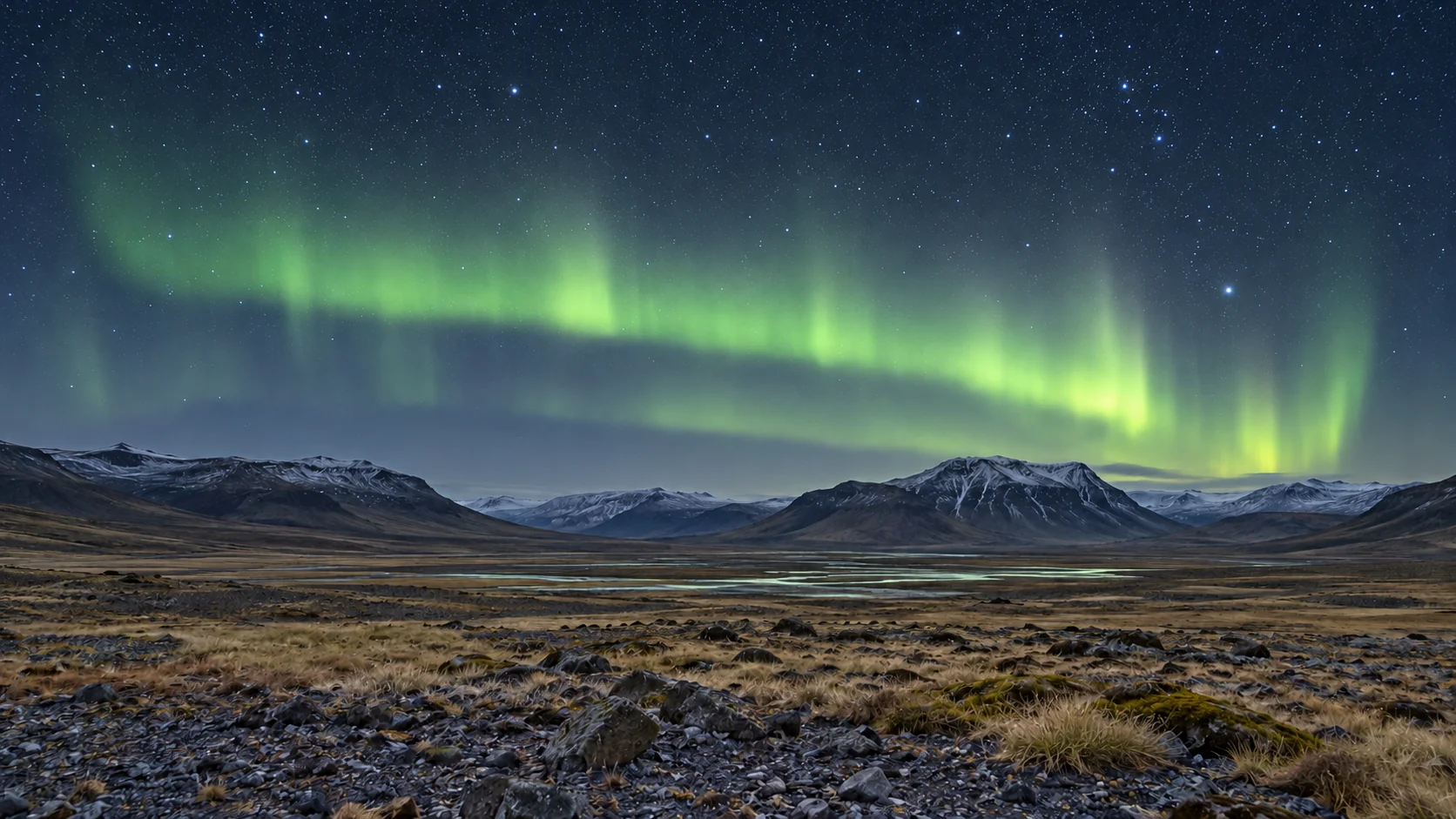
These are explanatory simulations based on the same landscape, not measured eye–camera comparisons. Human colour perception and camera results vary. Bright aurora can also show vivid colour to the unaided eye.
Rod cells help in low light but distinguish colour less effectively than cones. A faint arc may look grey-white; bright aurora can reveal colour. Adaptation, ambient light and individual vision differ. Neither “eyes only see grey” nor “you should see the photograph's colours” is a reliable rule.
A camera accumulates photons over seconds and transforms colour through white balance and processing. One frame can integrate a changing structure. A phone's night mode may combine several exposures, rather than recording exactly what an observer saw at one instant. Moonlight can reduce contrast in faint structures while illuminating the foreground. Sharing exposure and processing choices makes expectations more honest.
Sources: University of Alaska Fairbanks — Aurora questions · UNIS — Spectra and aurora photography
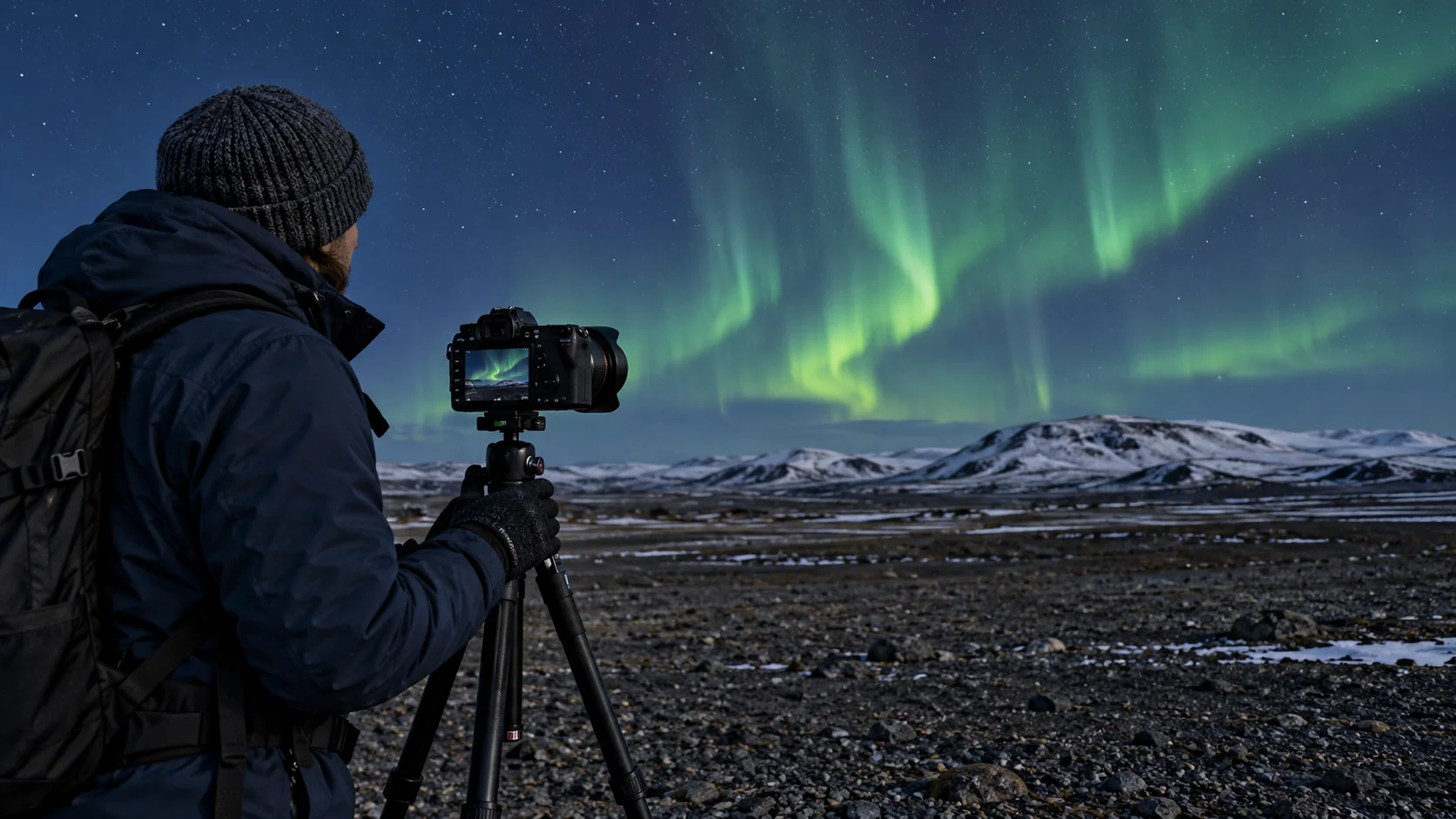
A stable tripod, wide lens, manual focus and RAW capture are a useful starting arrangement. Magnify a star to check focus; the infinity mark is not always exact at every temperature. An editorial starting test might use f/1.8–f/2.8, ISO 800–3200 and roughly 1–8 seconds. These are adjustable trial ranges, not universal settings.
Shorten exposure for fast rays; try longer exposure for faint slow arcs. Watch for a clipped green channel and elongated stars. Change one variable at a time instead of letting automatic exposure hide the comparison. Stabilise a phone, clean the lens and limit digital zoom. Do not describe heavily saturated processing as scientific colour. Keep spare batteries warm and allow equipment to warm gradually in a suitable bag when moving indoors to manage condensation.
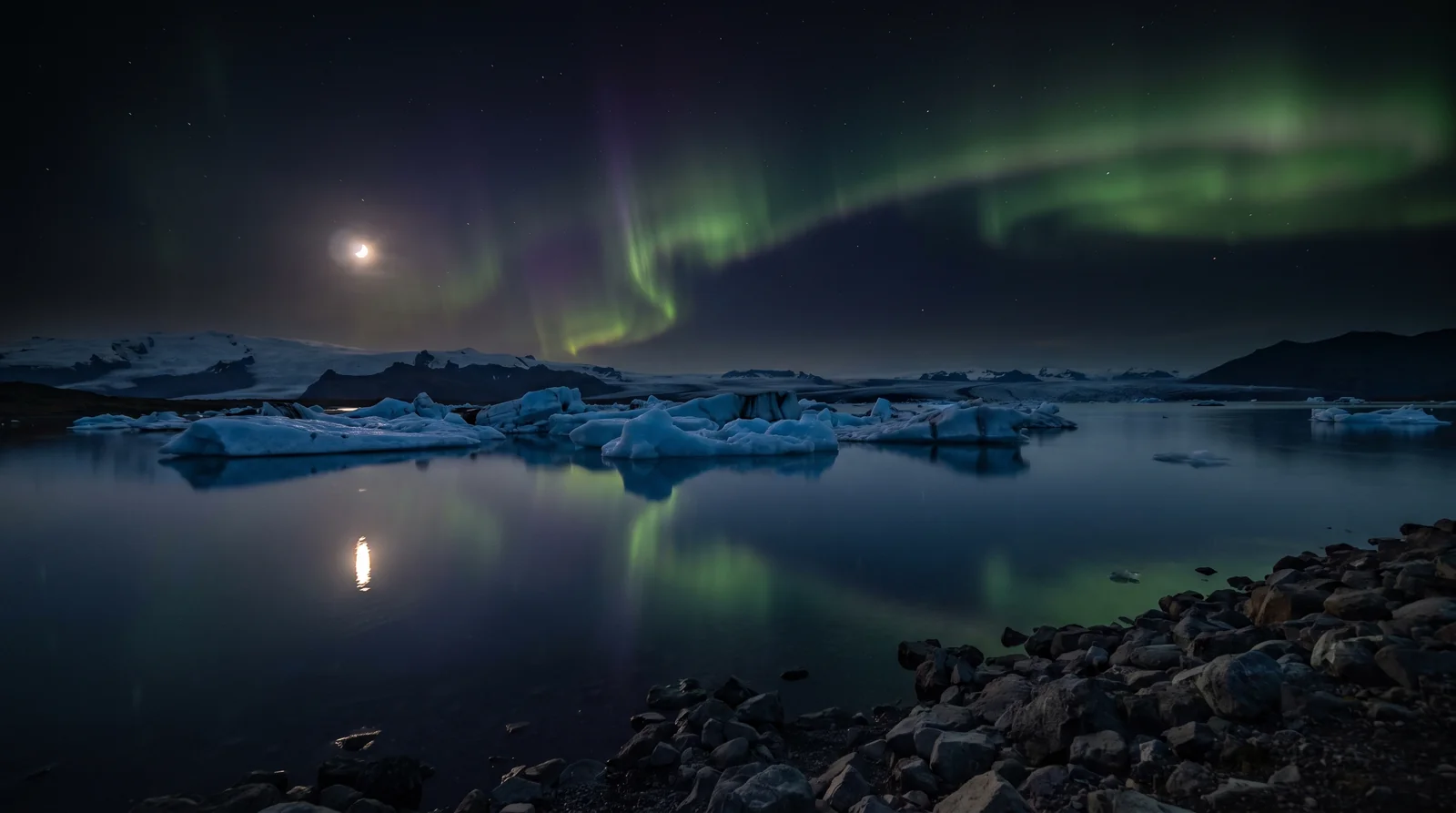
Record date and UTC interval, approximate location, viewing direction, cloud and ambient light, unaided colour, form and movement, camera settings and uncertainty. You need not publicly expose a private address or another person's whereabouts. Follow a research project's location, privacy and submission requirements when contributing.
Improve “green curtain at 23:10” by noting whether the eye or camera detected it, how cloud cover was estimated and which exposure was used. Record non-observation carefully: under complete cloud, write “sky unobservable”, not “no aurora occurred”. This separates missing data from absence in nature. Preserve the original image and keep processed versions separate.
Sources: UNIS — Arctic geophysics research · NIPR — Iceland conjugate observations
The solar wind is a tenuous plasma flowing out of the Sun's outer atmosphere and carrying a magnetic field. Free electrons and ions respond collectively to electric and magnetic fields. Earth's field deflects much of this flow, creating a magnetosphere compressed on the dayside and stretched into a long nightside tail.
Saying that solar electrons simply hit the sky skips essential steps. Energy transfer from the wind, storage in the magnetosphere, particle redistribution, acceleration and precipitation are distinct processes. Coronal mass ejections and fast solar-wind streams can change the coupling. Not every solar flare faces Earth, and not every disturbance produces a visible display from Iceland.
Sources: NASA — Auroras · NASA — Tracking energy through space
Conceptual sequence, not a scale map or a measurement. Alternative pathways and feedbacks are simplified.
Reconnection changes magnetic connectivity and can transfer stored magnetic energy into particle motion, heat and waves. Field lines are mathematical representations, not literal strings. A snapping elastic band is a useful image for energy release, but not a complete physical mechanism.
Energy release in the nightside magnetotail is associated with auroral substorms: a quiet arc can brighten and develop rapidly moving structures. A substorm is not synonymous with a global geomagnetic storm. Several intensifications may occur in a night. What a photographer sees as a sudden flourish becomes, for a researcher, a timed sequence that tests where energy was transferred and which process came first.
Sources: NASA — Tracking energy through space · NASA — THEMIS and moving aurora
A magnetic field bends a charged particle's trajectory; a static magnetic force alone does no work on it. Electric fields and wave–particle interactions provide energy. Field-aligned potential differences and electric fields associated with Alfvén waves are different routes to auroral acceleration. One mechanism should not be used to explain every form of aurora.
Schroeder and colleagues' 2021 laboratory study demonstrated resonant transfer of energy from Alfvén waves to electrons. The surfing analogy describes electrons interacting with a wave at suitable velocities. The experiment did not reproduce the entire magnetosphere at full size: key dimensionless parameters and energy transfer were compared. That is a more useful scientific statement than saying that the night sky itself was recreated in a laboratory.
Sources: Schroeder et al. (2021) — Alfvén-wave acceleration · University of Iowa — Laboratory evidence
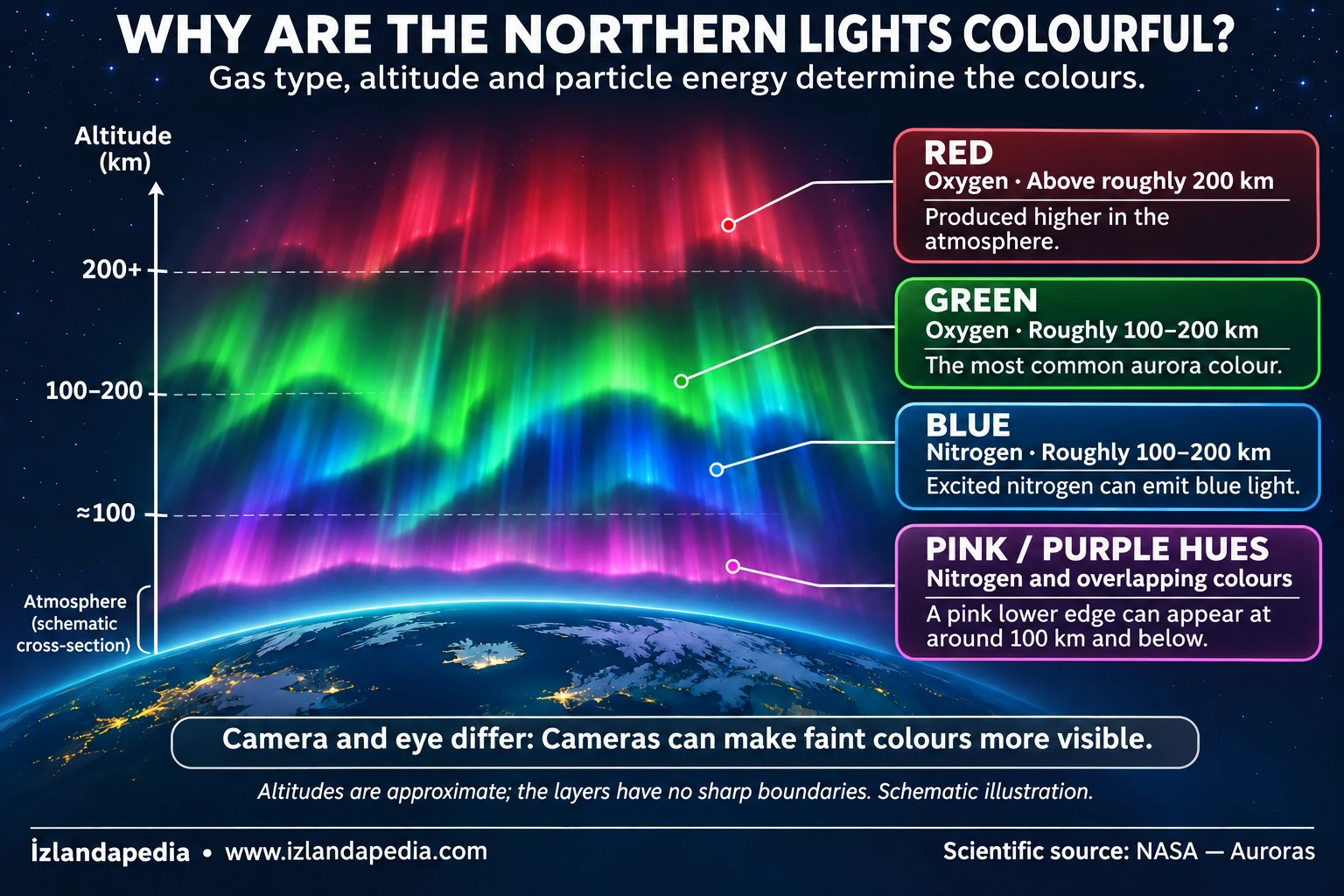
An energetic electron can transfer energy to an oxygen atom or a nitrogen molecule. As the excited system moves to a lower energy state it may emit a photon. The relation E = hν = hc/λ connects photon energy and wavelength. A 557.7 nm green photon carries approximately 2.22 eV; a 630.0 nm red photon approximately 1.97 eV. These are calculated photon energies, not the incident electron's full kinetic energy or the excitation threshold.
Excitation does not guarantee a visible photon. A subsequent collision may transfer the energy before radiation occurs: collisional quenching. Atmospheric density, composition, excitation pathways and transition lifetimes matter together. Colour alone is therefore not a reliable altitude ruler.
Sources: NASA — Red and green aurora · UNIS — Spectra and aurora photography
A major green auroral line is atomic oxygen at 557.7 nm. Oxygen's 630.0 nm line is important in red aurora. NASA's illustrative description associates green with roughly 100–250 km and red with roughly 200–500 km; these are not rigid atmospheric floors. Viewing geometry and atmospheric profiles change the picture.
Molecular and ionised nitrogen produce band emissions; the 427.8 nm band of ionised molecular nitrogen is one research example. A pink lower edge does not prove the existence of a single pink gas. Emissions, human perception and camera response combine. You cannot infer chemical abundance directly from an image's RGB values: that requires calibrated spectral measurements and a physical model.
Sources: NASA — Red and green aurora · NASA NTRS — Pulsating aurora measurements · UNIS — Spectra and aurora photography
| Example | Emitter | Approximate context | Avoid this inference |
|---|---|---|---|
| 557.7 nm · green | Atomic oxygen | Often associated with roughly 100–250 km | Every green pixel is not at the same height |
| 630.0 nm · red | Atomic oxygen | Higher, thinner air; roughly 200–500 km illustration | Red alone does not measure particle energy |
| 427.8 nm · blue-violet band | Ionised molecular nitrogen | A target of particular research filters | Camera colour is not a single spectral band |
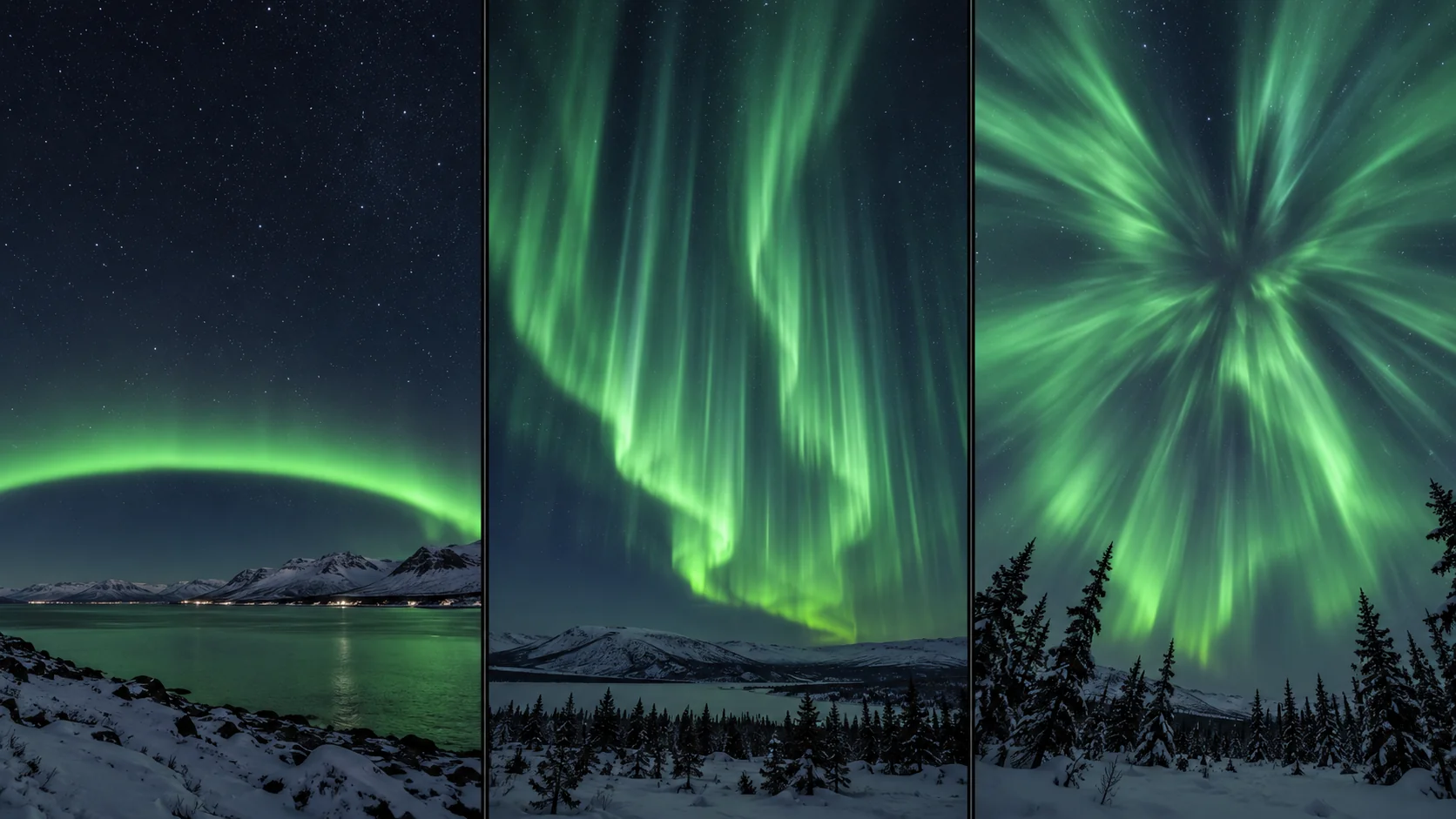
An arc can appear as a quiet band along the horizon; a curtain adds folds and ray structure. Fine rays reflect field-aligned structure in projection. A corona is the perspective effect of overhead rays appearing to converge. It is not a physical hole opening in the sky.
Diffuse aurora may lack crisp edges. Pulsating aurora changes brightness in patches, making a time-resolved sequence more informative than a single still. Visual categories do not uniquely diagnose a particle distribution. Forms can change within one night. Recording time, direction, movement and duration adds much more scientific value than writing only that a curtain was visible.
Sources: NASA — THEMIS and moving aurora · University of Alaska Fairbanks — Aurora questions · NASA NTRS — Pulsating aurora measurements
The auroral oval is not a fixed circle around the geographic North Pole. Its position and shape depend on geomagnetic structure, activity and magnetic local time. Geographic and geomagnetic latitude are different coordinates. Iceland's advantages cannot be explained simply by how far north it lies.
Travelling farther north is therefore not always better. Aurora can be visible under relatively low global activity, and it may appear on the northern horizon, overhead or towards the south. From a safe place, inspect the whole sky. Do not treat an oval boundary as a wall or a Kp value as your personal percentage chance of success.
Sources: Veðurstofa Íslands — Aurora and the magnetic field · GFZ — Kp index
Kp is a three-hour, planetary, quasi-logarithmic index derived from magnetic variations at ground observatories. It does not measure local clouds, dark adaptation or a mountain blocking your view. Kp 6 does not mean twice the visible brightness of Kp 3. Statistical work must respect the scale and use suitable transformed quantities where needed.
Solar-wind speed, density and interplanetary field direction provide other information. Southward Bz in GSM coordinates can favour coupling under suitable conditions; one negative sample guarantees nothing. Persistence, field magnitude, propagation delay and the magnetosphere's prior state matter. A negative Bz reading is not a reason to ignore a weather warning.
Sources: GFZ — Kp index · Matzka et al. — Kp and derived indices · NOAA — OVATION forecast and limitations
An observation records what an instrument measured; a forecast is a model-based statement about the future. NOAA's OVATION product estimates short-term auroral location and intensity using solar-wind input. Its documentation describes roughly 30–90 minutes of lead time; a Kp-driven fallback during missing input may provide no lead time. The title “30 minute” is not an appointment.
The map alone does not calculate a traveller's probability of seeing light through clouds. Model error, input delay, geometry and weather all matter. This guide links to timestamped official products instead of displaying pretend live data. Distinguish an image's issue time from its valid time. Yesterday's saved forecast is not evidence for tonight.
Sources: NOAA — OVATION forecast and limitations · Veðurstofa Íslands — Aurora forecast
The Lorentz force F = q(E + v × B) describes particle motion. Since the magnetic term is perpendicular to velocity, the direct kinetic-energy transfer is dK/dt = qE·v. A plasma is more than independent test particles: its collective motion also changes the fields.
The simplified Alfvén speed vA = B/√(μ₀ρ) uses magnetic-field magnitude B and mass density ρ. This ideal magnetohydrodynamic expression is not a complete description of every kinetic or dispersive regime. Optical radiance integrates volume emission along the line of sight. For isotropic emission and negligible absorption, I = (1/4π)∫ε(s)ds. Inferring a particle flux at a particular altitude from pixel brightness is therefore an inverse problem with assumptions, not a direct conversion.
Sources: Schroeder et al. (2021) — Alfvén-wave acceleration · UNIS — Spectra and aurora photography · Matzka et al. — Kp and derived indices
An all-sky camera records a broad field, but fisheye geometry, vignetting and cloud obstruction need attention. Narrow-band cameras isolate selected emissions. Spectrometers separate wavelengths, magnetometers record magnetic variations, and radar probes other ionospheric plasma properties. No instrument supplies the whole picture.
Research needs synchronised timestamps, dark-current and flat-field corrections, radiometric calibration, pointing and exposure information. Automatic camera gain can brighten a picture without a physical increase in the aurora. With open data, inspect cadence, gaps, units, processing and usage conditions. An uncalibrated social-media video can suggest an event worth studying; it is not equivalent to a quantitative measurement.
Sources: UNIS — Arctic geophysics research · UNIS — Spectra and aurora photography · NASA NTRS — Pulsating aurora measurements
| Question | Measurement | Main limitation |
|---|---|---|
| Where does a structure move? | Synchronised all-sky images | Line of sight and assumed altitude |
| Which emissions are present? | Spectrometer / narrow-band camera | Calibration, bandwidth and background |
| How does magnetic activity change? | Magnetometer network | One station cannot resolve every current |
| What are plasma conditions? | Radar and satellite measurements | Different sample volumes and times |
| Do hemispheres resemble each other? | Simultaneous conjugate observations | Conductivity, seasons and mapping uncertainty |
Iceland is more than an aurora-tourism destination. NIPR's metadata dates its collaborative conjugate observations with the University of Iceland to 1984. Stations such as Húsafell and Tjörnes contribute to comparisons between magnetically related northern and southern regions. A station name does not imply public visitor access or guarantee that every instrument remains operational.
Conjugate observations compare regions with related magnetic connectivity. The two hemispheres need not look identical: seasonal illumination, ionospheric conductivity and field geometry differ. Questions include the acceleration of fine structures, ionospheric feedback and north–south asymmetry. A photograph can motivate these questions; answering them requires coordinated measurements.
Sources: NIPR — Iceland conjugate observations · NIPR — Syowa–Iceland observations · University of Iowa — Ionospheric feedback research
Airglow is faint atmospheric emission from processes not automatically classified as aurora. Light pollution, illuminated thin cloud, satellite trails and ice-crystal light pillars can also mislead. Green in one processed frame is not sufficient identification, particularly with automatic white balance.
The narrow mauve feature studied as STEVE is not simply ordinary aurora; it has distinct physical properties and may occur alongside green picket-fence structures. If identification is uncertain, record a possible aurora rather than claiming certainty. Time, location, exposure and consecutive frames are more useful than an impressive label. Caution does not diminish curiosity; it makes observation stronger.
Sources: NASA — Research on STEVE · University of Alaska Fairbanks — Aurora questions
To ask why a brightening occurred, first define the timescale: a one-second ray or a ten-minute evolution? A three-hour Kp summary cannot by itself explain a one-second feature. Simultaneous increases in two curves are not proof of causation. A common driver, data delay or automatic exposure may explain a correlation.
Specify your hypothesis, instruments, alignment method, exclusion rules and uncertainties before analysing. Ask which measurement would separate alternatives. “Did calibrated 557.7 nm radiance at fixed gain increase?” is more testable than “the green channel got brighter”. This guide maps a subject; it does not replace a peer-reviewed paper's methods and supplementary material.
Sources: Schroeder et al. (2021) — Alfvén-wave acceleration · UNIS — Arctic geophysics research · Matzka et al. — Kp and derived indices
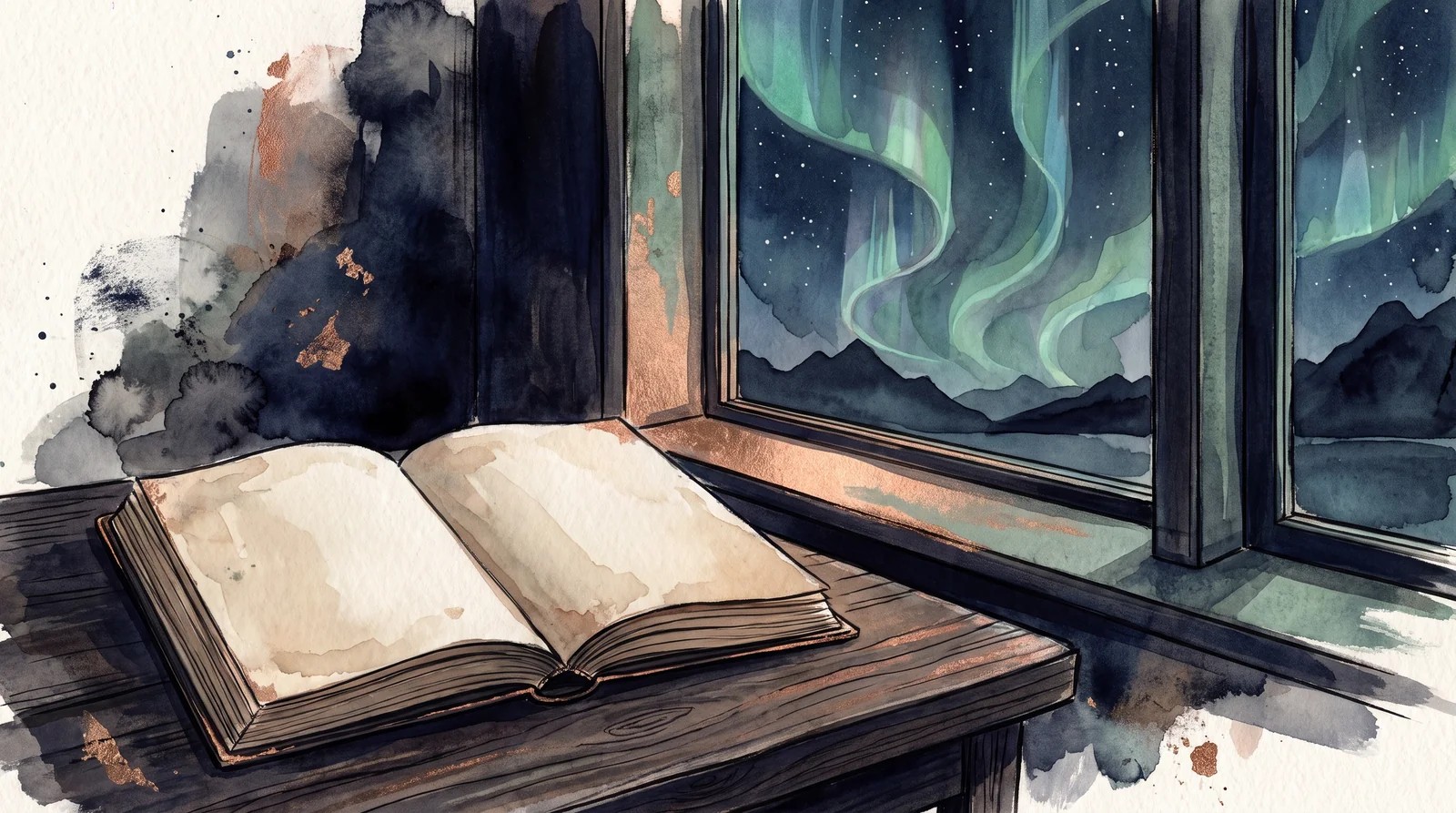
Science asks which process produces the light. Literature can ask how that light carries witness, fear, curiosity or a sense of boundaries. These approaches need not compete, but a fictional luminous doorway is not a model of the atmosphere. The readings below distinguish sourced work details from our editorial interpretation.
Not all these works are set in Iceland. American poetry, a Yukon narrative, British fantasy and Norwegian painting must not be bundled into “Icelandic folklore”. Ask instead what different writers make the phenomenon do. Is light an observed event, a metaphor or a rule of an invented world? That question supports a more careful and rewarding reading.
Editorial interpretation / original exercise
The poem beginning “Of bronze and blaze” appears as “Aurora” in Poems: Third Series (1896). Titles and punctuation can vary between editions. This short example follows that historical text: “Of bronze and blaze / The north, to-night!”
Our close-reading suggestion is to notice material and motion, not colour alone. Bronze suggests weight and solidity; blaze suggests change. The sky seems to hold both. This is interpretation, not a claim about Dickinson's scientific intention. After reading, describe an aurora image through texture, rhythm and scale instead of merely calling it green. Compare editions before treating every dash or capital as identical across the publication history.
Sources: Emily Dickinson — Aurora, Poems: Third Series (1896)
The Cremation of Sam McGee includes the line “The Northern Lights have seen queer sights”. Light is personified as a witness to a human story rather than a passive backdrop.
The poem's Yukon setting should not be relocated to Iceland. Our suggested reading follows the contrast between an immense sky and a small, bodily human experience. Cold, fear and dark humour complicate a purely romantic landscape. The bridge to science is a distinction: particles are not being assigned memory; the narrator assigns the sky a witnessing role. Read the full poem for its rhythm and narrative turn rather than treating this short quotation as a substitute.
Northern Lights (1995) begins the His Dark Materials trilogy and was published in the United States as The Golden Compass. Even its title invites a reading of the northern sky as more than scenery: it points towards the unknown. No long extract from the novel is reproduced here.
Our editorial suggestion is to compare Lyra's questioning with an observer's refusal to accept the first explanation. Do not identify fictional Dust with the electrons of auroral physics or ordinary atmospheric dust. Fantasy need not act as a science textbook. Its power includes imagining that a world could be otherwise. Reading it alongside the laboratory section makes the difference between evidence and invention more visible.
Sources: Philip Pullman — Northern Lights
Nasjonalmuseet dates Peder Balke's Northern Lights over Coastal Landscape to the 1870s, inventory NG.M.01323. Its listed dimensions are only 10.5 × 12 cm. That detail is easy to miss on a screen: a sense of vastness does not require a physically large painting.
Open the museum record and ask how coastal darkness supports the light, where reduced detail directs attention, and how luminous direction changes apparent scale. These are our prompts for visual interpretation. The illustrations on this page are not Balke works or imagined lost paintings attributed to him. We link to the museum object and keep the origins of different images explicit.
Aurora stories belong to particular communities, periods and records. Unsourced claims about what all Vikings, all Sámi people or all Icelanders believed erase that diversity. Repetition in tourism writing does not make a story a historical document.
We do not reproduce unverified folklore as fact. Ask who told or collected a story, when and where it was recorded, in which language, and which edition underlies a translation. “Aurora” can also mean dawn or refer to a goddess; the word alone does not prove a description of polar lights. Respect includes making ownership, context and uncertainty visible, not simply retelling an attractive story.
Editorial interpretation / original exercise
Try a two-column exercise. On the left, record only observation: “A faint northwestern arc; a fold appeared over three minutes; grey to the eye, green in the photograph.” On the right, write an image: “The sky resembled a slowly opening letter.” One is a checkable record, the other a personal interpretation. They can coexist without one proving the other.
Next, avoid “dance”, “magic” and “amazing”. Describe speed, silence, bodily cold or the portion of sky occupied. Give a photograph two captions: one explaining its production and one explaining your response. Artistic expression and technical honesty need not conflict. These are original editorial exercises, not quotations from a poet.
Editorial interpretation / original exercise
Yes. Kp is not a local on/off switch. Darkness, sky clarity and auroral position matter.
No. Contrast in faint features can decrease, but bright displays remain possible and moonlight illuminates scenery.
No. Cold is not the light-producing mechanism; it often accompanies the dark-season observing experience.
Opaque cloud blocks the view; gaps may develop. A gap guarantees neither aurora nor a safe journey.
No. Inspect the whole sky from a safe place: depending on the oval, features may be overhead or southward.
No. Exposure, perception and processing differ. Record eye and camera observations separately.
None can guarantee the physical event and weather. A repeat-trip or refund policy is a commercial condition.
Do not assume a reported sound travels directly from an emission hundreds of kilometres above. Evaluate sound claims through separate measurements, timing and local-source analysis.
In suitable conditions, yes. Stabilise it and try night mode, remembering that computational stacking changes the image.
Ground-observer decisions centre on weather, roads and terrain. Space-weather effects on satellites and communications are a separate issue.
No. The four images are illustrative. Explanatory graphics are not measured data.
No. Follow the official links. No static Kp value or invented success percentage is presented as current data.
Listen to all six phrases in Icelandic at normal or slow speed.
Practical travel guidance reviewed on 3 October 2026. Weather, access and observations need a fresh check for your own date and location.
This guide does not display a live forecast. Open the official maps and check their date and time. Illustrations are not records of a particular place or aurora night; their original captions remain visible.
The original guide’s scientific and literary sources were checked on 20 September 2026. Official sources for the viewing season, forecast maps and safe driving were checked again on 3 October 2026. Scientific mechanisms draw on institutional explanations and research papers; literary examples on accessible texts and catalogues. Close readings, initial camera settings and exercises are editorial contributions. Short quotation glosses are not presented as published translations. The four images are illustrative, not documentary photographs or measurements. Tables and sequences are explanatory, not live data.
Iceland travel guide · Ferðalag um Ísland
This mark is saved only in this browser and is never sent to our server.
More guides for your trip: Puffins · Conservation volunteering · Living in Iceland
Back to the start of the travel guide →