Why Sakallı Celal?
İzlandapedia aims to tell Turkey about Iceland, and Iceland about Turkey. In this new series we introduce people from Turkey whom Icelandic readers have rarely heard of, but may come to love.
Our first guest is Sakallı Celal (“Bearded Celal”), because his story is full of values that Iceland holds dear:
- Equality: according to the sources, he appointed the first woman teacher at a boys' secondary school in Turkey.
- Respect for labour: although an admiral's son, he worked shoulder to shoulder with factory workers.
- Free thought and humour: his sharpest weapon against the powerful was his wit.
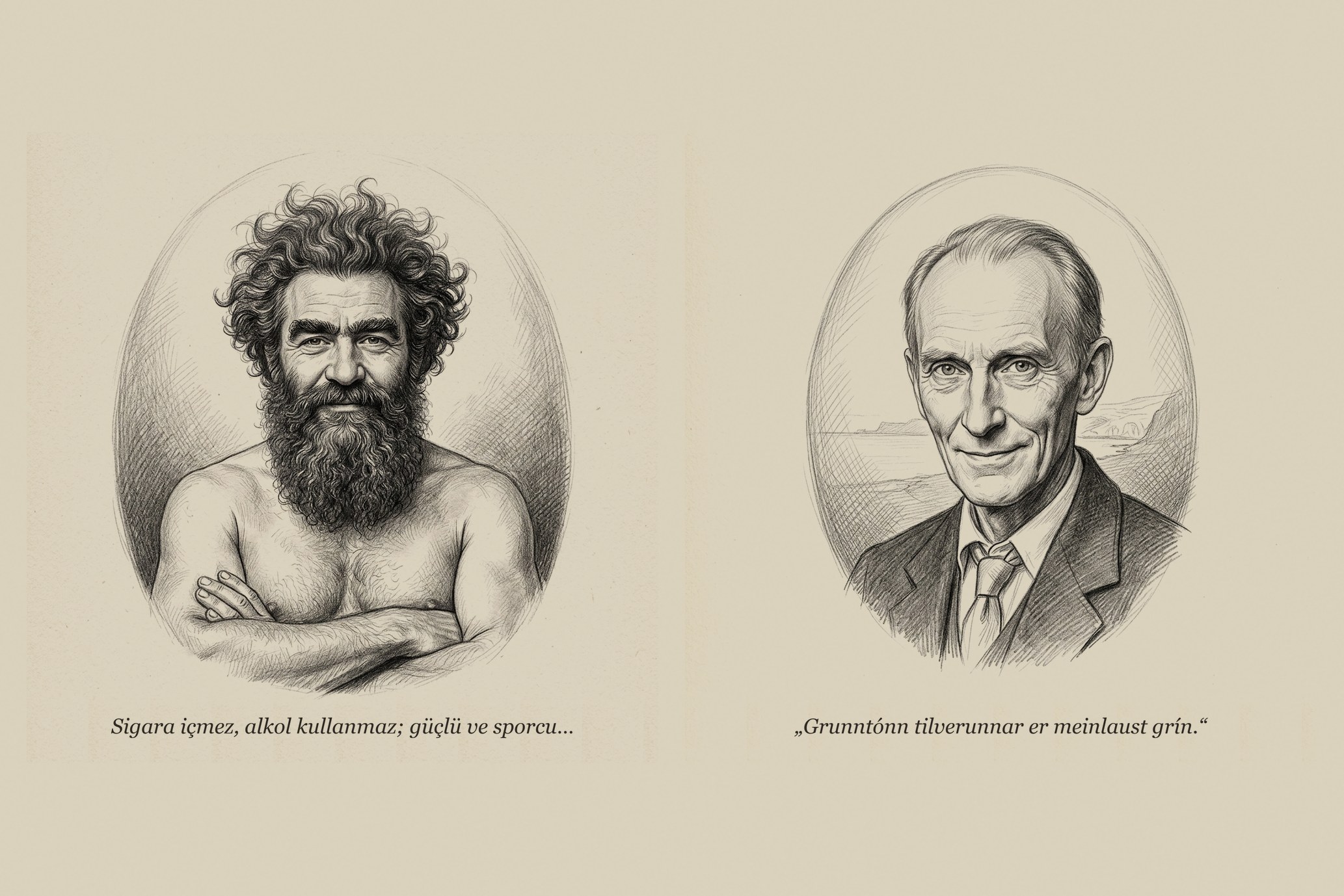
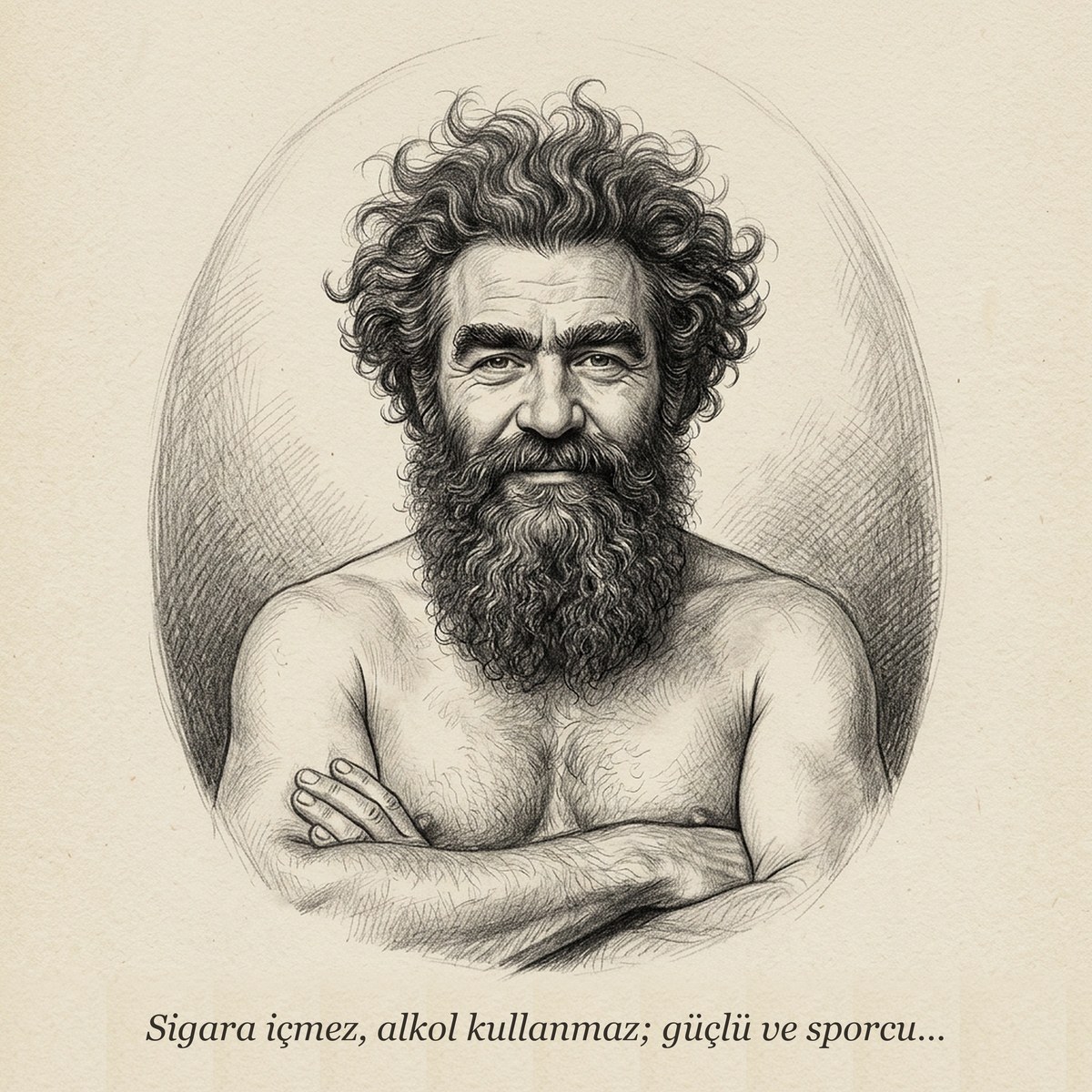
- A simple life: he never accepted money from anyone and never smoked or drank.
And Iceland had an “eccentric sage” of its own, very much like him. We will introduce him at the end.
An admiral's son
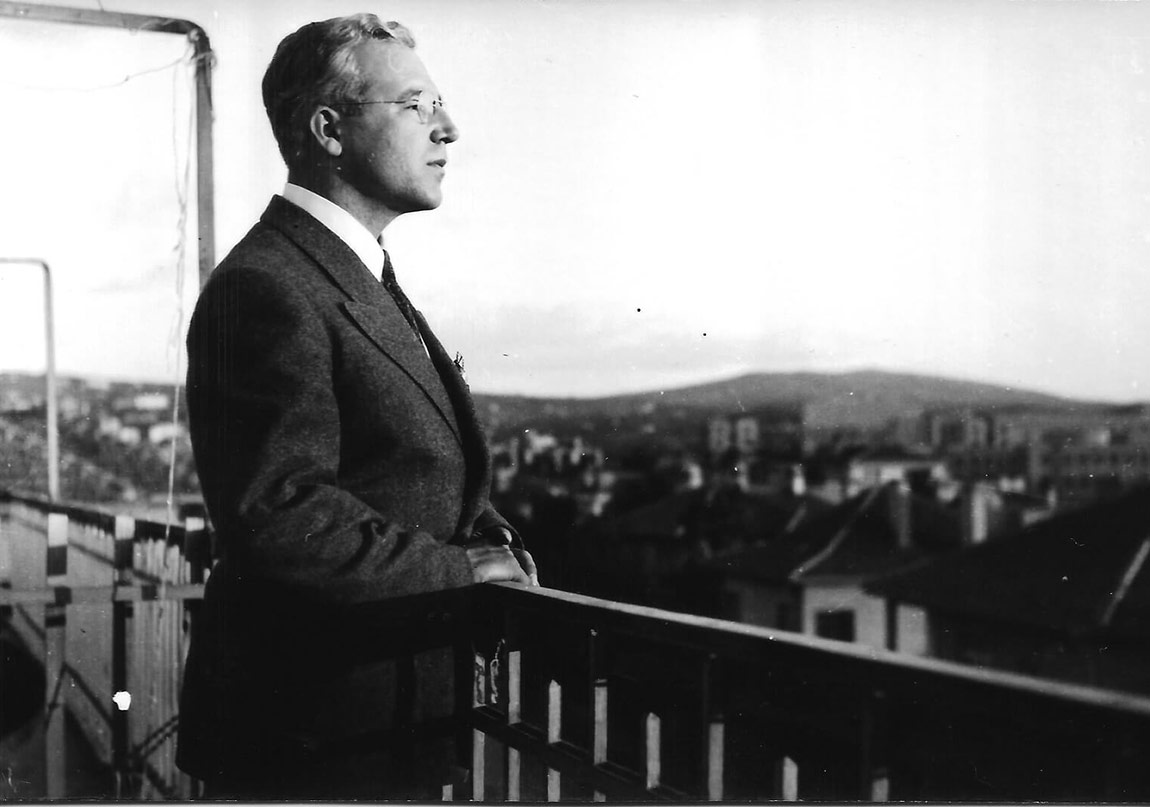
His real name was Mahmut Celal. He was born in Istanbul in 1886. His father, Admiral Hüseyin Hüsnü Pasha, had commanded the Ottoman fleet and served as Minister of the Navy. Even before school age, Celal begged to learn French so that he could read his older brothers' books.
His childhood was marked by two tragedies. His brother Cemal was sentenced to death for opposing the sultan; when Celal heard he was to be hanged, he ran to the square. Cemal escaped execution but spent years in prison on Rhodes. Another brother died after falling from the horizontal bar during school gymnastics.
He graduated from Galatasaray High School in Istanbul in 1907. The school's director, the great poet Tevfik Fikret, made him an assistant teacher. Among his pupils was the young Nâzım Hikmet, later Turkey's best-known poet.
The birth of a beard
He was sent to the Sorbonne in Paris on a state scholarship. He wanted to study mechanical engineering but was enrolled in political science. When his family refused to help him change course, he grew a beard in defiance and never shaved it off again. He came home without a degree, saying the state had paid for enough. His nickname comes from that beard.
The teacher sacked over football
His first teaching post was in Skopje. He paid for a football pitch himself, ordered balls from France and had shorts made for his pupils. Football was declared “sinful” and he was dismissed. In Kastamonu he was reported for going bareheaded and teaching about the French Revolution.
In the early years of the Republic he became director of Ankara High School. He cut religious lessons and added French: “Religion is learned at home and in the mosque; a foreign language only at school.” When the school's sewer burst and no one cared, he put on overalls and fixed it himself. When the ministry asked him to let pupils graduate without exams, he said “This is not a dyer's vat” and resigned, never to work for the state again.
Ship's engineer and fig worker
For a while he was chief engineer on the ferry Gülcemal. In 1928 he started work at a fig cooperative in Aydın, western Turkey, and soon became foreman. He taught the workers to read and write and explained cooperatives to the farmers.
Because he stood by the workers, he was denounced as a “communist” and his house was searched. When the police pointed to a portrait of Karl Marx on the wall and asked “Who is this?”, Celal answered without blinking: “My father.” When they asked for communist documents, he tapped his head: “What you are looking for is in here. Open it and take it, if you can.” An industrial accident crippled his right index finger; he called it “my communist finger”.
The great writer Sabahattin Ali, then a teacher in Aydın, described Celal in a 1930 letter as the only sensible person he had met there. The fact that everyone called Celal mad, he wrote, only proved what an excellent man he was.
His sayings
Sakallı Celal left not a single book. His sayings were born in conversation and survived through those who heard them. The best known:
- “So much ignorance is only possible with an education.”
- “Turkey is a ship sailing steadily east. Some run west along its deck and think they are going west.”
- “We proclaimed the Tanzimat reforms; it didn't work. We proclaimed a constitution; it didn't work. We proclaimed a republic; it didn't work. How about proclaiming a little seriousness?”
A note of honesty: these sayings reached us through witnesses, and some may have changed over time. The most detailed account of his life is Orhan Karaveli's biography Sakallı Celal, based on the testimony of people who knew him.
A thousand thorns for one rose
He spent his last years in Istanbul, in a small flat provided by friends, looking after a school library. He never accepted financial help. He never married, saying marriage would stop him living as he wished.
He died of a brain haemorrhage on 6 June 1962. His funeral left from his beloved Galatasaray High School. His lifelong friend, the poet Yusuf Ziya Ortaç, stayed away: “Can a man walk behind his own coffin?”
He lies in Aşiyan Cemetery in Istanbul, near his teacher Tevfik Fikret. His gravestone bears an old saying: “For one rose, the gardener serves a thousand thorns.”
His Icelandic soulmate: Þórbergur Þórðarson (1888–1974)
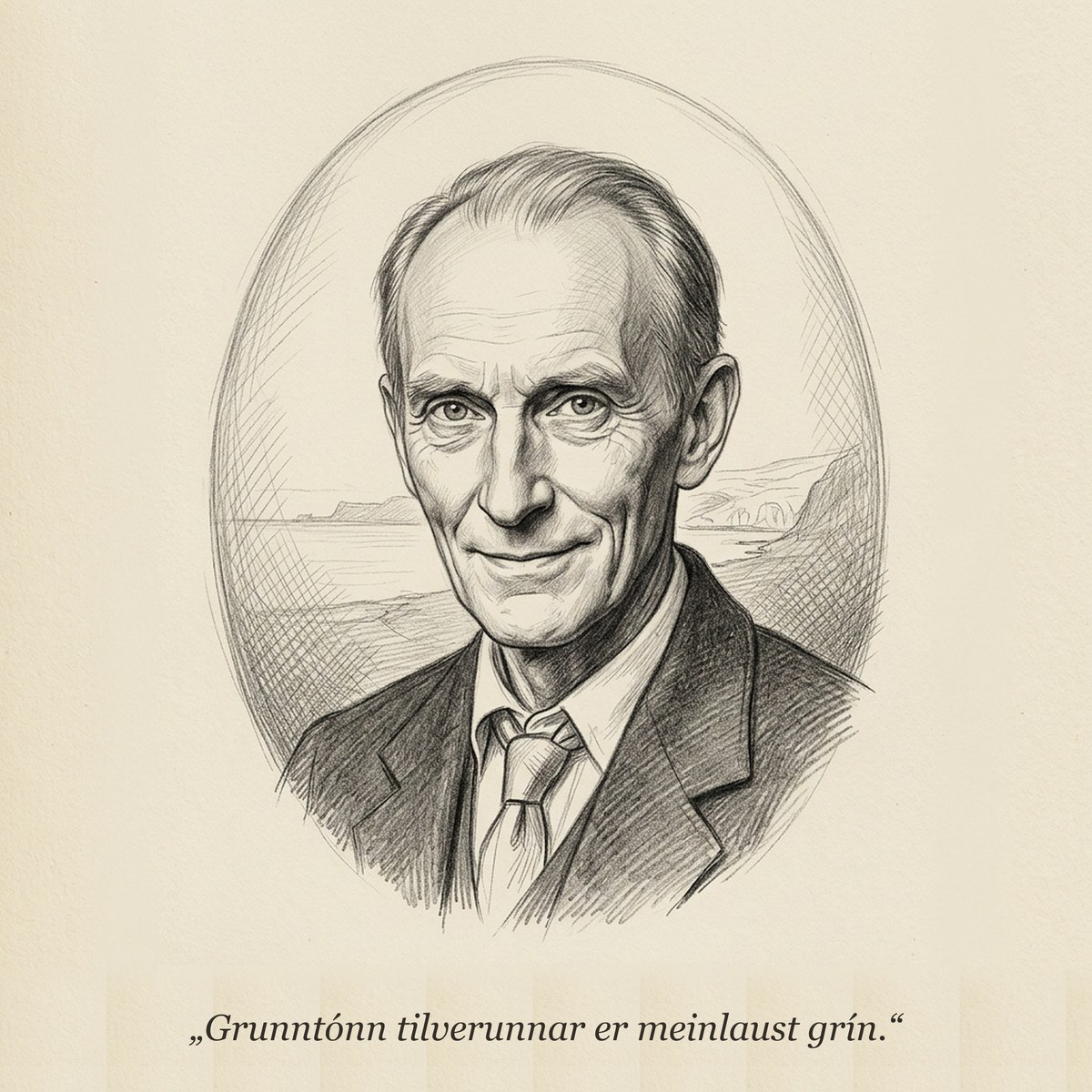
Two years after Celal, on 12 March 1888, Þórbergur Þórðarson was born at Hali in Suðursveit, south-east Iceland. Suðursveit was then cut off from the world by glacial rivers; the first bridge came only in 1960. On long winter evenings his family read the sagas aloud, but the red-haired boy preferred watching the French fishing schooners offshore to farm work.
Sailor, poor student, sacked teacher. As a young man he went to Reykjavík and spent three years at sea as a cook on a schooner. As he later put it: “I came as a penniless man and left as a beggar.” He studied literature and philosophy at the University of Iceland but was not allowed to sit the exams; like Celal, he never got a degree. From 1918 he worked as a teacher.
Bréf til Láru (Letter to Lára), published in 1924, shook Icelandic literature. It mocked the church, the worship of money and social injustice. Þórbergur became famous overnight, and was dismissed from teaching. Just like Celal, sacked over football in Skopje.
Eccentric habits. He did his “Müller exercises” every morning and bathed in the cold sea. He took up yoga and theosophy. From 1925 he wrote nothing for six years, devoting himself to Esperanto. He loved words so much that he spent his life collecting Icelandic vocabulary, and Icelanders called him, with respect, Meistari Þórbergur (“Master Þórbergur”).
A pen that defied power. He was a socialist. In 1934 he called Hitler a “sadist” in a newspaper article; he was tried in Iceland's Supreme Court and fined 200 krónur.
Humour and wisdom. He laughed at himself in his books. Some of his best-known lines:
- „Megnið af volæði veraldarinnar stafar af skorti á ímyndunarafli.“ Most of the world's misery comes from a lack of imagination.
- „Það vilja allir verða ráðherrar, þótt enginn sé fær um að stjórna sjálfum sér.“ Everyone wants to be a minister, though no one can govern himself.
- „Grunntónn tilverunnar er meinlaust grín.“ The basic tone of existence is harmless jest. Sakallı Celal could have said it too.
A hymn for children. In the 1950s he wrote Sálmurinn um blómið (The Hymn of the Flower) for a little girl, Lilla Hegga; a book for children of all ages about peace and equality. Then he returned to the Suðursveit of his childhood: starting with Steinarnir tala (The Stones Speak, 1956), his books made that remote corner one of Iceland's best-loved regions.
The Master's farewell. In 1974 the University of Iceland gave him an honorary doctorate; the university that never let him graduate finally honoured him. He died in Reykjavík on 12 November 1974.
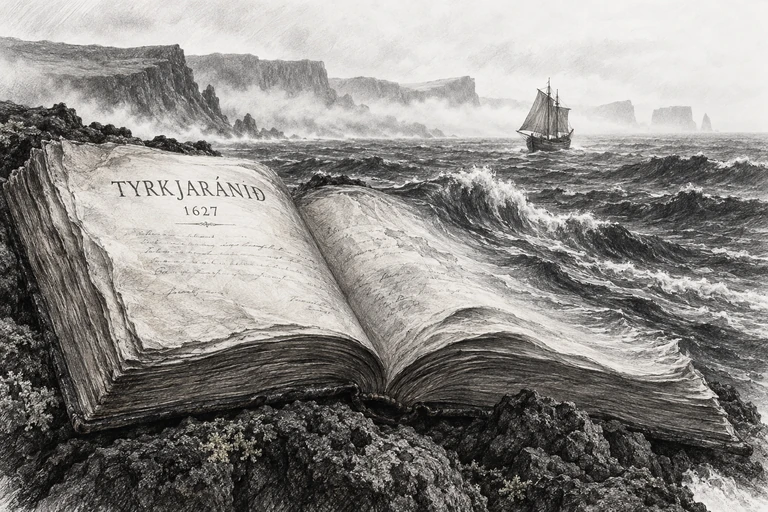
Today. Since 2006 his birthplace at Hali has been home to Þórbergssetur, a cultural centre with a museum, restaurant and exhibitions. Its north wall is shaped like giant book spines and can be seen from the Ring Road, between Vatnajökull and Jökulsárlón; an easy stop on any trip around Iceland.
Two men, one soul
One lived in Istanbul, the other in Reykjavík; neither knew of the other. Both worked at sea, both left university without a degree, both were sacked as teachers for their ideas. Both mocked the powerful, loved sport and a simple life, and were called “eccentric”. The only difference: Celal left his words in the air and in people's memories; Þórbergur wrote his on paper.
Sources
- Orhan Karaveli — Sakallı Celal (Pergamon 2004; Doğan Kitap 2007)
- Wikipedia (de) — Sakallı Celâl (Karaveli 2007 ve Bayazoğlu 2014'e sayfa atıflarıyla)
- Biyografya — Sakallı Celal
- Dünyalılar — Sakallı Celâl, bir 'eski zaman kahramanı' (2015)
- BirGün — Bu dünyadan 'Sakallı Celal' geçti (2021)
- Þórbergssetur — Þórbergur Þórðarson 1888–1974
- Þórbergssetur — Stutt æviágrip (Torfi Steinþórsson)
- Miðstöð íslenskra bókmennta — Þórbergssetur at Hali in Suðursveit
- Visit Iceland — Who was Þórbergur Þórðarson?
- Wikipedia (en) — Þórbergur Þórðarson
Spotted a mistake? info@izlandapedia.com · Instagram @izlandapedia