What the numbers say
According to data published by Statistics Iceland (Hagstofa Íslands) on 3 September 2026, women aged 25–64 had an average total income of ISK 897,000 a month in 2025. For men of the same age the figure was ISK 1,088,000. The difference is ISK 191,000 a month, or roughly ISK 2.3 million a year. In other words, women take home about 82% of what men do.
Across all ages the picture is the same: women’s monthly average was just over ISK 790,000, men’s above ISK 960,000.
Gap: ISK 191,000 a month
Source: Statistics Iceland
Look at pay alone and the gap grows
Total income is more than wages. It also includes capital income and “other income” such as pensions and social benefits. That is the only category where women are ahead: among 25–64-year-olds, women’s other income was ISK 129,000 a month and men’s just under ISK 92,000. Men lead in capital income: ISK 98,000 against 88,000.
Take those two out and employment income comes to about ISK 898,000 a month for men and ISK 680,000 for women. For money earned from work alone, the gap rises to ISK 218,000 a month, or 24%. According to Statistics Iceland, women’s employment income is lower than men’s in every five-year age group.
So what is the reason?
Statistics Iceland’s answer is clear: most of the gap comes from women and men working in different jobs. The figures point to three reasons.
1. Different jobs, different pay. The labour market is divided by gender: women and men are concentrated in different occupations and industries. The hourly pay gap is widest in financial and insurance activities, at 26.1%. Among occupations, it is widest for technicians and associate professionals, at 24.8%. Among clerks, women earn slightly more than men.
2. A wider gap in the private sector. In 2024 the unadjusted hourly pay gap was 15.2% in the private sector, 7.7% in central government and only 4.0% in local government. Across all employees it rose to 10.4%, from 9.3% a year earlier. In other words, the gap did not narrow last year – it widened slightly.
3. Fewer hours, and a gap that grows with age. Statistics Iceland attributes the difference in employment income to differences in working hours, occupations and industries. The gap also grows with age: the hourly pay gap is only 0.7% for employees aged 24 and under, but 9.4% for ages 35–44 and 16.7% for ages 55–64. Women and men start out on almost the same pay; the gap opens over the years.
Source: Statistics Iceland
So how big is the gap between a woman and a man doing the same job? When occupation, industry and education are held equal, Statistics Iceland puts the remaining “adjusted” gap at 3.6% for 2023, down from 4.4% in 2019. Only a small part of the problem is “different pay for the same job”. The larger part is that the jobs where women are concentrated pay less.
What does “most equal country” mean?
According to the World Economic Forum’s Global Gender Gap Report, published on 16 September 2026, Iceland has closed 93% of its gender gap and ranks first for the 17th year in a row. It is also the only country above the 90% mark. But the ranking measures politics, education, health and the economy together. The Statistics Iceland figures show that even in the world’s most equal country, equality has not yet reached people’s wallets.
What’s on 24 October?
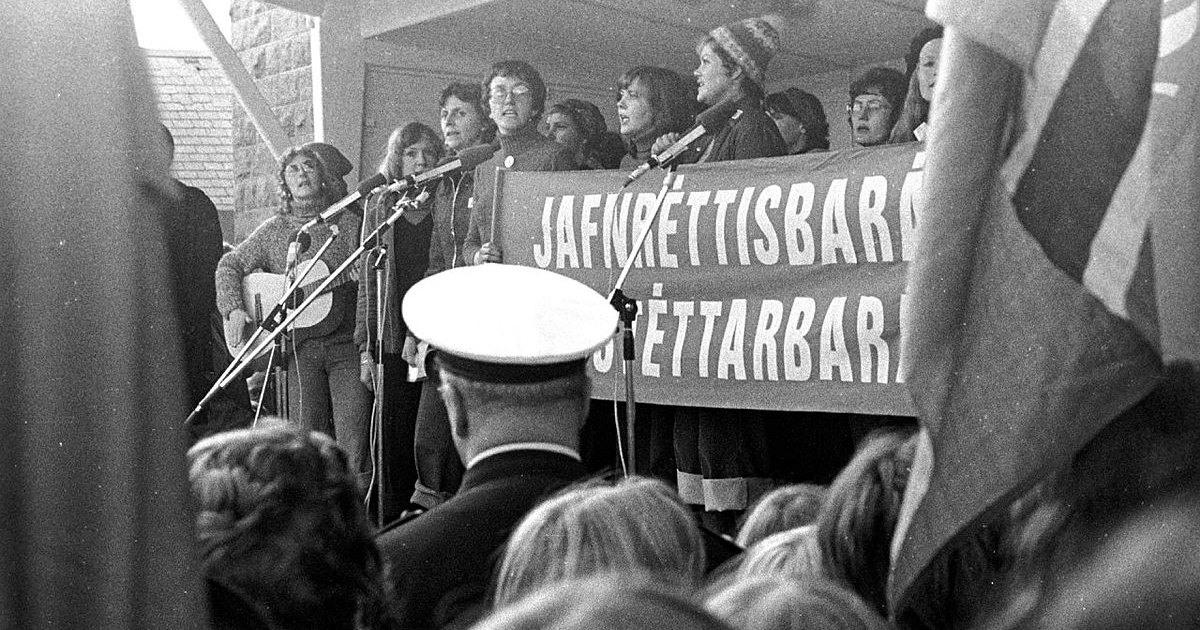
In Iceland, 24 October has been a symbol of the fight for equality since the Women’s Day Off (Kvennafrídagurinn) in 1975, when women stopped paid work, housework and childcare at the same time.
The Icelandic Women’s Rights Association (Kvenréttindafélag Íslands) is holding its eighth Kynjaþing forum that day at Hallveigarstaðir (Túngata 14) in Reykjavík. Sessions run from 12:30 to 17:30 and admission is free. Most of the programme is in Icelandic; a panel on Ukrainian women building new lives in Iceland, organised by W.O.M.E.N. in Iceland, will be held in English.
You can read the story of the first protest in 1975 in our 24 October article.
If you work in Iceland
- Under Icelandic law, women and men must be paid equally for the same or equally valuable work. If you think you are paid less than a male colleague doing the same job, your union is the first place to go; our guide to unions and workers’ rights explains where to start.
- Compare your payslip with your union’s pay scale on our union wages page.
- This Statistics Iceland release does not break income down by origin or citizenship; there is no separate figure for immigrant women.
Methodology: The annual difference of ISK 2.3 million, the 82% ratio and the employment-income gap of ISK 218,000 / 24% were calculated by İzlandapedia from the monthly averages published by Statistics Iceland. Employment income is total income minus capital income and other income. Hourly pay gap figures refer to 2024; the adjusted gap refers to 2023.
Sources
- Hagstofa Íslands, 3.9.2026 — Income based on tax registers 2025
- Hagstofa Íslands, 11.9.2025 — Unadjusted gender pay gap 2024
- Hagstofa Íslands, 21.1.2025 — Gender pay gap 2019–2023
- World Economic Forum, 16.9.2026 — Global Gender Gap Report 2026
- Kvenréttindafélag Íslands — Dagskrá Kynjaþings 24. október 2026
Spotted a mistake? info@izlandapedia.com · Instagram @izlandapedia