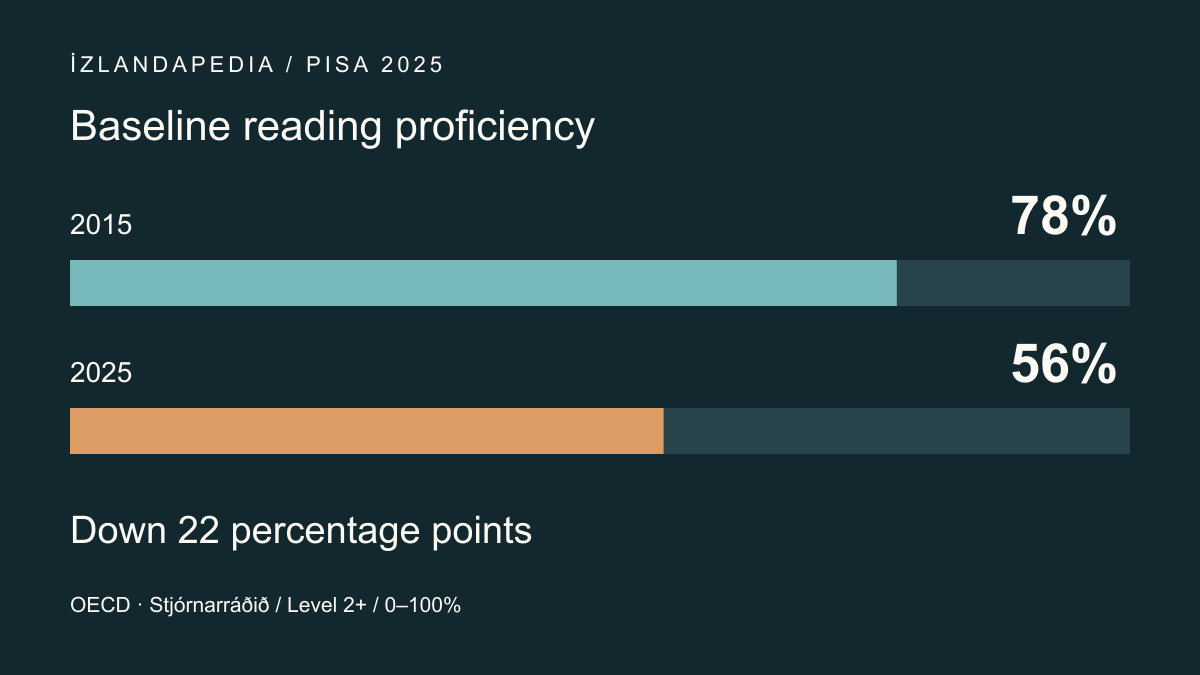
Iceland’s education system faces a serious test. PISA 2025 shows a further decline in reading and mathematics, leaving the country below the OECD average and its Nordic neighbours in all three core subjects. In 2015, 78% of students reached baseline reading proficiency; by 2025, that share was 56%.
The OECD released its international results on 8 September 2026. Iceland’s Ministry of Education and Children published its assessment on a page dated 7 September. Its central message is that too many children finish compulsory schooling without the baseline skills measured by PISA. Stjórnarráðið · PISA 2025 · 07.09.2026
The headline’s “worst picture” describes a historically low level of performance. It does not mean a statistically significant new decline in every subject: reading and mathematics fell from 2022, while science remained broadly unchanged. OECD · PISA 2025 · Iceland · 08.09.2026
44 out of every 100 students fall below baseline reading proficiency
Only 56% reached baseline proficiency in reading, compared with 62% in mathematics and 62% in science. Top performers accounted for just 2–4%, depending on the subject. Stjórnarráðið · PISA 2025 · 07.09.2026
PISA’s baseline is Level 2 or above. Falling below it should not be confused with being unable to read any words. The assessment asks whether students can understand and use information, recognise a text’s central meaning and apply knowledge to problems. It is a defined proficiency threshold, not a diagnosis of an individual child. OECD · PISA 2025 · Iceland · 08.09.2026
2015: 78% → 2025: 56%
The share reaching baseline reading proficiency fell by 22 percentage points over ten years. This is a change in the proportion of students, not a loss of 22 PISA score points. The two measures must be kept separate. Stjórnarráðið · PISA 2025 · 07.09.2026
That comparison turns an apparently isolated disappointing result into a question about sustained performance. Successive surveys test different groups of students; they do not follow the same children over a decade. The results show a long-term system trend, without identifying a single cause.
PISA 2022 had already sounded the alarm
Iceland’s average scores were below OECD averages in all three subjects:
| Subject | Iceland, 2022 | OECD average, 2022 |
|---|---|---|
| Mathematics | 459 | 472 |
| Reading | 436 | 476 |
| Science | 447 | 485 |
These are mean scores from 2022, not 2025 results or proficiency percentages. OECD Education GPS · PISA 2022
The OECD’s 2022 assessment found that performance was already declining before 2018. The fall between 2018 and 2022 exceeded the typical learning gain over an entire school year around age 15, in all three subjects. That is a statistical comparison between cohorts, not proof that every child lost exactly one year of learning. The earlier decline also means the whole trend cannot be attributed to the pandemic. OECD · PISA 2022 · Iceland
The decline slowed, but recovery has not arrived
Between 2022 and 2025, the proportion achieving baseline proficiency fell by four percentage points in both reading and mathematics. Science changed within the margin of error. The ministry reports that Iceland’s recent trajectory is now closer to the OECD-wide trend than in 2022, when its decline was particularly severe. Stjórnarráðið · PISA 2025 · 07.09.2026
The distinction matters: the dramatic 2022 deterioration has not been reversed. Science’s relative stability is not a return to earlier performance levels. PISA 2025 places all three subjects below every assessment before 2022. OECD · PISA 2025 · Iceland · 08.09.2026
Boys face a particularly large reading challenge
In 2025, 50% of boys reached baseline reading proficiency, compared with 62% of girls: a gap of 12 percentage points. In 2022, the corresponding shares were approximately 53% and 68%.
The ministry reports statistically significant declines for girls in all three subjects and for boys in reading. The challenge is therefore not confined to boys, even though they remain further behind in reading. Group averages should guide support without becoming assumptions about any individual pupil. Stjórnarráðið · PISA 2025 · 07.09.2026
Students of foreign origin: only 28% reach the reading baseline
The ministry reports that only 28% of students of foreign origin reached baseline reading proficiency. It finds that differences diminish after accounting for social and economic circumstances, but do not disappear. It calls for stronger Icelandic-language teaching, academic support and social participation. Stjórnarráðið · PISA 2025 · 07.09.2026
The 2022 OECD country note had already shown a reading gap of 65 score points between students with and without an immigrant background. After adjustment for socio-economic circumstances, it was still 42 points. Those are historical score gaps, not 2025 proficiency rates. OECD · PISA 2022 · Iceland
These results cannot by themselves establish that immigration caused Iceland’s overall decline. They raise a practical question: are children learning Icelandic as an additional language receiving the support they need? “Foreign origin” follows the ministry’s terminology; it should not automatically be treated as identical to nationality or to every child learning Icelandic as a second language.
Strong relationships do not automatically deliver strong results
The ministry identifies strengths in perseverance, school relationships, self-regulated learning and teacher support as reported by students. Curiosity and goal-setting are above OECD averages, and Iceland is among the countries with low bullying indicators. These are valuable assets for improving learning. Stjórnarráðið · PISA 2025 · 07.09.2026
They do not establish that every child is happy or safe. Survey responses about relationships and wellbeing measure different aspects of education from academic proficiency. A credible response must protect these strengths while improving reading, mathematics and science.
Small differences between schools, persistent differences between pupils
The ministry reports the smallest variation in performance between schools among OECD countries. That suggests the challenge cannot simply be attributed to a handful of weak schools. However, equality between schools does not mean that all pupils within each school have equal outcomes. Stjórnarráðið · PISA 2025 · 07.09.2026
The educational question is how a broadly shared system can identify different needs early and provide effective support throughout compulsory schooling.
Resources also need to translate into learning
Education at a Glance 2025 reports that investment from primary through tertiary education represented 5.6% of GDP in Iceland, compared with an OECD average of 4.7%. This is a separate education-finance indicator, not a 2025 PISA result. OECD · Education at a Glance 2025 · Iceland
The discussion therefore needs to address both resources and their use: support for teachers, early assessment of reading and mathematics, help for children learning Icelandic, and regular follow-up of student progress. PISA alone cannot calculate which intervention will deliver the greatest benefit.
What PISA measures—and what it does not
The Programme for International Student Assessment examines how 15-year-olds apply reading, mathematical and scientific knowledge. Iceland has participated since 2000. Science was the main domain in 2025. OECD · PISA 2022 · Iceland OECD · PISA 2025 · Iceland · 08.09.2026
A source difference: the ministry reports almost 4,000 students from 134 compulsory schools, with school participation of 99% and student participation of 83%. The OECD country note gives 3,974 students in 137 schools. These counts are attributed separately because the published sources differ; their reason for differing is not established here. Stjórnarráðið · PISA 2025 · 07.09.2026 OECD · PISA 2025 · Iceland · 08.09.2026
PISA does not measure the entire value of an education system, diagnose every pupil or establish causation on its own. Nevertheless, repeated low results warrant attention. A consistent decline across successive cohorts is more consequential than a single disappointing ranking.
What will the government do?
The ministry outlines priorities covering literacy, Icelandic, core academic skills and STEM subjects, teaching materials, professional development and teacher specialisation, expert support for schools, and better data and assessment. It says measures will be set out in the government’s third education-policy action plan in the winter. These are announced priorities, not evidence that the measures have already improved results. Stjórnarráðið · PISA 2025 · 07.09.2026
The test of the response will be whether support reaches classrooms and whether progress becomes visible and measurable.
İzlandapedia
Editor’s commentary
This section is editorial commentary, separate from the news report.
It would be a serious mistake to treat Iceland’s PISA results simply as a race up an international league table.
The central issue is not Iceland’s position in the OECD rankings. It is whether a child approaching the end of compulsory schooling can understand a text, solve a basic mathematical problem and evaluate scientific information.
PISA 2025 delivers a clear message: a very large share of children in Iceland are approaching the end of compulsory education without reaching the expected baseline of academic skills.
More importantly, this is not a new problem. The fall from 78% reaching baseline reading proficiency in 2015 to 56% today is too large and longstanding to explain solely through the pandemic or a single cohort.
Iceland’s advantage is that the problem is not beyond remedy. Its strong public finances, high education spending, small population, strong teacher–student relationships and relatively equal schools provide significant advantages.
Yet the results show that these advantages are not translating into academic achievement.
After PISA 2025, the question should move beyond “Why did Iceland decline in PISA?” to “If this decline has been known for ten years, why has it still not been stopped?”
Perhaps the real shock in Icelandic education is not that the results are poor. It is that poor results are no longer a surprise.
A2–B1
Icelandic practice
A2–B1 · Read the news in easy Icelandic, listen and check your understanding.
Easy reading
Loading audio recordings…
PISA er alþjóðleg könnun. Hún mælir hæfni nemenda. Nemendurnir eru um fimmtán ára. Á Íslandi ná fimmtíu og sex prósent nemenda grunnhæfni í lesskilningi. Árið tvö þúsund og fimmtán var hlutfallið sjötíu og átta prósent. Nemendur þurfa góðan stuðning. Kennarar og skólar gegna mikilvægu hlutverki. Sterk tengsl í skólanum eru líka mikilvæg.
English meaning
PISA is an international survey. It measures students’ proficiency. The students are about fifteen years old. In Iceland, fifty-six percent of students reach baseline reading proficiency. In two thousand and fifteen, the proportion was seventy-eight percent. Students need good support. Teachers and schools play an important role. Strong relationships at school are also important.
Vocabulary and examples
lesskilningur
EN · reading comprehension
TR · okuduğunu anlamaLesskilningur er mikilvægur í námi.
Reading comprehension is important for learning.
Okuduğunu anlama, öğrenmede önemlidir.
grunnhæfni
EN · baseline proficiency
TR · temel yeterlilikNemendur þurfa grunnhæfni í lestri.
Students need baseline reading proficiency.
Öğrencilerin temel okuma yeterliliğine ihtiyacı vardır.
nemandi
EN · student
TR · öğrenciHver nemandi þarf stuðning.
Every student needs support.
Her öğrencinin desteğe ihtiyacı vardır.
kennari
EN · teacher
TR · öğretmenKennarinn hjálpar nemendum.
The teacher helps students.
Öğretmen öğrencilere yardım eder.
stuðningur
EN · support
TR · destekGóður stuðningur getur hjálpað.
Good support can help.
İyi bir destek yardımcı olabilir.
niðurstöður
EN · results
TR · sonuçlarNiðurstöðurnar sýna breytingu.
The results show a change.
Sonuçlar bir değişiklik gösteriyor.
hlutfall
EN · proportion / percentage
TR · oranHlutfallið hefur lækkað.
The proportion has fallen.
Oran düşmüştür.
prósentustig
EN · percentage point
TR · yüzde puanMunurinn er tuttugu og tvö prósentustig.
The difference is twenty-two percentage points.
Fark yirmi iki yüzde puandır.
Grammar and expressions
„Hún mælir …“
„Hún“ refers to the feminine noun „könnun“ (survey). „Mælir“ is the present tense of „mæla“: measures.
„Nemendur þurfa góðan stuðning.“
„Þurfa“ (to need) takes the accusative here: „góðan stuðning“. „Ég þarf …“ means I need …
„Hlutfallið hefur lækkað.“
„Hefur“ + „lækkað“ means has fallen. „Lækka“ means to fall or decrease; „hækka“ means to rise or increase.
„Prósent“ / „prósentustig“
A change from 78% to 56% is 22 percentage points: „prósentustig“. It is not 22 PISA score points or a 22% decrease.
Mini quiz
Writing practice
Write 2–3 sentences in Icelandic: What support do you need when learning? Start with „Ég þarf …“ and „Kennarinn getur …“
Example answer
Ég þarf stuðning í íslensku. Kennarinn getur hjálpað mér að skilja ný orð. Ég vil lesa meira.
Salka · Talrómur / Icelandic Language Technology Programme · CC BY 4.0