Who is he?
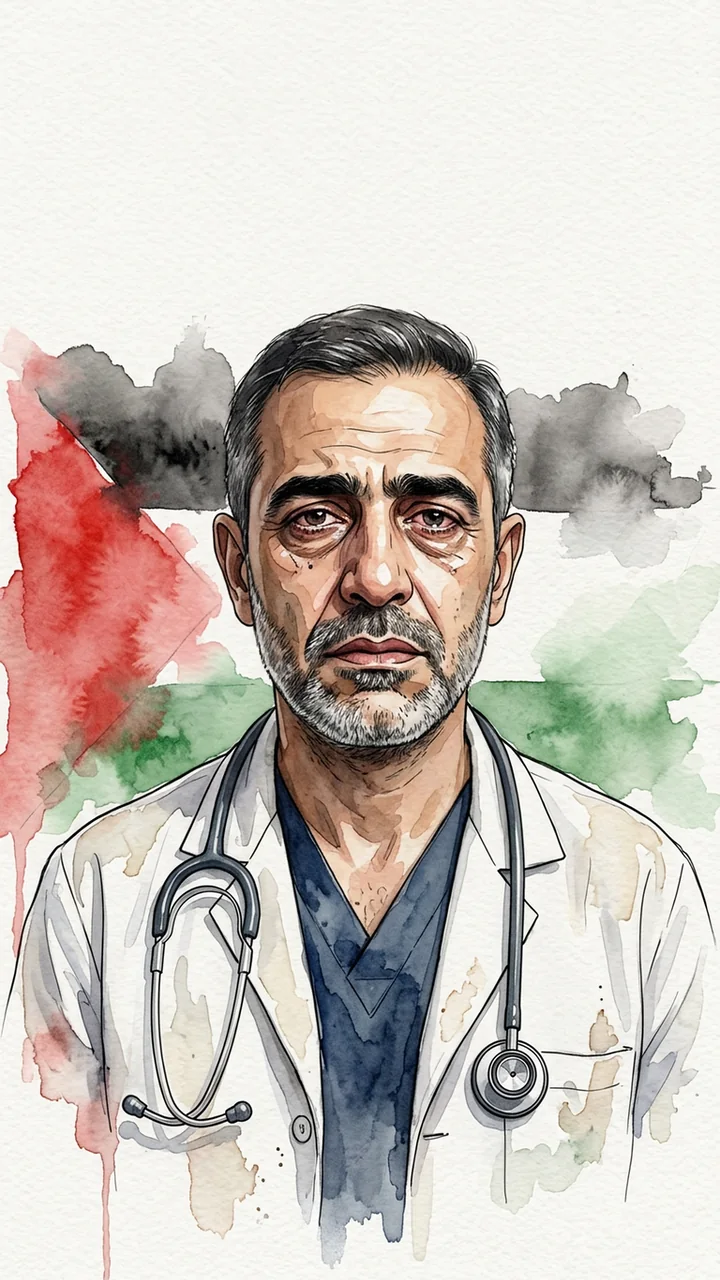
Hussam Abu Safiya was born on 21 November 1973 in the Jabalia refugee camp; his family had been displaced from the village of Hamama in 1948. He studied medicine in Kazakhstan, at Ahmet Yassawi University in Turkistan, and returned to Gaza in 1996 with his Kazakh wife, Elbina. He specialised in paediatrics and neonatology, headed the children's department at Kamal Adwan and became the hospital's director in February 2024. He was also lead physician in Gaza for the Chicago-based charity MedGlobal.
Kamal Adwan, in Beit Lahiya, was one of the last functioning hospitals in northern Gaza in the autumn of 2024. According to Front Line Defenders, by November 2024 only two doctors remained.
25 October 2024: he buried his son in the courtyard
On 25 October 2024 Israeli forces entered the hospital; the same day a drone strike at the entrance killed his 15-year-old son Ibrahim. Aerial footage showed the doctor leading the funeral prayer in the courtyard; Ibrahim was buried beside a hospital wall. Abu Safiya was briefly detained and released that day, and went back to work.
A month later, on 23 November 2024, a drone strike hit the hospital as he walked to his office after surgery; he suffered six shrapnel wounds to his leg. He refused calls to evacuate.
27 December 2024: in a white coat, towards the tank
On 27 December 2024 the Israeli army raided the hospital and forcibly evacuated staff and patients. It said it had detained 240 people and called the hospital a "Hamas terrorist stronghold". Footage from that day shows Abu Safiya, in the white coat he had not taken off for months, walking through the rubble towards an Israeli tank, speaking to a soldier and being driven away. The image became a symbol of Gaza's health workers in media around the world.
On 3 January 2025 the Israeli army said he was under investigation on suspicion of "holding a rank" in Hamas; it shared no evidence. Released detainees who had worked with him said he was not a Hamas member. In 2026 the pro-Israel group NGO Monitor, citing a 2016 photograph and social media posts, claimed he held the rank of "colonel" within Gaza's health ministry; the Jerusalem Post reported that an army spokesperson confirmed the claim. What ranks issued in Gaza's public institutions under Hamas rule mean is disputed; Israel has brought no charges to date.
22 months without trial: which law, which court?
Abu Safiya was first interrogated at the al-Fakhura site in Jabalia, then taken to the Sde Teiman camp in the Negev. On 9 January 2025 the Ashkelon Magistrates' Court extended his detention; his family was not informed and he could not see a lawyer until after 22 January. From February 2025 he was held at Ofer Prison in the West Bank.
The legal basis is Israel's Unlawful Combatants Law of 2002: detention orders based on secret evidence, renewable indefinitely. The Beersheba District Court extended the detention by six months in October 2025 and, on 28 April 2026, rejected a release request and extended it again. On 16 June 2026 Israel's Supreme Court dismissed the appeal filed by his lawyer, Nasser Odeh. The doctor attended the 10 June hearing by video link; he looked markedly thinner.
The cell: from Rakefet to Ramla
What the lawyer reported after the first visit on 11 February 2025: stripped, shackled, made to sit on gravel, beaten with batons and electric sticks, 25 days in solitary confinement, heart treatment refused. 19 March 2025: 20 kg lost in two months, four fractured ribs, high blood pressure and arrhythmia. 13 July 2025: more than 40 kg lost.
In April 2026 he was in Negev (Ketziot) Prison. According to Front Line Defenders he has been held in prolonged solitary confinement since 3 June 2026; Al Jazeera and PHRI identify the unit as "Rakefet", the underground wing of Nitzan Prison in Ramla. After the court hearing of 10 June 2026 he was reportedly assaulted by five guards with fists, batons and metal rods. On 2 July 2026, after repeated refusals, his lawyer was allowed to see him: handcuffed and shackled, struggling to walk, bruises on his head and face, difficulty breathing. Odeh said he had trouble recognising his client.
On 7 July PHRI requested an examination by an independent doctor; when the request went unanswered, the group petitioned an administrative court in early August. On 10 August 2026 Abu Safiya was transferred to the Israel Prison Service medical centre in Ramla, which PHRI says "in itself indicates serious medical needs that cannot be adequately addressed in ordinary prison wards". In early September his lawyer reported continued beatings by guards, sleep disrupted by loudspeakers at night and threats over describing his conditions. On 19 August an Arab member of the Knesset was refused permission to visit him.
What the world has said
- United Nations: Special Rapporteurs Tlaleng Mofokeng and Ben Saul called for his release on 24 March 2026, citing reports of "severe torture". The UN Working Group on Arbitrary Detention's opinion that the detention is arbitrary was made public on 6 July 2026; the next day five UN rapporteurs warned of "continued severe torture" and a risk of "imminent death" and demanded his immediate release.
- Amnesty International: warned in July 2026 that his life was in grave danger and asked the US government to act under the Leahy Law.
- Médecins Sans Frontières: on 20 July 2026 demanded the release of all detained Palestinian health workers. According to PHRI at least 13 other doctors from Gaza are held without charge; Gaza's health ministry said in April 2026 that 380 health workers had been detained and 86 were still in custody.
- Lyon: the French city made him an honorary citizen; when a member of parliament accused the mayor in January 2026 of "glorifying an Islamist", Mayor Grégory Doucet stood by the decision: Lyon "will never renounce its humanist heritage".
- US Congress: Rashida Tlaib, Ilhan Omar, Pramila Jayapal and three other representatives called for his release on 6 October 2026.
İzlandapedia's analysis: which rules have been broken?
The assessment below is İzlandapedia's own, based on the facts reported by his lawyer, PHRI, Front Line Defenders and UN mechanisms. The counter-position should be noted: Israel argues that the Fourth Geneva Convention does not apply de jure in the occupied territories, has not regarded Gaza as occupied since 2005, and its Supreme Court upheld the Unlawful Combatants Law as constitutional in 2008. The International Court of Justice, in its advisory opinion of 19 July 2024, found that the Palestinian territory including Gaza remains occupied and that Israel's obligations as occupying power continue. Within that framework, the file shows at least twelve distinct breaches:
1. The raid on and emptying of the hospital. Civilian hospitals may in no circumstances be the object of attack (Fourth Geneva Convention, art. 18); protection ceases only if a hospital is used to commit "acts harmful to the enemy", and only after a warning with a reasonable time limit (art. 19). The burden of proof lies with Israel; no public evidence has been produced for the "Hamas stronghold" claim. The UN Commission of Inquiry concluded in October 2024 that attacks on Gaza's hospitals amounted to war crimes; the Rome Statute lists intentional attacks on hospitals as a war crime (art. 8(2)(b)(ix)).
2. The detention of medical personnel. Persons regularly and solely engaged in the operation of civilian hospitals "shall be respected and protected" (GC IV art. 20; customary rule 25). No one may be punished for carrying out medical activities compatible with medical ethics (Additional Protocol I, art. 16; Israel is not a party, but the rule is regarded as customary). Protection is lost only if the person is shown to have taken part in hostile acts outside his humanitarian function; in 22 months no such evidence has been brought before a court.
3. The "unlawful combatant" category. International humanitarian law knows two statuses: combatant and civilian. A civilian who takes a direct part in hostilities loses protection but remains a civilian; there is no third status of "unlawful combatant". Israel's 2002 law creates a regime of administrative detention based on secret evidence and renewable indefinitely. Protected persons may be interned only "for imperative reasons of security", with independent review if possible every six months (GC IV art. 78). The UN Working Group on Arbitrary Detention found the detention arbitrary in July 2026.
4. Judicial review, lawyer and family. Anyone deprived of liberty must be brought "promptly" before a judge (International Covenant on Civil and Political Rights, art. 9(3); according to the UN Human Rights Committee, 48 hours as a rule). Abu Safiya first appeared in court after 13 days, on 9 January 2025; access to a lawyer was barred until 22 January; his family was not informed. Concealing a detainee's whereabouts for weeks falls, under the Committee's General Comment 35, within the prohibitions of enforced disappearance and torture.
5. Transfer from occupied territory into Israel. Protected persons must be detained in the occupied country (GC IV art. 76); forcible transfers and deportations are prohibited (art. 49). Sde Teiman, Negev/Ketziot and Nitzan Prison in Ramla are on Israeli territory. The Rome Statute treats unlawful transfer as a grave breach (art. 8(2)(a)(vii)).
6. Torture and ill-treatment. Israel has been a party to the UN Convention against Torture since 1991 (arts. 1, 2, 16); ICCPR art. 7 and GC IV arts. 31–32 prohibit physical and moral coercion absolutely; common Article 3 applies in all circumstances. The beatings with batons and electric sticks, forced sitting on gravel, four fractured ribs and the assault by five guards in June 2026 reported by the lawyer were described by UN rapporteurs as "severe torture". A complainant must be protected from threats and reprisals (CAT art. 13); threats over "describing his conditions" breach that rule too.
7. Prolonged solitary confinement. Under the UN Mandela Rules, solitary confinement for more than 15 consecutive days is "prolonged" and prohibited, as is indefinite solitary confinement (rules 43–44). The isolation that began on 3 June 2026 has lasted five months. According to the UN Special Rapporteur on torture, prolonged solitary confinement can in itself amount to torture or ill-treatment.
8. Medical care and independent examination. Prisoners are entitled to health care equivalent to that in the community, and to transfer to specialised institutions when prison facilities cannot cope (Mandela rules 24–27); to adequate food (rule 22); and prison doctors must document and report signs of torture (rule 34; Istanbul Protocol). Where there is reason to believe torture has occurred, the authorities must open a prompt and impartial investigation on their own motion (CAT art. 12). More than 40 kg lost, an untreated arrhythmia, an X-ray result missing from the file and a refused independent examination are contrary to these rules.
9. Access for lawyers, family and independent monitors. Free communication with counsel (ICCPR art. 14(3)(b); GC IV art. 72), family correspondence and visits for internees (arts. 106–107, 116) and ICRC access to all protected persons (art. 143) are guaranteed. Lawyer visits were refused repeatedly; the International Committee of the Red Cross has said it has had no access to Palestinian detainees in Israel since October 2023; a member of the Knesset was refused a visit on 19 August 2026.
10. Presumption of innocence. Everyone is presumed innocent until proved guilty (ICCPR art. 14(2)). The army announced its suspicion of "a rank in Hamas" publicly but has filed no indictment in 22 months; declaring someone guilty in public without trying him empties the presumption of meaning. The prohibition on punishing a person for an offence he has not personally committed, and on collective penalties (GC IV art. 33), is also engaged.
11. The death of his son and the strikes on the hospital. The drone strikes that killed 15-year-old Ibrahim at the hospital entrance on 25 October 2024 and wounded the doctor on 23 November call for independent investigation under the principles of distinction, proportionality and precaution (AP I arts. 48, 51, 57; customary rules 1, 14, 15); the duty to investigate suspected grave breaches lies with Israel (GC IV art. 146). No public investigation is known.
12. The obligations of third states. Common Article 1 of the Geneva Conventions obliges all states parties to "ensure respect" for the Conventions in all circumstances; the Convention against Torture requires states to prosecute or extradite perpetrators (arts. 5–7). These obligations bind Iceland too. That is why "Has Iceland done anything?" is a legal question, not only a political one.
Icelandic Medical Association responds to İzlandapedia
In a response received by İzlandapedia on 28 October 2026, Icelandic Medical Association President Steinunn Þórðardóttir outlined the association’s previous actions concerning Abu Safiya and healthcare workers in Gaza. Executive Director Dögg Pálsdóttir forwarded the response.
The association’s public appeal urges the Icelandic government to support the WHO Director-General and Amnesty International Secretary General’s demand for Abu Safiya’s immediate release. It also covers other healthcare workers held without due process, calls for an end to attacks on healthcare staff, hospitals and ambulances, and seeks access to healthcare and humanitarian aid and an immediate ceasefire.
Þórðardóttir said the association had worked to secure joint statements by Nordic medical associations. The documents she supplied include their statement of 18 August 2025, which seeks practical action on healthcare protection, medical evacuations, humanitarian assistance and a lasting ceasefire.
She also said the association took part in the “Þjóð gegn þjóðarmorði” rally at Austurvöllur on 6 September 2025, where she spoke about healthcare in Gaza. She said it had been active in discussions within the World Medical Association (WMA) and supported its statements.
The WMA appeal dated 13 July 2026, linked in the response, calls for independent medical care for detained health professionals; due process and a fair trial, or immediate and unconditional release in the absence of formal charges; an end to solitary confinement; and access to lawyers and families.
The reply documents earlier advocacy. It does not announce a new initiative prompted by our questions or indicate that the doctor has been released. İzlandapedia has also separately contacted the Iceland-Palestine Association.
Correction and update — 28 October 2026: An earlier version stated that no public statement had been made in Iceland. Following the association’s response and the documents it supplied, that generalisation has been removed and the introduction, Iceland section and corresponding FAQ corrected.
Frequently asked questions
Who is Hussam Abu Safiya?
The director of Kamal Adwan Hospital in northern Gaza, a paediatrician and neonatologist. He was detained during the raid on the hospital on 27 December 2024 and has been held in Israel ever since.
What is he charged with?
Nothing formally. The Israeli army speaks of suspicion of "holding a rank in Hamas"; the doctor and his colleagues deny it. The detention rests on the Unlawful Combatants Law, which allows indefinite extensions without trial.
What is his state of health?
Serious, according to his lawyer and PHRI: more than 40 kg lost, fractured ribs, signs of beatings, an untreated heart rhythm problem. Since 10 August 2026 he has been in the Ramla prison medical centre. An independent medical examination has not been allowed.
Who has called for his release?
UN rapporteurs and the Working Group on Arbitrary Detention, Amnesty International, Human Rights Watch, MSF, the Director-General of the WHO, the American Academy of Pediatrics, the City of Lyon and six members of the US Congress.
Which international rules does his detention breach?
At least twelve, according to İzlandapedia's analysis: the protection of hospitals and medical personnel (Fourth Geneva Convention, arts. 18–20), the requirement of imperative security reasons and six-monthly independent review (art. 78), the ban on transfer out of occupied territory (arts. 49, 76), prompt judicial review (ICCPR art. 9), the presumption of innocence (art. 14), the prohibition of torture (Convention against Torture), the ban on solitary confinement beyond 15 days and the duty of medical care (Mandela Rules 22–27, 43–44).
Has Iceland done anything?
The Icelandic Medical Association publicly urged the government to support the release of Abu Safiya and other health workers held without due process. In her response to İzlandapedia on 28 October 2026, President Steinunn Þórðardóttir also outlined its advocacy through Nordic medical associations and the WMA.
Sources
- Front Line Defenders – Palestinian human rights defender and paediatrician Dr. Hussam Abu Safiya faces imminent risk (case page, updated 2026)
- OHCHR – Israel must immediately release Dr. Hussam Abu Safiya: UN experts (7.7.2026)
- UN Palestine / OHCHR – OHCHR calls on the Israeli Government to urgently protect Dr. Hussam Abu Safiya (8.7.2026)
- Al Jazeera – UN experts urge Israel to free Gaza doctor amid reports of 'severe torture' (24.3.2026)
- Reuters / Internazionale – Israel's detention of prominent Gazan doctor is arbitrary, UN body says (6.7.2026)
- Amnesty International – Israel/OPT: Fears mounting for arbitrarily detained Palestinian doctor Hussam Abu Safiya amidst reports his life is in grave danger (July 2026)
- Al Jazeera – No end to torture of Gaza doctor Abu Safiya in Israeli prison: what to know (3.9.2026)
- Arab News – Israeli doctors' group petitions court for medical review of Hussam Abu Safiya (6.8.2026)
- The New Arab – Calls grow to free Abu Safiya after Israel extends detention (29.4.2026)
- Al Jazeera – US lawmakers call on Israel to release imprisoned doctor Hussam Abu Safiya (6.10.2026)
- LyonMag – « Lyon ne renoncera jamais à son héritage humaniste » : Grégory Doucet confirme la citoyenneté d'honneur de Hussam Abu Safiya (5.1.2026)
- The Jerusalem Post – NGO Monitor report on Hussam Abu Safiya's alleged rank (2026; İsrail tarafının iddiası / Israeli side's claim)
- ICRC – Fourth Geneva Convention relative to the Protection of Civilian Persons in Time of War (1949): arts. 18–20, 31–33, 49, 76, 78, 143, 146
- ICRC – Customary IHL, Rule 25: Medical personnel
- UNODC – United Nations Standard Minimum Rules for the Treatment of Prisoners (Nelson Mandela Rules): rules 22–27, 34, 43–44
- OHCHR – Convention against Torture and Other Cruel, Inhuman or Degrading Treatment or Punishment
- OHCHR – International Covenant on Civil and Political Rights, arts. 7, 9, 14
- ICJ – Legal Consequences arising from the Policies and Practices of Israel in the Occupied Palestinian Territory, Advisory Opinion of 19 July 2024
- Al Jazeera – UN inquiry accuses Israel of crime of 'extermination' in attacks on Gaza health facilities (10.10.2024)
- Wikipedia – Hussam Abu Safiya (biyografi ve kaynakça / biography and references)
- Læknafélag Íslands – Áskorun LÍ til stjórnvalda vegna ástandsins í Gaza
- Læknafélag Íslands – Ályktun stjórna norrænu læknafélaganna um ástandið á Gaza
- Nordic Medical Associations – Joint Statement on Gaza, 18 August 2025
- World Medical Association – Urgent appeal over detained Gaza physicians, 13 July 2026
Spotted a mistake? info@izlandapedia.com · Instagram @izlandapedia