The short answer first
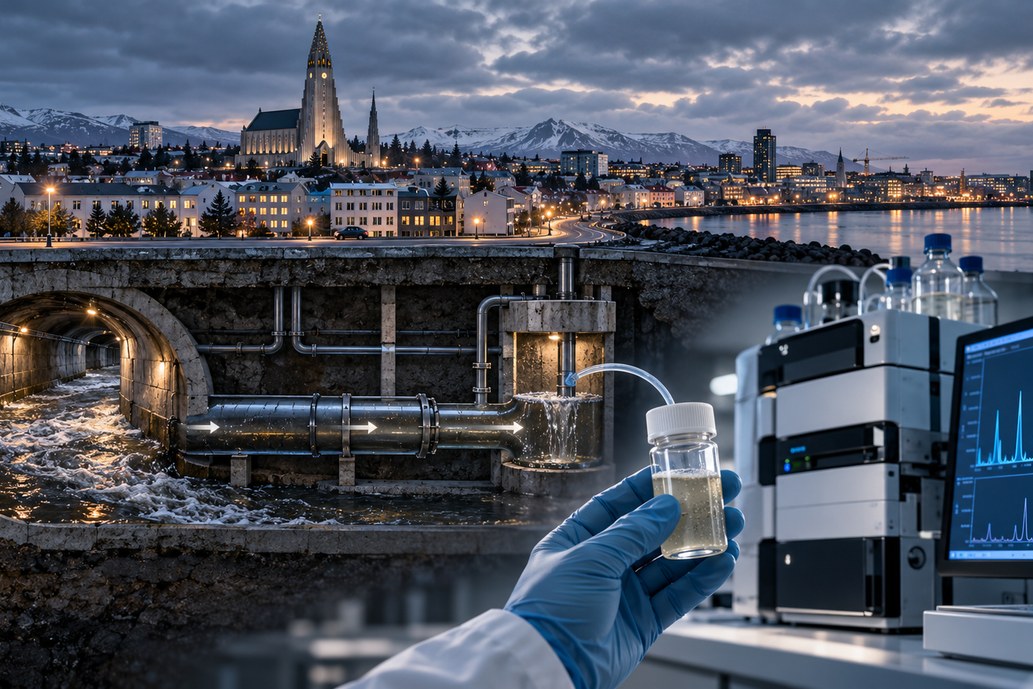
Surveys rarely tell the whole truth about drug use. So scientists look somewhere else: the sewers. Measurements run by the University of Iceland since early 2024 show:
- Ketamine now turns up in every measurement, and almost all of it is street ketamine, not medical.
- The cocaine in circulation is nearly pure; it used to be cut with sugar or other substances.
- Methamphetamine is rising, while MDMA (ecstasy) is flat.
- No fentanyl has been found, either in wastewater or in used syringes.
Police data and death statistics point the same way: 2025 brought record seizures, and deaths from drug and medicine poisoning in the last five years were about 45% higher than in the five years before.
How do you measure drugs in sewage?
Every substance we take leaves the body, broken down, in urine and ends up in the sewer. Testing a city's wastewater is like taking an anonymous urine sample from the whole city. Forensic chemist Adam Erik Bauer, who leads the research, puts it this way: “Eins og eitt stórt þvagpróf af Reykjavík”, “like one big urine test of Reykjavík.”
- Sampling: samples are taken every hour for seven days at the Klettagarðar treatment plant. Each represents about 110,000 people in the capital area.
- Analysis: the University's Laboratory of Pharmacology and Toxicology uses liquid chromatography with mass spectrometry (LC-MS) to detect tiny amounts, and screens samples against a database of about 2,000 substances to spot new arrivals early.
- Scope: five opioids (codeine, morphine, tramadol, oxycodone, fentanyl) plus cocaine, MDMA, methamphetamine, cannabis (THC) and ketamine.
No individual can be identified; the result is a picture of the whole city. In 2025 the project received ISK 3 million from Reykjavík Energy's VOR science fund. Its aim is to respond early, before a dangerous substance spreads and before the first death.
What are the substances tested for?
A short guide to the substances in this story. All are illegal in Iceland or available only on prescription.
| Substance | What it is | Effects and use | Status in Iceland |
|---|---|---|---|
| Cocaine | Stimulant made from coca leaves; white powder | Short-lived energy and confidence; risks to heart and blood vessels. Usually snorted | Circulating nearly pure; clear weekend peaks |
| Ketamine | An anaesthetic in medicine; powder or liquid on the street | Numbness and detachment; risk of bladder and memory damage | Found in every sample, almost all street ketamine |
| MDMA (ecstasy) | Synthetic stimulant; pills or crystals | Feelings of closeness and energy; risk of overheating and dehydration. Linked to parties | Flat |
| Methamphetamine | A stronger form of amphetamine | Long-lasting wakefulness; high dependence risk | Rising |
| Amphetamine | Synthetic stimulant | Wakefulness, loss of appetite; dependence | Reykjavík ranked 4th in Europe in 2016; dominant stimulant for years |
| Cannabis (THC) | Active substance of the cannabis plant | Relaxation; effects on attention and memory | Tracked in wastewater via the residue THC-COOH |
| Opioids: codeine, morphine, tramadol, oxycodone | Prescription painkillers | Strong pain relief; risk of dependence and respiratory arrest. Oxycodone (OxyContin) is the most misused | Prescriptions fell; oxycodone in wastewater does not track prescriptions, counterfeit tablets in circulation |
| Fentanyl | Synthetic opioid roughly 100 times stronger than morphine | A tiny amount can be fatal; main driver of the overdose wave in the US and Europe | Not found in Iceland |
| Nitazenes | New synthetic opioids even stronger than fentanyl | Linked to deaths in Norway and the UK | Not detected as of 2024; being monitored |
Prescription painkillers show up in wastewater through both medical use and misuse, which is why researchers compare them against prescription data.
What the wastewater shows
Ketamine everywhere. In May 2026 Bauer said ketamine now appears in every measurement. It is used in hospitals for anaesthesia and severe pain, but according to associate professor Freyja Jónsdóttir of the Faculty of Pharmacy, not at levels that would show up in wastewater. Specialised analysis indicates that what is measured is “nánast allt götuketamín”, almost all street ketamine.
Pure cocaine, weekend peaks. Samples from used syringes and harm-reduction services show nearly pure cocaine. Cocaine and MDMA use rises clearly at weekends, while opioid use is steadier through the week.
Oxycodone may not come from pharmacies. Opioid prescriptions fell from early 2024 to the end of 2025, but oxycodone in wastewater fluctuates and does not track prescriptions significantly. Researchers say this suggests it enters the country outside pharmacies, via the airport and harbours. Experts also warn of counterfeit medicines: tablets made to look like known drugs that may contain much stronger substances.
No fentanyl, but it is being watched. Heroin never gained a foothold in Iceland, and the researchers' hypothesis is that fentanyl spreads through heroin markets in neighbouring countries. Nitazenes, linked to poisonings in Norway, had not been detected in Iceland as of 2024.
Compared with the past
- 2016: in a 70-city European study, Reykjavík ranked fourth for amphetamine.
- 2017–2020: amphetamine was the dominant stimulant; cocaine rose substantially until 2019 and fell in 2020 during COVID-19 (Löve et al., 2022).
- 2024–2026: today ketamine and pure cocaine stand out.
Europe shows a similar shift. The EU Drugs Agency (EUDA) study published in March 2026, covering 115 cities in 25 countries, found ketamine residues up about 41% and cocaine up about 22% between 2024 and 2025, while MDMA fell 16%. Reykjavík has not been part of that European comparison in recent years, so no city ranking can be given.
Police data: a record year
According to preliminary police statistics published on 31 December 2025, 2025 was a record year for drug seizures:
| Substance | Seized in 2025 |
|---|---|
| Marijuana | about 468 kg |
| Cocaine | 106 kg |
| Hashish | 66 kg (well above the 2007–2025 average) |
Serious drug cases approached 140, most of them import cases, 79% above the average of the previous three years.
2026 has seen another major case: in an investigation into drugs hidden in the sea chests of a bulk carrier that sailed to Straumsvík in June, just over 106 kg of cocaine was found in total. A University of Iceland lab assessed its potency as very high. The case is ongoing; one man is charged with attempting to receive about 30 kg.
Deaths: a clear rise in the last five years
Figures from the Directorate of Health (Embætti landlæknis), updated on 23 September 2026, cover deaths from poisoning by drugs and medicines. They include prescription medicines and intentional poisonings as well as illegal drugs, so they are not “overdose deaths” in the narrow sense.

| Period | Deaths |
|---|---|
| 2016–2020 average | 32 |
| 2021 | 47 |
| 2022 | 35 |
| 2023 | 56 (record) |
| 2024 | 50 |
| 2025 | 45 |
The 2021–2025 average is 46.6 deaths a year, against 32.2 in 2016–2020. About two thirds of those who died were men; the most affected age groups are 18–44.
What these data cannot show
As the EUDA stresses, wastewater analysis cannot tell how many people use drugs, how often, or who they are, and a one-week sample may not represent a whole city. Seizure figures also depend on police effort: more seizures do not necessarily mean more use. But when three different sources (wastewater, police and death records) point the same way, the picture becomes more convincing.
Sources
- Vísir — Nánast hreint kókaín í umferð en ekkert fentanyl (19.4.2026)
- Bylgjan / Vísir — Fölsuð lyf í umferð og ketamín finnst í skólpinu (28.5.2026)
- Vísir — „Eins og eitt stórt þvagpróf af Reykjavík“ (9.9.2024)
- Orkuveitan, VOR-sjóður — Viðvörunarkerfi fyrir fíkniefnatengdar hættur (2025)
- Lögreglan — Met í haldlagningu fíkniefna: bráðabirgðatölfræði lögreglu 2025 (31.12.2025)
- DV — Gæsluvarðhaldsúrskurður í sjókistumálinu (23.9.2026)
- Embætti landlæknis — Lyfjatengd andlát, tölur 2008–2025 (Dánarmeinaskrá, 23.9.2026)
- EUDA — Europe's wastewater tells a new story (18.3.2026)
- EUDA — Wastewater analysis and drugs: a European multi-city study (yöntem ve sınırlar)
- Löve, Ásgrímsson, Ólafsdóttir — Illicit drug use in Reykjavik by wastewater-based epidemiology, Science of the Total Environment 803 (2022)
- Iceland Review — Reykjavík Fourth Highest on Amphetamine (6.1.2017)
- Landspítali — Eitrunarmiðstöð / Poison Information Center (543 2222)
Spotted a mistake? info@izlandapedia.com · Instagram @izlandapedia