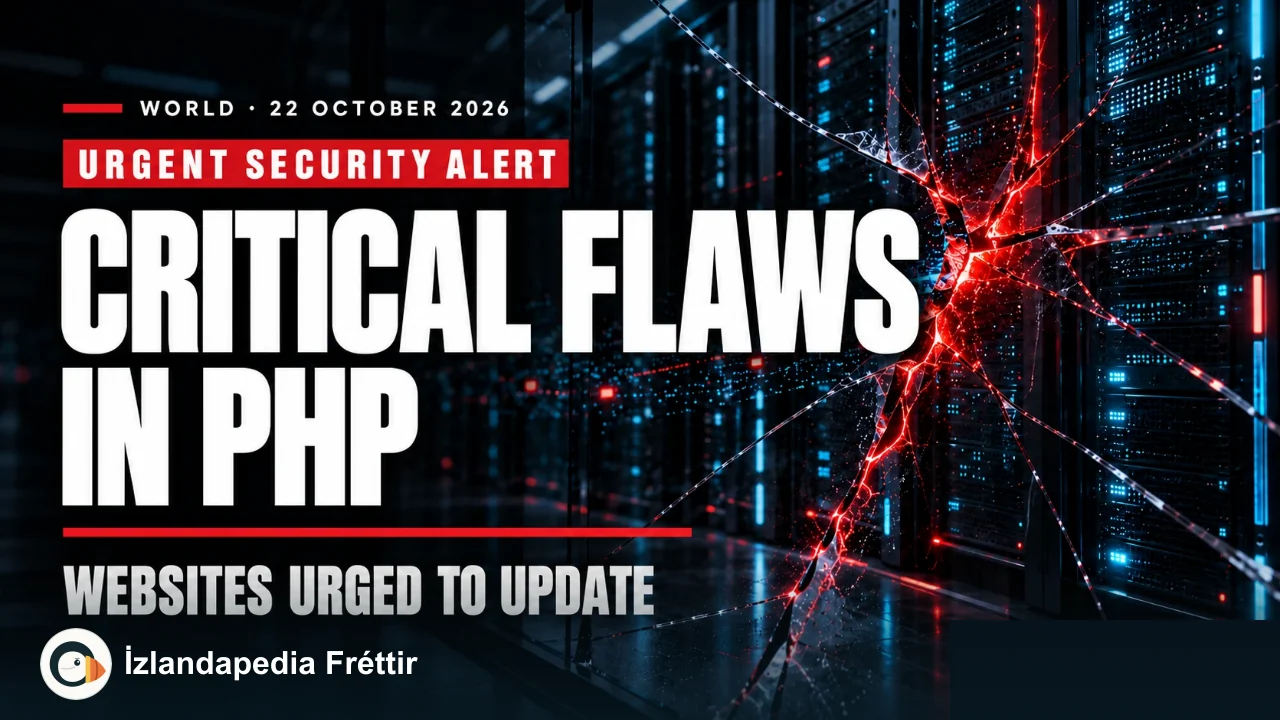
Reading the news, shopping online or filling in a form may look simple on screen. Behind those actions are programs running on servers. Two critical flaws in one widely used technology, PHP, have prompted urgent checks across online services.
The PHP project released security fixes on 21 October. CERT-EU, the cybersecurity service for EU institutions, urged organisations to update affected systems immediately. Both vulnerabilities have a severity score of 9.2 out of 10. CERT-EU advisory
What could an attacker do?
PHP is a programming language that runs on servers. It can handle sign-ins, forms, database queries and content management before sending a page to a reader’s browser.
The newly disclosed flaws concern how PHP handles memory and certain errors. Under particular conditions, an attacker can run unauthorised code on a server without logging in. Possible consequences include service disruption, unauthorised access to data or a compromised system. UK National Cyber Security Centre
A website using PHP has not necessarily been attacked. The existence of a vulnerability does not mean it has been successfully exploited on every affected system.
The Netherlands temporarily took its own security website offline
The Dutch National Cyber Security Centre said it temporarily took its own website offline as a precaution because of the PHP vulnerabilities. A later update reported that the site was available again. The announcement described a preventive measure, not a confirmed takeover by attackers. Dutch NCSC updates
The UK NCSC asked organisations to identify systems using PHP and prioritise those exposed to the internet. France’s CERT-FR also issued an alert and advised applying security fixes. UK NCSC · CERT-FR
The official notices reviewed do not provide a verified worldwide count of organisations harmed through these vulnerabilities.
Where does artificial intelligence fit in?
AI’s documented role here is in security research. The PHP Foundation says tools from Anthropic and OpenAI were used to examine PHP and validate security reports. AI also helps assess reports and group those with the same underlying cause. People make the decisions and work on every patch. PHP Foundation account
The evidence therefore establishes AI-assisted vulnerability research. It does not establish that attacks exploiting these particular flaws were directed by artificial intelligence.
Refrigeration systems were targeted in a separate French incident
A separate French alert illustrates how cyberattacks can reach beyond websites. CERT-FR reported numerous compromises involving remote refrigeration controllers from Danfoss, Copeland and Dixell. It advised removing direct public internet access to management interfaces and using protected networks. CERT-FR refrigeration alert
Interference with refrigeration can put food preservation and business operations at risk. However, no connection between those incidents and the newly disclosed PHP flaws is established in the official sources reviewed. They should not be presented as a single coordinated campaign.
What does this mean for Iceland?
We did not identify a confirmed Icelandic attack or service outage caused by these PHP vulnerabilities in the sources reviewed. Software risks, however, do not stop at national borders. An Icelandic business, online shop or news outlet using an affected PHP installation may also need to check its security status.
This is an assessment of the technical relevance to Icelandic services, not a report of a confirmed local incident.
What should website owners do?
The PHP project’s fixes are included in versions 8.5.12, 8.4.27, 8.3.36 and 8.2.35. Some operating-system suppliers also backport fixes into their existing packages, so a version number alone may not establish whether a system is patched. Website owners should confirm the patch status with their hosting provider. Official PHP releases · CERT-EU recommendations
WordPress stresses that the issue is not specific to WordPress. Updating a theme, plugin or WordPress itself does not replace fixing the PHP runtime on the server. WordPress security notice
A website loading normally does not demonstrate that its infrastructure is secure. The practical question for its owner is: have both security fixes been applied to the server that runs this site?
Sources
- CERT-EU · Critical vulnerabilities in PHP
- NCSC UK · Critical security issue affecting PHP
- NCSC Netherlands · PHP updates
- CERT-FR · PHP security alert
- PHP Foundation · Security release and research
- CERT-FR · Refrigeration controller incidents
- PHP · Official security releases
- WordPress · Critical PHP security release