
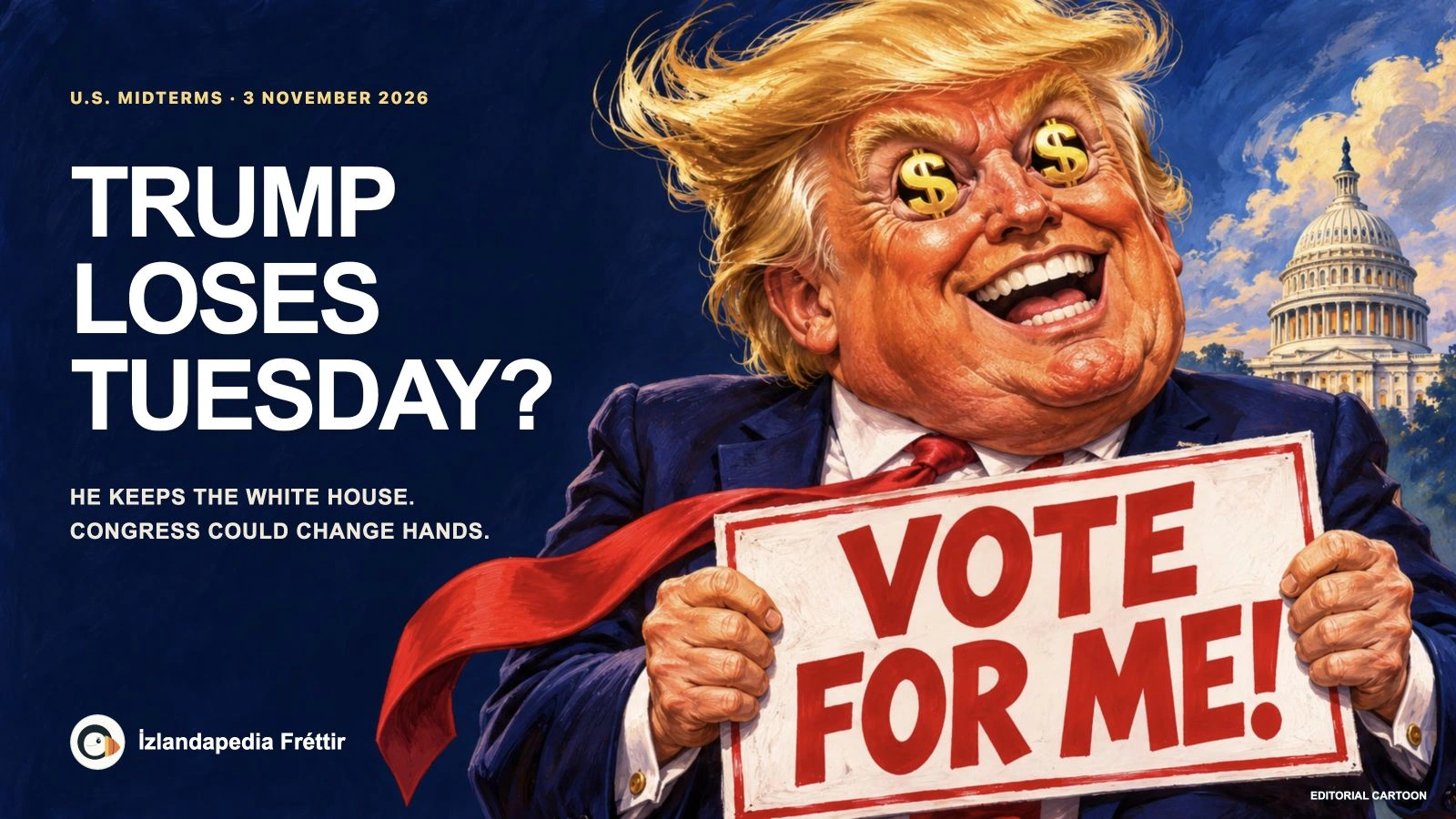
A bad election night would not bring a moving van to the White House on Wednesday morning. Donald Trump is not personally a candidate in the midterms on Tuesday, 3 November. His political strength is being tested through Republican candidates. The official U.S. midterm guide.
The key question is whether Republicans keep control of the House of Representatives and the Senate. Losing one or both could make Trump’s remaining time in office much harder. The consequences would depend on which chamber changed hands and the size of each majority.
What is being elected on Tuesday?
The federal general election takes place on Tuesday, 3 November 2026. All 435 seats in the House of Representatives are being contested in this election cycle. There are also 35 Senate seats at stake: 33 regular elections and special elections in Florida and Ohio. FEC election calendar · How midterms work · Senate election facts.
The two chambers can have different winners. One party can take the House while the other controls the Senate. That distinction matters more than a single headline declaring who has “won”.
1. Republicans lose only the House
A Democratic House majority could control its committees and legislative agenda. It could hold hearings, seek documents and question officials about the administration’s decisions. These are tools for scrutiny, not proof that a crime has occurred. The House’s oversight powers.
Trump would need more agreement with Democrats to pass new laws and spending plans. But the House does not confirm federal judges or ambassadors. That power belongs to the Senate.
2. Republicans lose only the Senate
A Democratic Senate majority could make it harder for Trump to appoint federal judges, ambassadors and senior officials who need Senate confirmation. It could reject nominees, delay a vote or press him to choose someone else. How Senate confirmation works.
Not every presidential appointment needs Senate approval. Nor would a change of majority dismiss existing officials overnight. It would mainly change the path facing future nominations that require consent.
3. Republicans lose both chambers
Trump would face a stronger challenge to his plans for laws and spending. Most new laws need both chambers to approve the same text, followed by the president’s signature. Trump could still veto a bill. Congress would need a two-thirds majority in each chamber to override him. How laws are made · The presidential veto.
Funding the government could require tougher negotiations. That would not automatically force Trump out of office or make agreement impossible. Congress would still need to pass the necessary funding legislation. The appropriations process.
In Washington, a seat is more than somewhere to sit. Some come with a say over the budget; others come with access to the filing cabinets.
4. Republicans keep both chambers
Trump would have a more favourable Congress for his legislative plans. But a majority is not a blank cheque. Republican disagreements, voting rules, existing laws and court decisions could still limit what he can do. How U.S. government powers are divided.
The size of each majority would matter, too. A narrow win and a large win give a president very different room to negotiate.
Could a defeat remove Trump from office?
No. Losing the midterms does not automatically impeach or remove a president. The House can approve articles of impeachment by a simple majority. That amounts to bringing charges; it is not the decision to remove him.
The Senate holds the trial. Conviction requires two-thirds of the senators present and leads to removal from office. Winning a congressional majority is therefore different from winning enough votes to remove a president. The Senate’s impeachment guide.
Would the dollar fall or tariffs disappear?
Dollar signs are easy to put in a cartoon. A reliable forecast for the dollar is harder. A change in congressional control does not guarantee a rise or fall in the currency or stock markets. The policies and decisions that follow would also matter.
Tariffs would not disappear simply because a different party won Congress. Congress has powers over trade and tariffs, while laws have also given the executive certain tariff powers. A new majority could change scrutiny or pursue new legislation, but the election itself would not cancel every tariff. CRS: Congress and presidential tariff powers.
Why does this matter to Iceland?
The United States is an important market for Icelandic exporters. Iceland exported ISK 85.5 billion in goods to the United States in 2025, according to Statistics Iceland. That figure covers goods exports, not all trade in goods and services between the two countries. Statistics Iceland’s 19 May 2026 release.
The countries also share the 1951 defence agreement and NATO cooperation. Iceland’s foreign minister described the agreement’s continuing importance to Iceland’s security in a 5 May 2026 article. Iceland’s Ministry for Foreign Affairs.
Changes in U.S. defence funding, trade rules and scrutiny of the president could therefore affect Iceland. A congressional election would not automatically end the defence agreement.
When would the changes take effect?
The regular new congressional terms begin on 3 January 2027. Special elections filling unexpired terms can follow a different timetable. Trump’s presidential term has a separate schedule: it normally ends on 20 January 2029.
The 22nd Amendment bars anyone from being elected president more than twice. Discussion of Trump’s role in 2028 is therefore also about his influence over the Republican Party and a successor, rather than an ordinary third presidential election campaign. The 20th and 22nd Amendments.
First counts on election night are not final official results. Close races may need more time for counting, checks and certification. The U.S. Election Assistance Commission.
The White House keys will not change hands on Tuesday night. What could change is how easily Trump gets his plans through Congress.
Sources and original documents
- Federal Election Commission — 2026 congressional election calendar
- USAGov — Congressional elections and midterm elections
- U.S. Senate Daily Press Gallery — Senate facts
- U.S. House — Investigations and oversight
- U.S. Senate — About nominations
- USAGov — How laws are made
- National Archives — Presidential veto procedure
- U.S. Senate — Appropriations
- U.S. House — The power of the purse
- USAGov — Branches of the U.S. government
- U.S. Senate — The Senate’s impeachment role
- Congressional Research Service — Congressional and presidential tariff authority, R48435
- Statistics Iceland — Trade in goods 2025
- Iceland Ministry for Foreign Affairs — Bandamenn á umrótatímum
- National Archives — Constitutional Amendments 11–27
- U.S. Election Assistance Commission — Results, canvass and certification