
ECONOMY · EXPLAINER
Who is Boluda, Samskip’s new owner? How could the sale affect grocery prices?
Spain’s Boluda has agreed to buy Samskip. Grocery prices could fall, stay the same or rise. The outcome depends on transport charges, competition and the pricing decisions of importers and supermarkets.
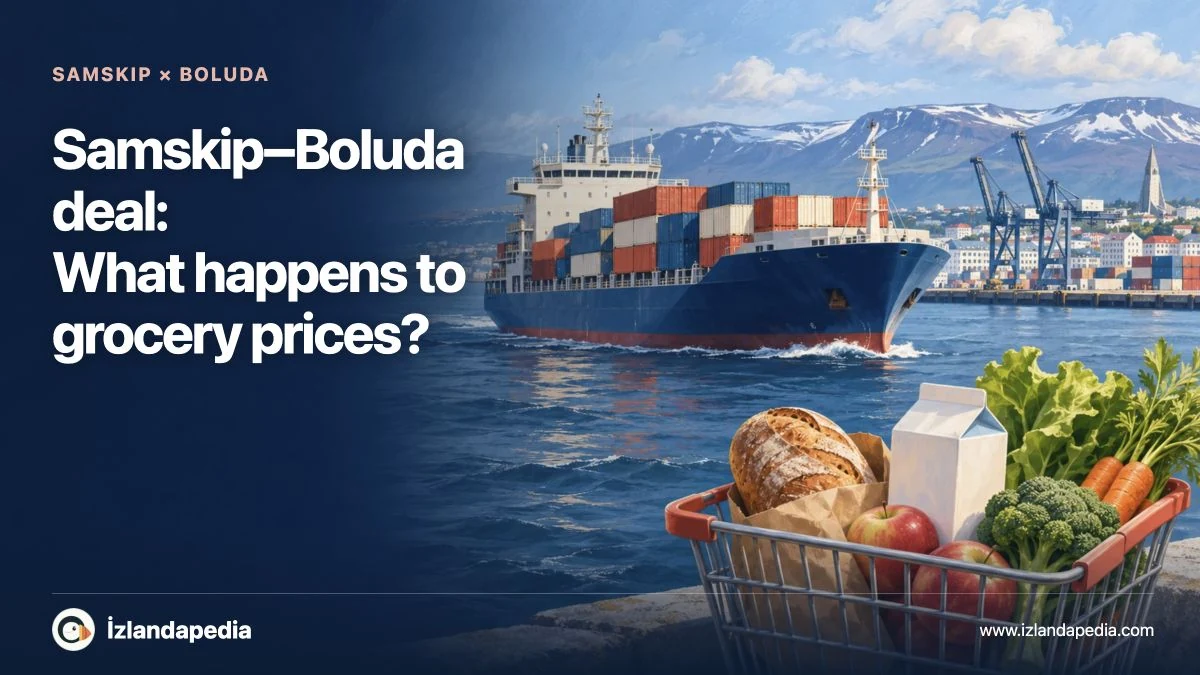
Samskip is an important carrier bringing goods to Iceland from abroad. Spain’s Boluda has signed an agreement to buy the whole company. How could that change what we pay at the supermarket? [1]
There are three possibilities: prices could fall, stay the same or rise. A change of ownership does not determine the outcome by itself. Total transport costs, competition between carriers and the pricing decisions of importers and supermarkets all matter. These are possible outcomes, not a price forecast.
RÚV revisited Samskip’s ownership history on the morning of 9 November. We looked at the proposed buyer and what the deal could mean for everyday spending. [4]
When would the sale be completed?
The agreement was announced on 28 October 2026. The companies expect the sale to be completed on 1 January 2027. They still need the required official approvals and must meet the agreement’s conditions. Until then, they will operate separately. [1]
The purchase price has not been made public. Samskip says its main owners, Ólafur Ólafsson and Ingibjörg Kristjánsdóttir, will leave the ownership group. Ólafur Orri Ólafsson will stay as CEO. [3]
Who is Boluda, and what does it do?
Boluda is a Spanish family-owned group working in shipping and port services. It traces its history to Naviera Fos, founded in 1837. Its tugboat business in Valencia began in 1920. [2]
There are two main divisions. Boluda Towage operates tugboats that help large ships enter and leave ports. Boluda Shipping carries goods and provides services for handling, storing and moving them through ports. Boluda Shipping is the proposed buyer of Samskip. [2]
The companies plan a combined network of 32 ships and 18 routes, reaching markets in 28 countries. These figures cover the international network, not Iceland alone. [1]
Would a new owner mean more competition?
Changing a company’s owner is not the same as adding a new carrier. Samskip would continue operating under a different group. The sale alone therefore does not show that customers have more competing companies to choose from.
Boluda could invest, open new routes or fill ships more efficiently. That could reduce the cost of moving a shipment. If Samskip offers better prices, other carriers may also review their charges to keep customers.
But if a customer cannot find another company to do the same job, bargaining over the price is harder. The practical question is: how many separate, independent companies can offer to bring the same goods to Iceland?
What does the OECD say about Iceland?
The OECD, the Organisation for Economic Co-operation and Development, points to the strength of two large freight companies in its 2025 Iceland report. One obstacle for new competitors is getting access to the port space and services they need. [9]
The report discusses long leases at Reykjavík’s Sundahöfn port. It recommends making port facilities easier for new companies to access. These findings are specifically about Iceland. [9]
Buying a ship is therefore not enough. A new carrier needs somewhere to dock, services to load and unload cargo, and a way to move it onwards. New competitors must be able to obtain those services if they are to operate.
What was Samskip’s earlier competition case?
In 2023, Iceland’s Competition Authority fined Samskip 4.2 billion ISK for unlawful agreements with its rival Eimskip. Eimskip had settled its part of the case in 2021 and admitted infringements. [5]
In March 2025, the appeals committee upheld important findings of wrongdoing but reduced Samskip’s total fine to 2.4 billion ISK. Samskip denies the allegations. [6][7]
RÚV reported on 29 October 2026 that litigation was continuing. The Competition Authority is also asking the courts to restore the 4.2 billion ISK fine. The original amount should therefore not be described as the final court outcome. This earlier case and Boluda’s purchase agreement are separate matters. [8]
Three possibilities for grocery prices
Prices could fall: Boluda’s investment and sailing plans could make each shipment cheaper. That could reduce the importer’s costs. If importers and supermarkets pass on the saving, and other costs do not rise, the shelf price could fall.
Prices could stay the same: Transport charges might not change. Even if they fall, businesses might keep the saving as profit. Or cheaper transport might merely offset higher exchange-rate, energy, tax or production costs. Shoppers might then see no change on their receipts.
Prices could rise: Higher transport charges or extra fuel and port fees could make imports more expensive. If importers and supermarkets add those costs to their selling prices, shoppers pay more. Weaker competition could also make cheaper alternatives harder to find. However, a change of ownership alone does not prove that competition has weakened.
Think of a packet of imported pasta. Its price covers production, shipping, port services, storage, distribution, taxes and profit. A fall in one cost does not guarantee a fall in the total. Equally, not every price increase could be attributed to this sale.
The journey of a price
- Producer
- Freight + port
- Importer + distribution
- Supermarket
- Shopping basket
How much can a transport price change affect the product?
Imagine a product costing 100 units, including 10 for transport. If transport gets 20% cheaper, that cost falls from 10 to 8. With all other costs unchanged and the entire saving passed on, the product price falls to 98.
If transport gets 20% more expensive, that cost rises from 10 to 12. Under the same assumptions, the product price rises to 102. If transport charges do not change, or none of the change reaches shoppers, the price in this example stays at 100.
In the tool below, a negative number means cheaper transport and a positive number means more expensive transport. The 10% transport share is illustrative, not a measured figure for a real product. All other costs are assumed unchanged.
What if transport gets cheaper or more expensive?
An illustrative calculation. Minus means a fall; plus means a rise. All other costs are assumed unchanged. Real products have different transport shares.
How can we tell what happens to prices?
First, check whether the sale is completed and which official approvals are given. Then compare the total cost of carrying the same cargo to the same destination, including both the main charge and extra fuel or port fees.
Small importers must also be able to get quotes from other companies. Then follow the prices of the same supermarket products. If moving the goods costs less, does that saving appear on the shopping receipt?
The sources we reviewed do not establish the direction or size of any grocery price change caused by this sale. There is not enough evidence to give a discount, an increase, a date or a ranking of the three possibilities.
The question for shoppers: How will the basket be affected?
Boluda’s investment could improve transport services. The result at the supermarket will depend on transport charges, competition, exchange rates and other costs, as well as companies’ profit decisions.
Company size alone cannot answer the question. Transport charges and the shelf prices of the same products need to be tracked, and the reasons for any fall, unchanged price or rise examined. Even completing the sale would not by itself mean cheaper or more expensive groceries.
Sources and method
Sources checked on 9 November 2026. Company plans and our explanation of possible price effects are clearly separated. No new interviews were conducted or questions sent to authorities.
- Samskip · Acquisition agreement · 28 October 2026
- Boluda · Corporate structure and history
- Samskip · Price disclosure, management and network · 28 October 2026
- RÚV · Ownership history · 9 November 2026, 07:01
- Competition Authority · 2023 infringement decision
- Competition Authority · Appeals committee findings · 19 March 2025
- Samskip · Response to appeal decision · 19 March 2025
- RÚV · CEO interview · 29 October 2026
- OECD · Economic Surveys: Iceland 2025 · Water and land transport