
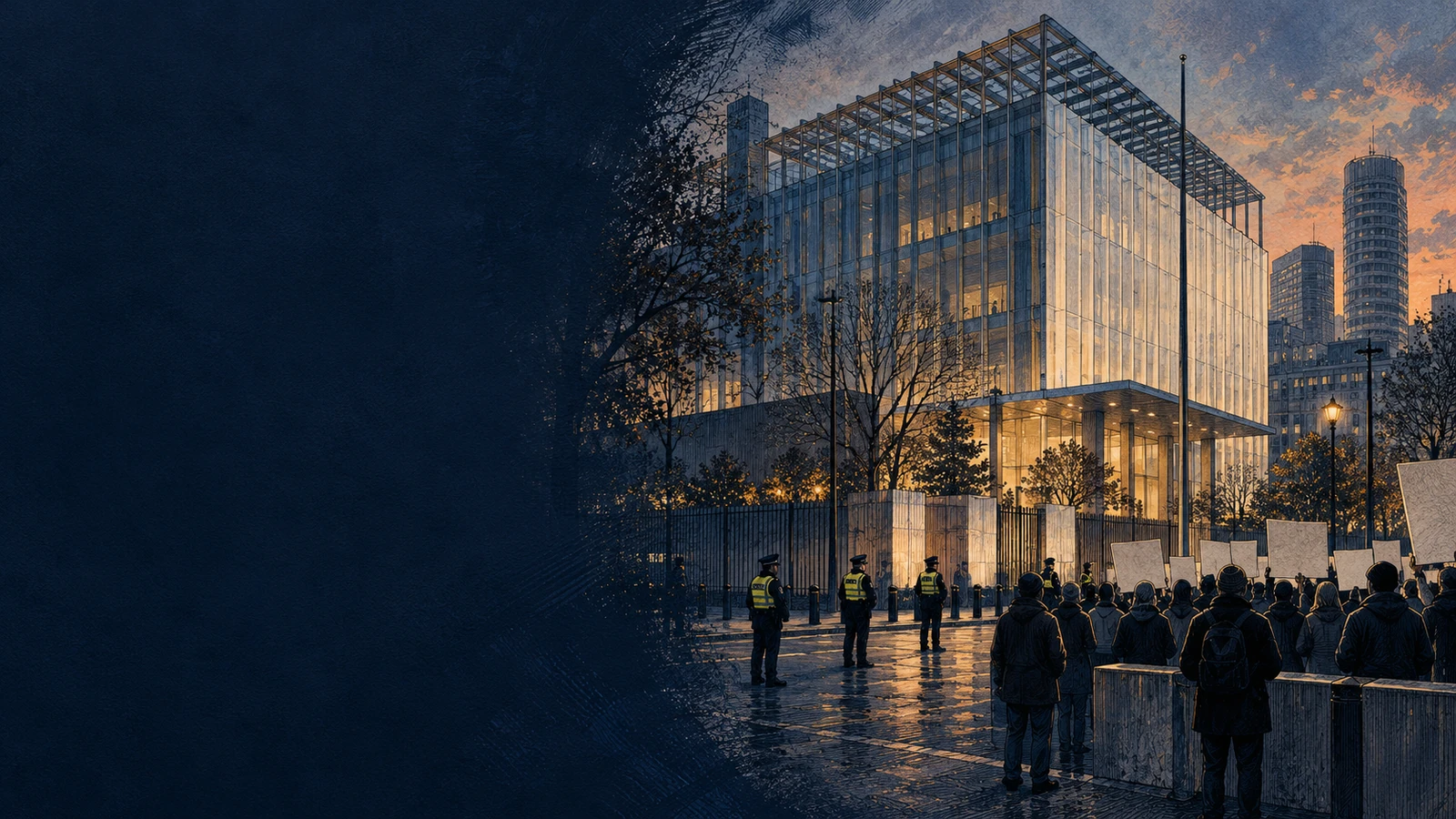
London’s Metropolitan Police said 325 people were arrested at a demonstration supporting Palestine Action outside the US embassy. In an update issued on Sunday, 1 November, police said 320 of the arrests concerned suspected expressions of support for a proscribed organisation under the Terrorism Act. The Met’s statement.
The demonstration took place outside the US Embassy in Nine Elms, southwest London, on Saturday 31 October. ITV’s report of 1 November.
AP reported an initial police arrest total of 139 on Saturday. The Metropolitan Police’s Sunday update raised the total to 325. AP’s 31 October report.
The police position and the scope of the ban
Police had warned participants of possible arrest the day before the demonstration. Commander Adam Slonecki, who led the operation, said enforcement could extend beyond placard-holders to people playing a key organising role or providing logistical support. The Met defended its approach as responding to conduct it considered criminal, rather than preventing people from expressing their views. The Met’s 30 October notice.
Palestine Action appears on the UK authorities’ list of proscribed terrorist organisations. The Home Office cites serious property damage in the group’s actions targeting companies connected to the defence industry among its reasons for the ban. The Home Office list.
The decision was announced in June 2025; the implementing measure came into force at 00:01 on 5 July 2025. The official ProtectUK record says it criminalises membership, inviting support, or expressing support while being reckless as to whether others will be encouraged to support the group. ProtectUK’s record.
The ban remains in force as litigation continues
The courts are still considering whether the ban is lawful. The High Court found it unlawful in February; the Court of Appeal reversed that decision on 15 June. Co-founder Huda Ammori’s appeal to the UK Supreme Court is listed for a hearing on 4–5 November 2026. A hearing date does not establish when judgment will be delivered. The Supreme Court case record.
What organisers and rights groups say
The protest organiser, Defend Our Juries, described the arrests as punishment for peaceful protest. LBC’s report.
In its ongoing campaign, Amnesty International UK criticises the use of counter-terrorism powers against peaceful protesters. It is urging prosecutors to end the resulting prosecutions, framing its objections around freedom of expression and peaceful assembly. Amnesty International UK’s position.
Liberty, which intervened in the case, says the ban can leave people uncertain about which statements might be criminal and discourage them from protesting. Its assessment dated 15 June calls for clearer limits on the definition of terrorism and the circumstances in which damage to property falls within it. Liberty’s assessment.
Arrest and conviction are different stages
Arrest, charge and conviction are distinct stages. The British government’s official guidance describes different possible steps after arrest, including charge, release and continuing investigation. The police figure of 325 is an arrest total; it does not establish the outcome of any individual case. Official custody guidance.
Sources and original documents
Sources are linked beside the relevant information. The documents and reports used are listed below.
- Metropolitan Police — 1 November arrest update (X)x.com
- ITV News / PA — 1 November 2026itv.com
- Associated Press — 31 October 2026apnews.com
- Metropolitan Police — 30 October operational noticenews.met.police.uk
- Home Office — current proscribed organisations listgov.uk
- ProtectUK — date the ban took effectprotectuk.police.uk
- UK Supreme Court — UKSC/2026/0099supremecourt.uk
- LBC / PA — organiser’s statement and demonstration reportlbc.co.uk
- Amnesty International UK — position on protesters’ prosecutionsamnesty.org.uk
- Liberty — assessment dated 15 June 2026libertyhumanrights.org.uk
- GOV.UK — process following arrestgov.uk