
CULTURE · CONSUMERS · LOCAL CRAFT
Icelandic sweater or made in China? The label matters when buying a lopapeysa
Icelandic wool, Icelandic design and hand-knitting in Iceland are different claims. A retailer’s own statement describes overseas production. Here is what the protected name “Íslensk lopapeysa” requires—and what shoppers should ask.
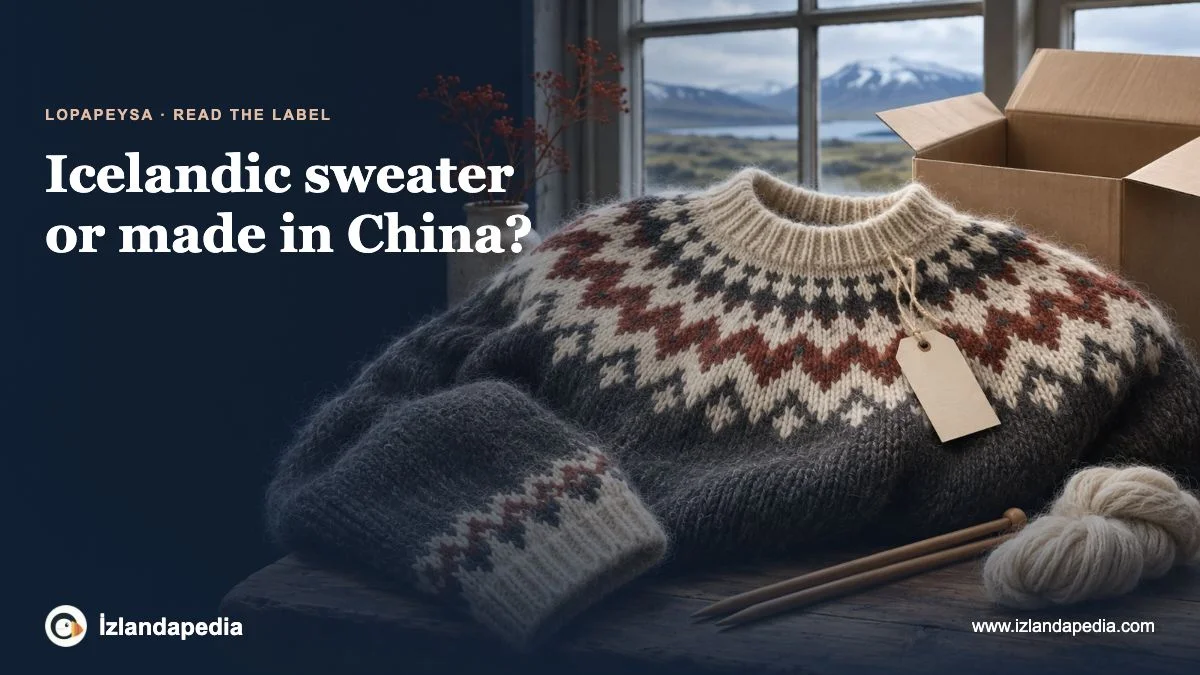
The pattern does not tell you where it was knitted
For visitors taking a wool sweater home from Reykjavík, the important question goes beyond the patterned shoulders: where and how was this garment knitted? Wool from Icelandic sheep can become a sweater overseas. Being designed in Iceland does not establish that it was hand-knitted here.
This distinction is documented by a retailer, not merely alleged online. Icewear’s German-language support page, marked as updated on 15 September 2022, says its online wool products are knitted in Latvia and China. The same statement says that some of its shops in Iceland also stock items hand-knitted in Iceland. The company’s entire range therefore cannot be treated as one production category: the individual garment’s information matters. [3]
What the protected name actually requires
The Icelandic Food and Veterinary Authority, Matvælastofnun, approved the Handknitting Association of Iceland’s application to protect “Íslensk lopapeysa / Icelandic Lopapeysa” as an origin-linked product name. Announcement 184/2020 was signed on 20 February 2020 and published on 5 March 2020. This is distinct from a shop’s branding or a statement about design alone. [1]
The specification covers new wool from Icelandic sheep, lopi yarn, a patterned circular yoke, hand-knitting in Iceland and circular construction without assembly seams. Both pullovers and open-front cardigans qualify. Protection is not an exclusive sales privilege for members of one association; compliance with the product specification is what matters. [2][4]
Overseas production is not, by itself, proof of deception
A sweater can genuinely contain Icelandic wool, have been designed in Iceland and have been knitted in China. Those facts can coexist. The consumer issue arises when the source of the fibre is confused with the source of the labour, leaving someone paying for local craftsmanship unable to identify what they are buying.
Icewear’s public statement documents overseas production. It does not measure the share of imported sweaters in Reykjavík shop windows today or establish how many garments carry misleading labels. Nor does it say that every item knitted abroad is machine-made. Claims that most sweaters are fake, or that every tourist chain deceives buyers, require current product-level evidence. Any assessment must connect a specific garment to the wording used to sell it. [3]
From fleece to sweater: where does the value arise?
Ístex says it washes and processes approximately 99% of Icelandic wool and that farmers own more than 80% of the company. It operates wool washing in Blönduós and yarn manufacturing in Mosfellsbær. This is a highly concentrated processing structure, but describing it without the farmers’ ownership would leave out an important part of the picture. [5]
The 2026 purchasing schedule lists first-class white autumn lambswool at ISK 613 per kilogram, H-1 autumn wool at ISK 438 and H-2 at ISK 116. These are Ístex purchasing rates for specified raw-wool categories, not the price of knitting yarn, labour or a finished garment. [6]
Comparing a kilogram of raw fleece directly with a sweater’s retail price does not reveal a retailer’s profit. Washing, sorting, preparing yarn, knitting, finishing and selling all add costs. However, when knitting takes place overseas, the income generated by that knitting does not go to a knitter working in Iceland. Asking where the work happened is therefore a meaningful way to support local craft.
An old sheep heritage, a more recent sweater tradition
The garment does not need a thousand-year history to have cultural value. The University of Iceland places its familiar form within the knitting and pattern traditions of the mid-20th century, drawing on older knitting techniques. The history of the sheep and the age of this particular garment are different things. [2][9]
Icelandic wool combines long, coarser outer fibres called tog with fine, insulating inner fibres called þel. That helps explain its texture and practical qualities. A slightly coarse feel, however, cannot establish where a sweater was knitted. Touch is no substitute for traceable production information. [7]
Ask for more than a familiar-looking label
Start with a direct question: was this particular sweater hand-knitted in Iceland? Ask where its wool came from, who made it and whether those details can be provided on a label or receipt. “Designed in Iceland” describes design; “handknitted in Iceland” makes a more specific claim about method and location. [10]
Check the protected-name criteria alongside the garment’s material and manufacturing information. A knitter’s name or an association’s label can help traceability, but authentic garments do not all have to carry the same association tag. Patterns and construction provide clues rather than proof of origin. An opening, zip or button band on a cardigan is not itself evidence of factory production. [2][4]
Where to start looking
The Handknitting Association of Iceland was founded in 1977 by a group consisting mainly of women seeking income through knitting. It says it sells sweaters made in Iceland from Icelandic wool by its members. It lists shops at Skólavörðustígur 19 and Borgartún 31 in Reykjavík. Check current opening hours and the particular garment’s details before visiting or buying. [8]
Independent knitters, cooperatives and second-hand stalls may also be options. Yet a small shop, a flea-market setting or a high price does not guarantee provenance. Ask the same questions wherever you shop. If the souvenir you want is local craftsmanship as well as a pattern, you should be able to understand which production story your money supports.
Five questions before buying
Quick answers
Does Icelandic wool mean made in Iceland?
No. The fibre can come from Iceland while the sweater is knitted overseas. Ask about production location separately.
Is seamless construction sufficient proof?
No. Material, knitting method and production location all matter.
Does every garment require the same association tag?
The protected name is governed by production requirements; one association’s sales tag is not a universal requirement.
Sources and documents
- 184/2020 · Stjórnartíðindi
- Háskóli Íslands · 20.07.2020
- Icewear · 15.09.2022
- Matvælastofnun · PDF
- Ístex
- Ístex · 2026 · PDF
- Textílmiðstöð Íslands
- Handprjónasamband Íslands
- Vísindavefur Háskóla Íslands
- Visit Iceland
Sources checked: 7 November 2026. General information about the rules, not a legal ruling on a particular garment.