Latest: a last-minute deal
At 15:59 on 8 October, just before the deadline for termination expired, the employers' confederation SA signed an agreement to extend the collective agreements with VR, the retail workers' federation LÍV and the craft unions' alliance Fagfélögin. The agreements were therefore not terminated.1314
The day before, things looked very different: on the evening of 7 October, VR's board voted unanimously to terminate the agreements. VR chair Halla Gunnarsdóttir said SA had not moved "one little inch" towards the unions.15
The turning point came on the afternoon of 8 October. Gunnarsdóttir met Prime Minister Kristrún Frostadóttir and came away with an offer of extra mortgage interest support (in Icelandic, vaxtabótaauki). She then went to SA's offices with representatives of LÍV and Fagfélögin, where talks continued up to the last minute.13
According to Gunnarsdóttir, two things were decisive: the prime minister's approval of special interest support that will benefit the groups that have lost pay the most, and agreement on new safeguard clauses so that those groups do not end up in the same situation next year.14
The other large unions had already made their decision on the evening of 6 October: Starfsgreinasamband (SGS), Efling, Samiðn and Byggiðn extended their agreements with SA to the end of 2027. The government is backing the extension with a package of measures: increases in public fees that feed directly into inflation will be capped at 2.5% in 2027, and if annual inflation is above 4% at the end of October 2027, indebted households will receive one-off interest payments totalling ISK 2 billion in early 2028 (ISK 3 billion if inflation is above 5%). Bills are also planned to raise child benefits and to ban monthly rent indexation.16
The details of the deal with VR, LÍV and Fagfélögin, such as the content of the new clauses and the size of the interest support, have not yet been published. We will update this article as they become available.
5 October: a full mandate for the board
On the evening of 5 October, VR's council of trustees gave the board a full mandate to terminate the collective agreements on Thursday, unless something else happens in the meantime. VR chair Halla Gunnarsdóttir told RÚV after what she described as a well-attended and forceful meeting.12
She said the ball is in SA's court. VR's demands are aimed above all at ensuring that large groups of members do not go through further pay cuts after two years of them. "We cannot accept another year and a half of pay cuts," she said.12
SA's managing director Bjarni Benediktsson told RÚV that keeping the current agreements is the wisest course and that there is no room for further cost increases. He noted that the government plans more than 20 billion krónur in tax increases on businesses and said the outlook for companies is "simply not all that bright". SA's board meets again on 6 October, and he said SA has not closed the door on further talks before the deadline.12
How did it start?
At 17:30 on 5 October, VR's council of trustees and board met. The board, which is also the negotiating committee, may decide to terminate the collective agreement if SA does not give a satisfactory answer.1
The deadline for termination is Thursday 8 October at 16:00.3 The same evening, Fagfélögin, an alliance of craft and trade unions representing about 7,000 members, also met to discuss a mandate to terminate.11
Why now?
In March 2024, Icelandic unions and employers signed a four-year deal known as the "stability and welfare agreement". It runs from February 2024 to January 2028 and was designed to bring down inflation and interest rates.5
It included a safeguard: if 12-month inflation in August 2026 exceeded 4.7%, either side could terminate. (The agreement would have held if annualised six-month inflation from March to August had been 4.4% or lower.)5
What do the two sides say?
VR: "SA has delivered absolutely nothing"
According to VR chair Halla Gunnarsdóttir, a large share of members have seen real pay cuts for two years: agreed increases stayed below inflation and the burden on families with children grew. On 24 September VR submitted a new proposal to keep the agreement alive, with conditional clauses that would kick in if pay erosion continued. She says SA has not replied in 11 days.1
"SA has delivered absolutely nothing."
Halla Gunnarsdóttir, chair of VR
She says municipalities, the government and many employers have shown a will to keep the agreements.1
SA: "We have stood by the agreements"
In a statement today, the employers' confederation SA rejected accusations of breaking faith. SA wants the agreements to continue, but says high interest rates leave no room for extra wage increases. It argues that joint analyses show purchasing power has risen, and urges the government to avoid tax and fee increases.6 In a Gallup survey for SA and the Central Bank, 34% of firms expect to cut staff in the next six months.8
Efling: "Terminating now is not wise"
Sólveig Anna Jónsdóttir, chair of Efling, the union for many hotel, cleaning and service workers in the capital area, does not favour termination. She says Efling members would lose the 4.99% pay rise due in January.9 Her proposal: keep the agreements, but let them lapse automatically if inflation has not fallen to 3.5% by autumn 2027.10 Efling also keeps the option to terminate by 8 October if needed.
What does it mean?
Until 8 October, there were three possible paths. The outcome was the third: a last-minute compromise.
- Termination. The agreement ends and the parties return to the table. The "peace obligation" that comes with the agreement disappears, which makes strikes or lockouts possible later. But strikes do not start overnight: members must vote and notice must be given. According to Sólveig Anna Jónsdóttir, termination also puts January's planned pay rises in doubt.9
- The agreement continues. This is SA's preference. Planned January pay rises would go ahead; SA puts them at between 3.5% and 5%.7 But the unions' complaint about eroding pay would remain unresolved.
- A last-minute compromise. As VR and Efling propose, the agreement continues but a new condition is added that reopens it if inflation does not fall.110
The bigger picture: in Iceland, wages, interest rates and prices are tightly linked. The 2024 agreement was meant to break that chain. Termination could mean a new period of uncertainty in the fight against inflation; keeping the agreement could prolong the loss of purchasing power.
If you work in Iceland
- Your agreement continues. The agreements were not terminated; the current rules still apply and strikes are not on the table. January's planned pay rises stay in place.
- Which union are you in? Most shop and office workers belong to VR; hotel, cleaning and restaurant workers in the capital area are mostly in Efling. Electricians, construction and kitchen trades belong to unions within Fagfélögin. Your payslip shows which union your dues go to.
- Follow the details. The details of the new clauses and the interest support are still to be published. Your union's website and emails are the most reliable sources.
Sources and context
Most sources are in Icelandic; quotes are translated. This article was last updated on 8 October 2026.
- VR – Three days until termination of agreements (5 October 2026, in Icelandic)
- Vísir – Decision tonight on terminating agreements (5 October 2026, in Icelandic)
- Daily Northern – VR weighs terminating collective agreement (5 October 2026)
- Vísir – Inflation at 5.6%: the agreement condition is broken (27 August 2026, in Icelandic)
- SA – What are the agreements' conditions? (February 2026, in Icelandic)
- SA – Statement "Að gefnu tilefni" (5 October 2026, in Icelandic)
- SA – A broken condition calls for reform, not extra cost (22 September 2026, in Icelandic)
- SA / Central Bank – Gallup company survey (September 2026, in Icelandic)
- Útvarp Saga – Sólveig Anna: termination not wise now (2 October 2026, in Icelandic)
- Útvarp Saga – Efling's 3.5% inflation proposal (3 October 2026, in Icelandic)
- RSÍ – Fagfélögin seek a mandate to terminate (2 October 2026, in Icelandic)
- mbl.is – VR board given full mandate to terminate (5 October 2026, 19:31, in Icelandic)
- mbl.is – Agreement reached (8 October 2026, 16:03, in Icelandic)
- mbl.is – The prime minister's offer was key (8 October 2026, 16:28, in Icelandic)
- Vísir – SA has not moved "one little inch" (8 October 2026, in Icelandic)
- Vísir – Agreements extended to the end of next year (6 October 2026, in Icelandic)
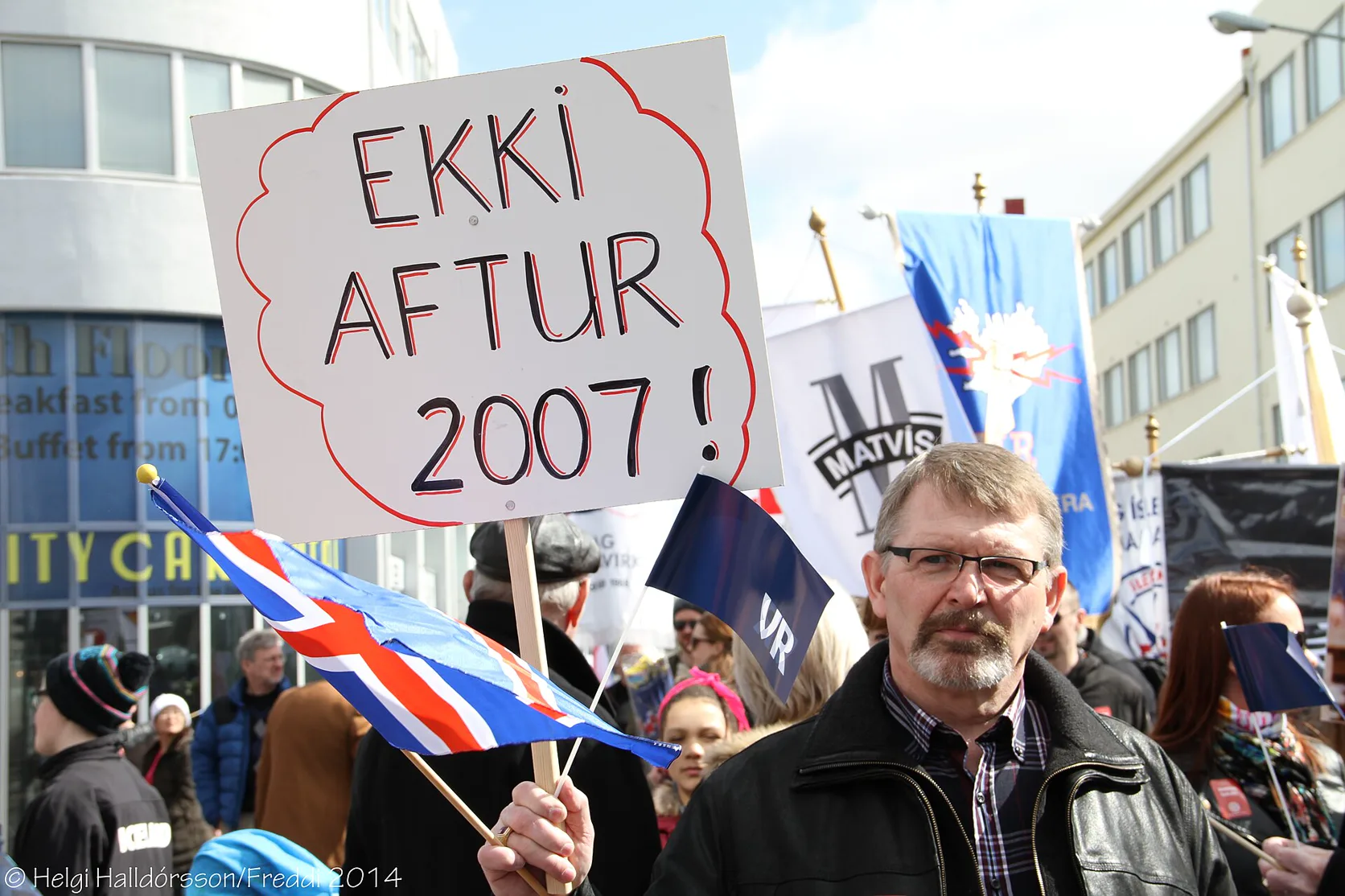
- Cover photo: Helgi Halldórsson, Wikimedia Commons, CC BY 2.0
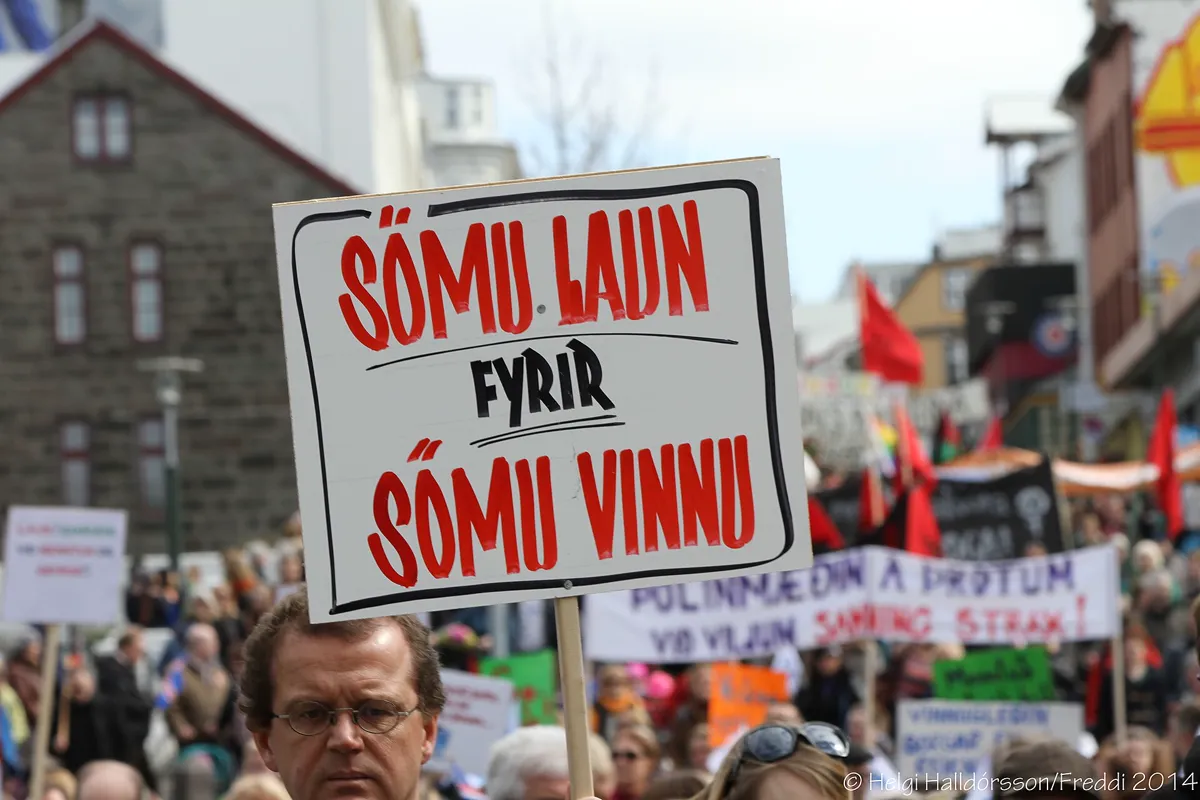
- Second photo: Helgi Halldórsson, Wikimedia Commons, CC BY 2.0
First published on 5 October 2026. Send a comment or request a correction.
İzlandapedia: independent guides, language learning and news.