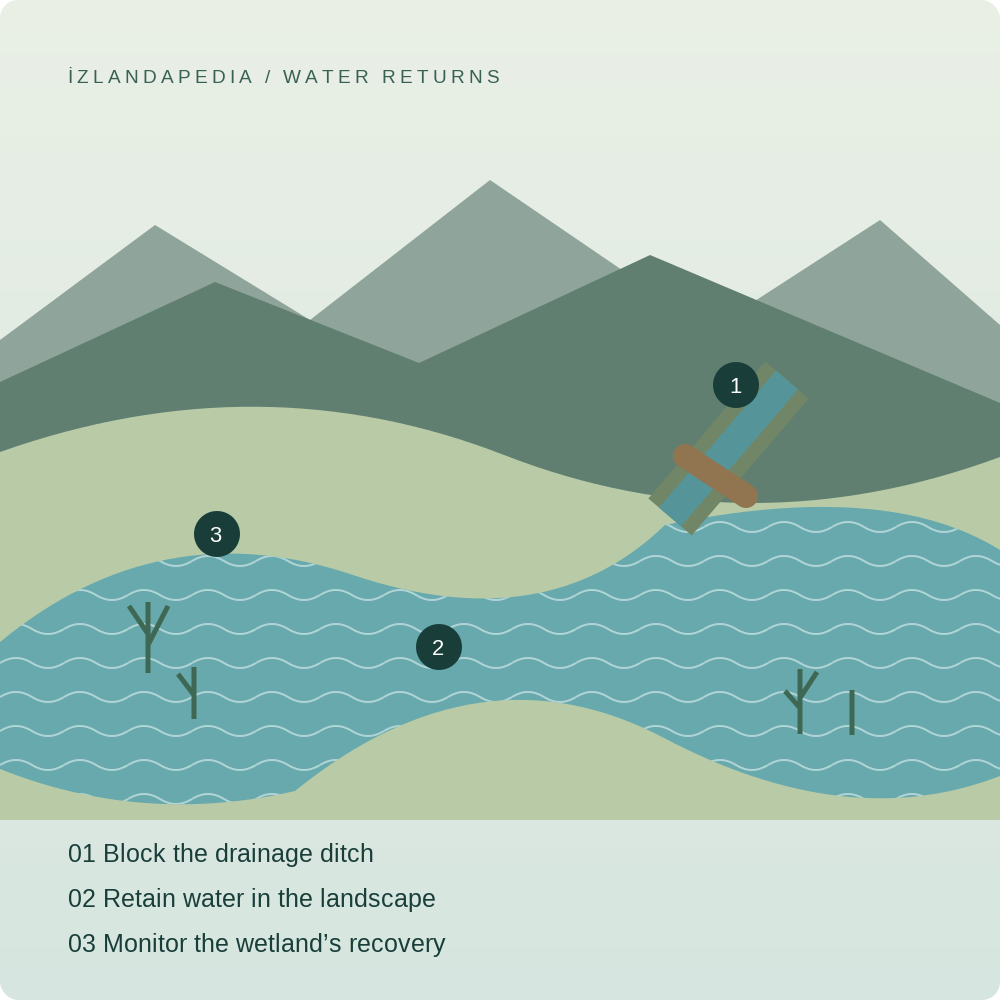
For readers familiar with stories of wetlands being drained in Türkiye, news from Ölfus in southern Iceland offers a different direction. At the state-owned property of Sogn, work has begun to block drainage ditches and help wetland habitat recover. 1
The hopeful element is the willingness to revisit an earlier intervention and repair its effects. Recognising damage to natural systems can be a starting point for taking responsibility for their recovery.
An autumn programme begins at Sogn
According to Land and Forest Iceland’s announcement on 2 October, this autumn’s programme covers 225 hectares across five state-owned properties. Around 23 kilometres of drainage ditches are to be filled. The agency compares the area with roughly 315 football pitches. These are announced targets, not an account of completed restoration. 1
At Sogn itself, the plan is to restore about 25 hectares and block more than four kilometres of ditches. The work forms part of a five-year partnership to protect and restore ecosystems on state-owned land, supporting climate and biodiversity policy. 1
Why keep water in the landscape?
Wetlands provide habitat for wildlife, help filter pollution and store carbon, according to the United Nations Environment Programme. Draining them can therefore change much more than the appearance of a landscape. 2
Water levels are especially important in peatlands, where organic material accumulates in the soil. FAO explains that rewetting drained peatlands raises the water level, helps stop carbon loss and can support new carbon storage. Not every wetland is a peatland, and outcomes differ between sites. 3
Türkiye: a history of drainage and restoration
Türkiye’s Fourth Agriculture and Forestry Council working document on wildlife and biodiversity estimates that about 200,000 hectares of wetlands were drained in works carried out particularly between 1950 and 1990. This is a historical estimate, not a total for all wetland losses today. 4
The same document records restoration efforts. It reports that the previously drained Lake Avlan was enabled to retain water again, and that rehabilitation work was undertaken at Konya Akgöl, Ereğli reed beds and other sites. These historical examples do not establish present-day water levels or show that every problem has been resolved. 4
Learning from damage, making room for recovery
The new Icelandic programme and Türkiye’s earlier projects took place under different conditions. Their common thread is the effort to restore water’s place in ecosystems after interventions that removed it.
Work beginning at Ölfus is a concrete step. Its success will need to be judged over time through changes in water, soil and habitat. Keeping announced targets separate from measured results helps readers understand what has actually been achieved.
Restoration cannot erase the history of loss. It does show that repeating past mistakes is not the only option. Efforts in both countries to repair damaged wetlands offer a welcome reminder of the value of protecting nature—and taking responsibility when it has been harmed.
Sources
Sources checked: 7 October 2026. Iceland announcement: 2 October 2026.
İzlandapedia · Source-based news and guides to life in Iceland.
Send feedback or suggest a correction