
This article was corrected on 10 and 18 November 2026; the original publication date is retained.
Draft 93% increase in Iceland’s residence-permit income requirement: the “unemployment-benefit” paradox for foreign workers
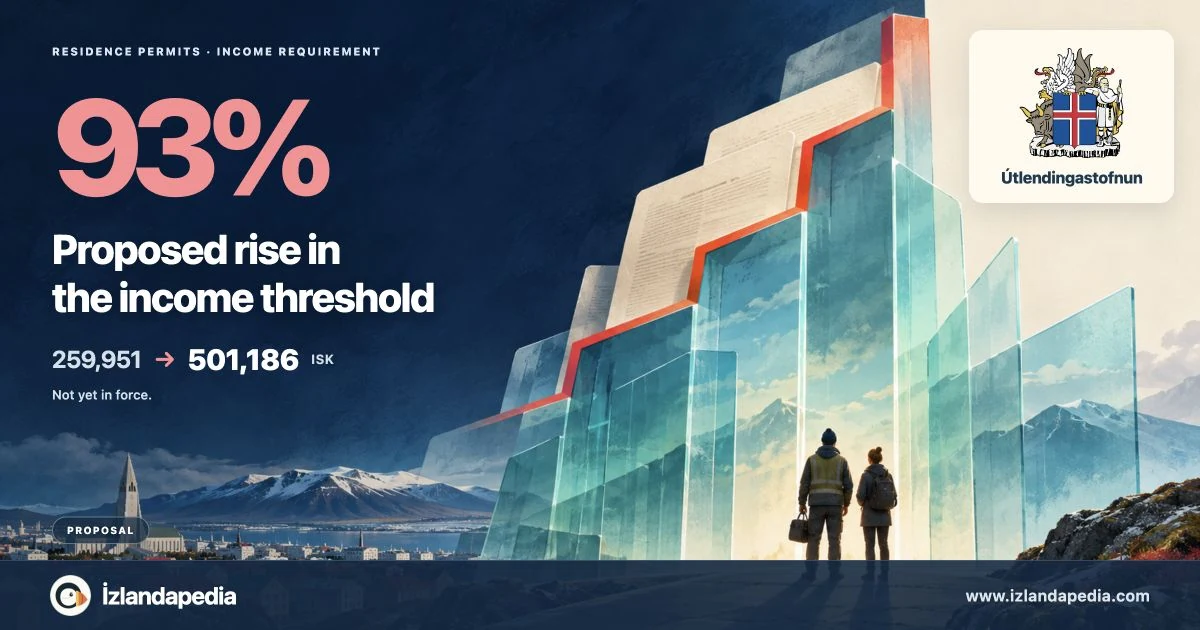
Iceland’s Ministry of Justice (Dómsmálaráðuneytið) has opened a consultation on draft regulations that would almost double the minimum means-of-support requirement (framfærsluviðmið) for residence-permit and citizenship applications. Raising the monthly requirement for one person to ISK 501,186 would leave the state’s basic unemployment benefit below the required threshold, putting foreign workers in a serious legal predicament.
The draft regulations, published by the Ministry of Justice through the consultation portal Samráðsgátt, would fundamentally change the financial criteria for foreign nationals living in Iceland or planning to move there. Until now, the ministry has used Reykjavík City’s basic financial assistance level (fjárhagsaðstoð); under the new arrangement, the base amount is the average of three existing benchmarks: the housing-benefit income threshold, the full disability pension including the household supplement, and the child-benefit reduction threshold for a single parent. It is not indexed to the collectively agreed minimum wage.
The new income-requirement table: who would have to show how much?
If the draft takes effect, the minimum amounts that applicants or families would have to document each month would change as follows:
On a phone, swipe within the table to view all columns.
| Application category | Current requirement (ISK) | Draft requirement (ISK) | Increase |
|---|---|---|---|
| One person (individual) | ISK 259,951 | ISK 501,186 | +93% |
| Couples without children (married / cohabiting) | ISK 415,922 | ISK 801,897 | +93% |
| Single parent with two children | ISK 259,951 | ISK 801,897 | +208% |
| Students and doctoral candidates | ISK 259,951 | ISK 375,890 | +45% |
| Additional amount for each child | No existing addition | +30% of the basic threshold (about ISK 150,356 if the illustrative base is ISK 501,186; not a fixed amount) | New criterion |
Important legal detail — pending applications: the proposal is still a draft and has not entered into force. According to the ministry’s draft, however, the regulation would enter into force on 1 January 2027 (Article 19), covering not only new applications but also all applications already being processed by the Directorate of Immigration (Útlendingastofnun) that have not yet been decided.
Are these amounts before or after tax? The gross–net distinction
One of applicants’ main questions is whether the announced amounts are net or gross. Under the Directorate of Immigration’s criteria, these are pre-tax amounts: the requirement concerns gross income (fyrir skatta / heildarlaun). The following distinction nevertheless applies according to the type of application:
1. Employees: a gross salary of at least ISK 501,186 for one person, shown in the employment contract and recent payslips (launaseðill), would suffice. Útlendingastofnun looks at gross earnings rather than take-home pay, while checking directly against Iceland Revenue and Customs (Skatturinn) records that income tax (staðgreiðsla) has been paid regularly on that amount.
2. Students showing a bank balance: where students declare savings instead of payslips, there is no tax deduction from that balance. The monthly requirement of ISK 375,890 — a total of ISK 4,510,680 for a one-year residence permit — must therefore be held as a net, available balance in the account.
The legal predicament: could people receiving unemployment benefit lose their residence permits?
The aspect of the new draft most strongly criticised by unions — ASÍ and Efling — and lawyers is the gap between the state’s own basic unemployment benefit (grunnatvinnuleysisbætur) and the new means-of-support requirement.
In 2026, full basic unemployment benefit in Iceland is ISK 383,870 before tax. The draft, however, requires ISK 501,186 for one person’s support. In other words, an immigrant who loses their job and falls back on basic unemployment benefit would have an income ISK 117,316 below the ministry’s threshold.
This pushes foreign workers into a seemingly inescapable “residence-permit–unemployment-benefit paradox”:
1. It can help only during the first three months
A worker who loses their job can receive income-related unemployment benefit (tekjutengdar atvinnuleysisbætur) at 70% of their previous salary, up to a ceiling of ISK 605,159, for the first three months. If the person’s previous gross salary was approximately ISK 716,000 or more, they may exceed the ISK 501,186 threshold during those three months. But once they fall back to basic unemployment benefit of ISK 383,870 after the third month, they automatically cease to meet the income requirement unless they have cash savings in the bank to cover the difference.
2. The “no permit, no right to stay; no right to stay, no benefit” cycle
For foreign workers who are unemployed or dismissed around the time their residence permit must be renewed, the process operates in two different ways:
* Family reunification, permanent residence and citizenship applications: if a person with a residence permit carrying no employment restrictions is receiving basic unemployment benefit of ISK 383,870 at renewal, the new draft would deem them unable to support themselves, and their residence permit would not be renewed. Once the permit is revoked, the person loses their lawful domicile in Iceland (lögheimili). Under the rules of the Directorate of Labour (Vinnumálastofnun), two absolute conditions for receiving unemployment benefit are lawful domicile in Iceland and physical presence in the country. Thus, on the day a person loses their residence permit for failing the income requirement, they also lose, by law, the unemployment benefit they earned through years of contributions.
* Employment-based temporary permits — specialist and skilled workers: people arriving from outside the EEA/EU, for example Türkiye, on a permit tied directly to an employer already do not receive ordinary unemployment benefit when they become unemployed, despite monthly deductions from their wages for the Unemployment Insurance Fund (Atvinnuleysistryggingasjóður). If they cannot produce a new employment contract with a gross salary of at least ISK 501,186 within the short period allowed after dismissal, they lose both their residence permit and their right to remain in the country.
3. An administrative regulation undermining an acquired insurance entitlement
Legally, unemployment benefit is not an unconditional “social assistance” payment from a municipality. It is an acquired social-security and property entitlement financed by contributions deducted from the worker’s wages. By raising the means-of-support threshold to ISK 501,186 and treating the state’s official unemployment benefit of ISK 383,870 as insufficient income, the Ministry of Justice would, especially in periods of economic contraction and collective redundancies, effectively prevent foreign workers from using the insurance protection they have paid for.
Following public and trade-union submissions on the draft, it should become clearer in the coming days whether the Ministry of Justice will add an exception for people receiving unemployment benefit or for families with children.
This income threshold cannot be applied to people under international protection — refugee status (flóttamenn) or subsidiary protection (viðbótarvernd) — because both the 1951 Refugee Convention’s principle of non-refoulement and Iceland’s Foreign Nationals Act No. 80/2016 (Útlendingalög) directly prevent it.
For a refugee, however, there are three critical exceptions and boundaries where this new threshold of ISK 501,186, or ISK 801,897 for families with children, would come into play and affect them indirectly.
1. Exemption at residence-permit renewal: protection continues
If a person living in Iceland under refugee status or humanitarian/subsidiary protection loses their job and falls back on basic unemployment benefit of ISK 383,870, or even municipal financial assistance, the Directorate of Immigration cannot tell them: “Your income is below ISK 501,186, so I will not renew your permit and will deport you.” Because protection status is based on safety and the risk of persecution rather than economic sufficiency, refugees are exempt from this income requirement when renewing their own residence permits.
The first point of impact on refugees: family reunification after missing the deadline
Although refugees retain protection for their own permits, they can encounter the “deadline trap” in the Foreign Nationals Act when seeking to bring their spouse and children to Iceland through family reunification:
Exemption period: if a person granted refugee status applies for family reunification with their immediate family within the statutory period after receiving that status — generally three months — they are exempt from the income requirement.
A missed deadline or a family formed later: if the application is made after that legal window, or a new marriage takes place after refugee status has been granted, Útlendingastofnun starts requiring the refugee to meet this enormous new income threshold too: ISK 801,897 for a couple and ISK 1,102,609 for a family with two children. Such situations can cause distress and family tragedies.
The second point of impact on refugees: permanent residence and citizenship
When, after four years, a refugee seeks to convert their temporary protection permit to a permanent residence permit (ótímabundið dvalarleyfi), or applies for Icelandic citizenship (ríkisborgararéttur), the “protection exemption” ends.
At that stage, the state also expects the refugee not to have received municipal financial assistance in the recent period and to meet the new independent means-of-support requirement of ISK 501,186.
A refugee receiving basic unemployment benefit of ISK 383,870 therefore cannot be expelled and can continue receiving the benefit. But because their income falls below the new threshold, their path to permanent residence or citizenship is blocked, trapping them in a cycle of repeatedly renewing temporary permits.
Reading the political and legal picture behind the arrangement makes it clear that its principal targets are third-country nationals from outside the EEA/EU — the European Economic Area and European Union — and refugees.
EU/EEA citizens do not obtain residence permits from Útlendingastofnun under freedom of movement (frjáls för); they simply register with Registers Iceland (Þjóðskrá), and they are not subject to this high income threshold. In İzlandapedia’s assessment, the regulation will in practice work as a mechanism for filtering out third-country immigrants and hindering refugees from bringing their families or settling permanently.
In the editor’s assessment, the idea of extracting someone’s labour while it is useful and discarding them once it is not is, in a sense, an arrangement of slavery. It corresponds precisely to the criticism of “modern serfdom / labour shackled to the employer” (vistarband) voiced in parliamentary committees by Iceland’s largest workers’ union Efling, particularly under Sólveig Anna Jónsdóttir’s leadership, and by migrant-rights lawyers.
For centuries, Iceland’s historical vistarband system forced landless people to work for a landowner, prevented them from moving without the employer’s permission and excluded them from the system if they could no longer work. Today, the equation of “employment-based residence permit + ISK 501,186 income requirement” for non-EU immigrants reproduces that same mechanism under the guise of modern law.
From a lawyer’s perspective, three fundamental pillars demonstrate why this system creates a “use-and-discard and modern-slavery” arrangement.
1. Absolute dependence on the employer: being forced to endure workplace bullying and exploitation
A worker arriving from outside the EU, for example Türkiye, with a work permit cannot resign or speak out even if an employer mistreats them, withholds overtime pay or subjects them to psychological pressure. Leaving the job immediately ends their residence permit, and within a very short time they must find a new employer offering at least ISK 501,186 gross and begin the permit process from scratch. This high threshold and the bureaucratic obstacles take away the worker’s “freedom to change jobs”, effectively binding them to their existing employer.
2. “Pay your taxes and contributions, but stumble and you are out”: extortion without anything in return
In a modern state governed by the rule of law, taxation and insurance contributions form a reciprocal, or synallagmatic, contract: you pay into the state fund while working, and the state protects you when you become unemployed or ill.
The Icelandic system instead tells a non-EU immigrant: “Come while you are healthy and our economy is growing. Do the hardest jobs, and let us deduct approximately 31–37% in income tax and unemployment-insurance contributions from your wages. But if the sector enters a crisis and you are dismissed — as in October’s collective redundancies involving 281 people — we will keep the insurance contributions you have paid, deny you even ISK 383,870 in unemployment benefit and deport you because you cannot earn ISK 501,186.” In legal terms, a deduction taken without providing anything in return is not an insurance contribution but extortion.
3. A system importing “biological labour power”, not human beings
The additional income requirement of 30% of the basic threshold per child and the rise in the threshold for couples to ISK 801,897 show that the state sees the immigrant not as a human being with a family, children and social rights, but only as a temporary means of production whose physical and intellectual labour can be used. When that means of production breaks down through unemployment or illness, or seeks to establish a family and put down roots, it is deemed costly and thrown out of the system.
If challenged before Icelandic courts and ultimately the European Court of Human Rights, these draft regulations would be highly likely to be found clearly contrary both to fundamental provisions of Iceland’s Constitution (Stjórnarskrá lýðveldisins Íslands) and to the European Convention on Human Rights (ECHR), which Iceland has directly incorporated into domestic law.
From a lawyer’s perspective, the four concrete constitutional provisions and lines of higher-court case law that would lead to this regulation being struck down are as follows:
1. Violation of property rights: confiscating paid contributions — Constitution Article 72 and ECHR Protocol No. 1, Article 1
Under Icelandic Supreme Court (Hæstiréttur) and European Court of Human Rights case law — for example, Gaygusuz v. Austria — social-security and unemployment benefits financed by contributions deducted from a worker’s wages are not a favour from the state. They fall within the constitutionally protected right to property (eignarréttur).
The constitutional contradiction: the state’s compulsory collection of unemployment-insurance contributions (tryggingagjald) from a foreign worker, followed by deporting that worker when unemployed because the state’s own ISK 383,870 benefit is deemed insufficient for residence compared with the ISK 501,186 threshold, amounts to the administrative confiscation of a property right already paid for. It is directly contrary to Article 72 of the Constitution.
2. The right to social security and the administration contradicting itself — Constitution Article 76
Article 76 of Iceland’s Constitution provides that everyone’s right to assistance in sickness, disability, old age, unemployment and similar circumstances shall be guaranteed by law.
The constitutional contradiction: under the unity of public administration and the principle of proportionality (meðalhófsreglan, Administrative Procedures Act Article 12), it is arbitrary and disproportionate for one ministry — the Ministry of Social Affairs and Labour — to say that ISK 383,870 is the basic amount a person needs when unemployed while another — the Ministry of Justice — says that a person receiving less than ISK 501,186 cannot support themselves and must leave the country. Exercising a constitutionally recognised fundamental right to unemployment assistance cannot indirectly become a reason for deportation.
3. Respect for family life and a “disproportionate financial wall” — Constitution Article 71 and ECHR Article 8
Article 71 of the Constitution and ECHR Article 8 protect everyone’s right to respect for private and family life.
The constitutional contradiction: raising the threshold for a single parent with two children to ISK 801,897 — an increase of 208% — or to ISK 1,102,609 for a refugee or immigrant worker seeking to bring their spouse and two children creates an amount beyond the reach of an average worker in Iceland. Under European Court of Human Rights case law — including Biao and family-reunification cases against Denmark — states may impose an income requirement, but it cannot be so disproportionate and inaccessible that family reunification becomes practically impossible.
4. Equality and the prohibition of indirect discrimination — Constitution Article 65 and ECHR Article 14
Article 65 of the Constitution guarantees equality before the law and prohibits discrimination based on origin, national identity or status.
The constitutional contradiction: although the arrangement appears general on paper, it wholly exempts EU/EEA citizens while targeting non-EU, third-country nationals and refugees. By depriving one of two workers paying the same taxes and contributions of their rights when unemployed, it constitutes disproportionate discrimination based on national origin and status.
This news analysis provides general information, not individual legal advice. Assessments under the Constitution and ECHR are the Editor’s analysis, not findings presented as final court rulings.
OFFICIAL DOCUMENTSSources for the legal information box
Information checked on 5 November 2026. A draft is not the same as a regulation in force.