
CULTURE · MUSIC
Silenced voices at Harpa: How can music speak about silence?
On Sunday 8 November, KIMI brings Japanese poetry, language, memory and the silencing of Palestinian voices into one Reykjavík programme. Voice, accordion and percussion explore the distance between peaceful quiet and enforced silence.

A concert built around a question
We enter a concert hall expecting sound. What changes when silence becomes the subject? KIMI presents Þagnarómur — On Silence at Harpa’s Norðurljós hall on 8 November 2026 at 16:00. The programme combines music previously written for the ensemble with two new premieres. It offers several ways of approaching a word that can describe very different experiences. [1][2]
A pause in a poem, a gesture without speech and the suppression of a community’s story do not mean the same thing. Bringing these experiences together invites the audience to notice what surrounds a musical sound: the breath before it, the space after it, and the person whose voice may be missing.
Meet KIMI: Three performers, an unusual sound world
KIMI is a contemporary classical trio: singer Þórgunnur Anna Örnólfsdóttir, accordionist Jónas Ásgeirsson and percussionist Katerina Anagnostidou. Founded in Copenhagen in 2018, the group commissions new music for its distinctive combination of instruments and also arranges folk music from Iceland and Greece. [2]
For a first-time listener, the instruments offer useful points of reference. The voice brings breath and words; an accordion can sustain and reshape a sound; percussion can make texture as important as rhythm. Rather than searching only for a tune to remember, try following how a sound begins and what happens when it stops.
Japanese poetry, an Icelandic twist
New works by Guðmundur Steinn Gunnarsson and Aya Yoshida receive their premieres in this programme. KIMI describes their shared starting point as traditional Japanese poetry approached with an Icelandic twist. The public announcement does not name these works or identify the full set of poems. [1]
Understanding a word and hearing its shape are different experiences. An unfamiliar language can still communicate through breath, emphasis and the time between phrases. For listeners without specialist musical knowledge, this offers a simple way into the programme: pay attention to the relationship between the spoken or sung phrase and the space around it.
Udi Perlman: What lies beneath a quiet forest?
Tel Aviv–born, Berlin-based composer Udi Perlman lists the Harpa performance of Facing the Forests as its Icelandic premiere. Written for soprano, accordion and percussion, the approximately ten-minute work was first performed by KIMI in Athens on 1 November 2025. [3][4]
Its starting point is A. B. Yehoshua’s 1963 novella of the same name. A young forest watchman discovers the remains of a Palestinian village beneath the landscape he protects. Perlman explains that he concentrates on a change in perception rather than retelling the plot. His own text gathers Hebrew words associated with silence. The work’s movement from apparent tranquillity towards force asks the listener to consider silence as something that can be imposed. This account follows the composer’s programme note. [4]
Kolbeinn Bjarnason: Poetry, loss and hope
Icelandic composer Kolbeinn Bjarnason turned to composition in his fifties after a long career as a flautist. He also studied philosophy and literature. KIMI’s concert announcement connects his use of Refat Alareer’s poetry with the possibility that silenced voices can carry hope into the future. [1][5]
Bjarnason’s catalogue includes the 2025 work Kvöld sorgarinnar — Evening of Sadness for female voice, accordion and percussion. It draws on poetry by Alareer, Konstantinos Kavafis, Irina Ratushinskaya and Natasha S. The concert announcement does not specify which poem or section will be performed at Harpa. [5]
Jeppe Ernst: Watching becomes part of listening
The ensemble describes Danish composer Jeppe Ernst’s contribution through carefully shaped choreography and silent intensity. Movement can become part of the audience’s attention: a held position, the length of a gesture or the anticipation before an action. These are ways to approach the announced concept, rather than a reconstruction of a performance we have not seen. [1]
The evening should not automatically be understood as soothing background music. Its announced themes include memory, language and the suppression of voices. Some moments may invite calm; others may ask uncomfortable questions. There is no requirement to feel the same thing throughout. The contrast between different kinds of silence is itself a useful thread to follow.

Tickets, location and practical details
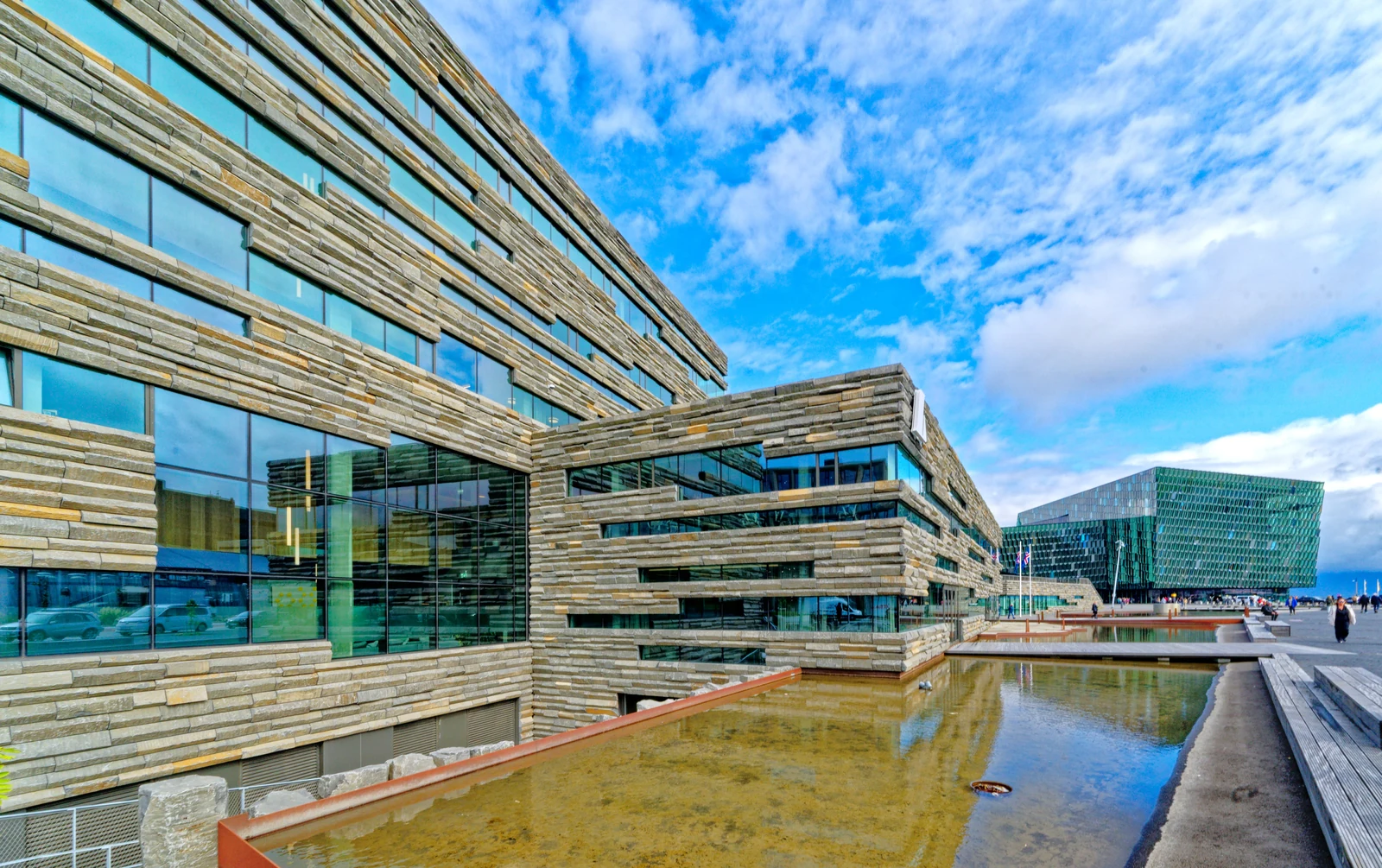
The concert begins at 16:00 on Sunday 8 November 2026 in Norðurljós at Harpa, Austurbakki 2, 101 Reykjavík. Tix advertises prices from ISK 2,500. Check the selected ticket for the final price and availability. Its listing gives approximately 70 minutes including a short interval; KIMI’s calendar shows 16:00–17:00, so we do not promise an exact finishing time. [1][2]
Allow time to enter the building and find the hall. Anyone needing step-free access, companion arrangements or other assistance should check current visitor information with Harpa before booking. Music using different languages does not automatically include surtitles or translations; the public sources do not confirm such a service.
Three questions to take into the hall
Is this silence a place to rest, or a space in which someone is prevented from speaking? What can a human voice communicate when I do not understand its words? After a work ends, do I remember a melody, a gesture or something that could not be said? These are our editorial listening prompts, not quotations from the artists.
The programme brings together artists approaching the same idea from different places. You do not need to solve every reference before attending. Paying attention to how people become audible, and how they are made inaudible, can itself be a meaningful way to spend a Sunday afternoon.