
Opinion / Culture
Anatolia’s enduring multiculturalism
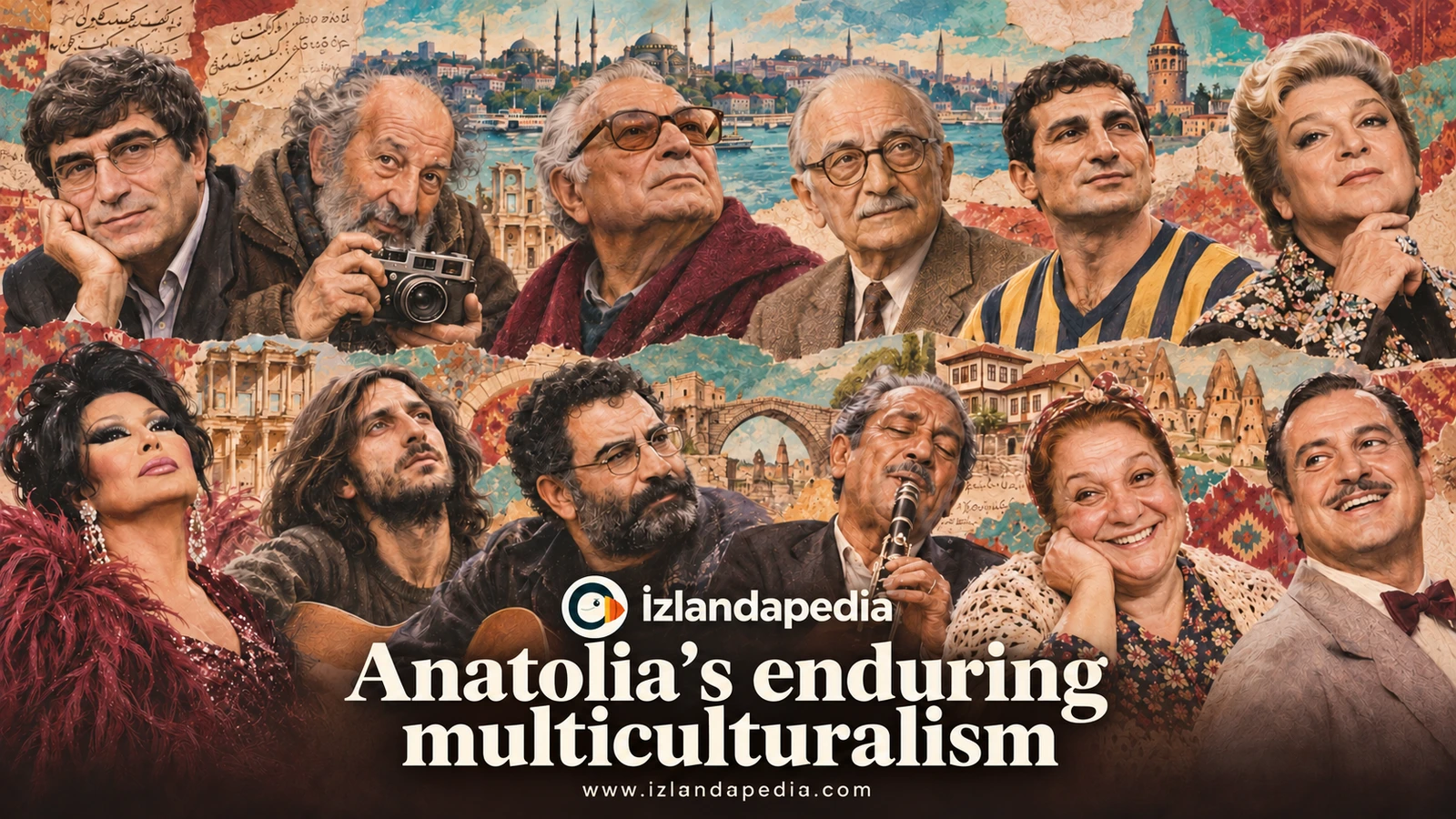
From population exchange and the Wealth Tax to the pogrom of 6–7 September and the Madımak massacre, the Republic’s first century contains profound ruptures that narrowed the space for different identities. Yet an Armenian linguist became a leading expert at the Turkish Language Association, a Greek footballer captained the national team, and a trans woman became Turkish classical music’s ‘Diva’. In this essay, I explore that enduring mosaic and the people who helped sustain it.
In this essay
A wounded but living mosaic
Multicultural life in Türkiye was not the product of a single official policy. Often it survived despite policies directed against it. Over a century, Armenians, Greeks, Jews, Kurds, Syriacs, Laz people, Alevis, Roma, Circassians and people who lived beyond prevailing gender conventions faced different pressures at different times. Many nevertheless continued to speak, write, sing and create.
This essay places two histories side by side: events that sought to erase identities, and people who maintained their attachment to Anatolia and Türkiye despite them. That strong sense of belonging was their common thread. Some went into exile; some could not even fulfil their wish to be buried where they were born. Their bond with the country was not easily broken.
A century of ruptures
I read the ruptures of different periods alongside one another. This history did not begin with the Republic: it followed earlier wounds, including the deportation and mass loss of Armenian lives in 1915. Under the 1923 population exchange, with specified exceptions, Greek Orthodox people in Türkiye and Muslims in Greece were forcibly displaced. From 1928, “Citizen, Speak Turkish!” campaigns put pressure on the public use of other languages. Jews in Thrace were attacked in 1934 and forced to leave the region. The Dersim military operations of 1937–38 remain contested today.
The Wealth Tax enacted in 1942 demanded many times more from a non-Muslim than from a Muslim doing the same work.[14]
On the night of 6–7 September 1955, thousands of properties in Istanbul, most belonging to Greeks, were attacked; churches and businesses were devastated. Historian Ayhan Aktar argues that non-Muslims’ faith in the Republic, especially that of the Greek community, was badly shaken by that night. Nine years later, in 1964, approximately 12,000 Greek passport holders were expelled. Including relatives who left with them, the exodus numbered tens of thousands. Istanbul’s Greek community shrank dramatically in the following years.
After the coup of 12 September 1980, Law No. 2932, enacted in 1983, severely restricted expression and publication through language, targeting the public use of Kurdish. It was repealed in 1991 under Turgut Özal, but pressure continued in practice for a long time. The same military administration also barred trans and travesti performers from the stage.[12]
On 2 July 1993, the Madımak Hotel in Sivas was set on fire while hosting intellectuals who had come for the Pir Sultan Abdal festival. Thirty-three intellectuals and artists, most of them Alevi, and two hotel workers died: 35 people in total. In 1999, Ahmet Kaya faced harsh and unjust hostility at an awards ceremony after saying he would record a Kurdish song. On 19 January 2007, Hrant Dink, editor-in-chief of Agos, was shot dead outside his newspaper’s office.[13]
Yet at every link in that chain, there were also people who brought light despite the darkness.
Voices within the state and parliament
One of the most striking examples of multiculturalism stands at the very centre of the language reform. Armenian linguist Agop Dilaçar was born Hagop Martayan in Istanbul in 1895. He spoke Armenian, English, Greek, Spanish, French and Russian. Atatürk gave him the surname Dilaçar, and in 1934 he was appointed chief expert at the Turkish Language Association. He worked there until his death in 1979; his contribution belongs to the history of Turkish itself.[1]
In the same year, under the Surname Law, Atatürk also gave the surname Türker to Berç Keresteciyan, an Ottoman Bank executive of Armenian origin. Berç Keresteciyan Türker served in parliament as an independent deputy for Afyonkarahisar from 1935 to 1946. His seat should not be described as a legally reserved non-Muslim quota seat.[4]
Turkish diplomacy produced its own heroes. In 1944, on Rhodes under German occupation, Turkish consul Selahattin Ülkümen challenged the deportation of Jewish Turkish citizens and saved 42 Jews from being sent to Auschwitz. That is 42 people, not 42 families. Approximately 1,700 other Jews on the island were deported. Yad Vashem recognised Ülkümen as Righteous Among the Nations in 1989. Türkiye’s Foreign Ministry awarded him its Distinguished Service Medal together with Necdet Kent in Marseille and Namık Kemal Yolga in Paris.[2]
Parliament’s rostrum, too, sometimes became a stage for this mosaic. On 6 November 1991, Diyarbakır deputy Leyla Zana concluded an oath begun in Turkish with a Kurdish sentence meaning, “I take this oath in the name of the brotherhood of the Turkish and Kurdish peoples.” The chamber reacted angrily. Her later imprisonment of approximately ten years followed a separate prosecution; it would be wrong to attribute it solely to that sentence in the oath. Twenty years later, in 2011, lawyer Erol Dora entered parliament as an independent from Mardin, becoming the Republic’s first Syriac MP, and raised the Mor Gabriel Monastery land case there. The 2015 election brought the first Roma and Yazidi MPs into parliament, and three Armenian MPs were elected after an absence of 54 years.
Keeping memory alive through writing
Hrant Dink founded Agos to bring the voice of Türkiye’s Armenians into public conversation. At his funeral in 2007, more than 100,000 people marched with signs in Turkish, Kurdish and Armenian declaring, “We are all Hrant, we are all Armenians.” His wife Rakel Dink spoke first, reading her letter “To the Beloved”. In its most remembered passage, she said that Hrant had left his loved ones but had not left his country. The Hrant Dink Foundation, whose founders include Rakel Dink, was established in 2007 to work against every form of discrimination.[3]
Kurdish writer Musa Anter, also known as Apê Musa, continued writing despite trials and prison sentences. He was murdered in Diyarbakır in 1992, while there for a cultural festival. Years later, the case was dismissed after the limitation period expired.
Yaşar Kemal was born in Hemite, in Osmaniye, the son of the only Kurdish family in a Turkmen village. He spoke Kurdish at home and Turkish in the village. His works were translated into more than 40 languages; İnce Memed became one of the most internationally recognised novels in Turkish. In 2007, in Diyarbakır, he spoke at the funeral of Mehmed Uzun, regarded as a founder of the Kurdish novel. He said that he was of Kurdish origin but was not a Kurdish-language writer, while Uzun had opened the “thorny path” of the Kurdish novel’s language. Their relationship shows Turkish and Kurdish literature drawing nourishment from shared roots without becoming interchangeable.[7]
Mıgırdiç Margosyan was born in Diyarbakır’s Gavur Mahallesi in 1938. In his book of that name, he recalled Armenians, Syriacs, Chaldeans, Turks, Bosniaks and Kurds living side by side in the Diyarbakır of his childhood. He died in 2022.
Istanbul-born Sephardic Jewish writer Mario Levi told the story of a Jewish family living in the city from the 1920s to the 1980s in İstanbul Bir Masaldı. The novel won the Yunus Nadi Prize in 2000. Although he could have written in French, Levi chose Turkish. He died in 2024.
The many languages of the stage
Millions of listeners in Türkiye grew up without knowing that an Armenian, Greek, Jewish or Roma musician stood behind some of their favourite songs.
In the Republic’s early decades, the oud had two great masters: Armenian Udi Hrant Kenkulian and Greek Yorgo Bacanos. Udi Hrant was blind from birth and profoundly influenced later generations. Bacanos played on Turkish radio for many years, from 1927 until his death in 1977. Dario Moreno, a Sephardic Jew from İzmir, became a world star in France while maintaining a strong bond with İzmir.
Armenian musicians played a major part in shaping Turkish pop. Onno Tunç, born Ohannes Tunçboyacıyan, composed and arranged music for Sezen Aksu’s albums; songs such as Sen Ağlama and Git carry his signature. He died in a plane crash in 1996. His brother Arto Tunçboyacıyan became an internationally renowned musician. Garo Mafyan was among the most prolific composers of the 1990s. Rober Hatemo, who rose to fame with his 1997 album Esmer, and rocker Hayko Cepkin, a graduate of Getronagan Armenian High School, are other familiar faces of this generation.
Fedon, whose father was Greek and mother Armenian, became one of the best-known voices of tavern music. Can Bonomo, from a Sephardic family in İzmir, represented Türkiye at Eurovision in 2012 and finished seventh.
Roma clarinettist Selim Sesler from Keşan was born into a family of musicians who had come from Drama in the 1923 population exchange; Fatih Akın’s films introduced him to audiences abroad. Alevi bard Âşık Mahzuni Şerif gave the Pir Sultan tradition a modern voice. He was imprisoned and banned from performing for years. Kazım Koyuncu from Hopa made rock in Laz, and his albums included songs in Laz, Hemshin Armenian, Mingrelian and Georgian. He died of cancer in 2005, aged 33.
Sometimes a collective rather than one person carried the mosaic. Founded at Boğaziçi University in 1993, Kardeş Türküler performs in Turkish, Kurdish, Azerbaijani, Armenian, Georgian, Laz, Circassian, Pontic Greek, Arabic and Persian. Works such as Kara Üzüm Habbesi bring different languages together within one musical narrative. Such music does not erase difference: it makes it audible.
There is a darker page to this story. Aram Tigran was born in Syria in 1934, to an Armenian family driven from Diyarbakır in 1915, and sang hundreds of Kurdish songs during his lifetime. He wished to be buried in Diyarbakır. When he died in 2009, that wish was refused on the grounds that he was not a Turkish citizen; soil from Diyarbakır was taken to his grave in Brussels. Ahmet Kaya, too, paid for his wish to sing in Kurdish by leaving his country, and died in Paris in 2000. Ten years later, when Ajda Pekkan sang in Kurdish on stage with Aynur, his wife Gülten Kaya recalled that Ahmet Kaya was one of the reasons this had become possible. Talent alone did not guarantee acceptance: love of country and exclusion from it could coexist.
Cinema, photography and lives beyond convention
Some of Yeşilçam’s most familiar faces were Armenian. Kenan Pars, who played the villain in hundreds of films, was born Kirkor Cezveciyan. Nubar Terziyan became another unforgettable figure in this cinematic memory. Sami Hazinses, a familiar face in Yeşilçam comedies, was also a composer; Zeki Müren performed one of his works. Adile Naşit’s mother was the Armenian kanto performer Amelya Hanım. Cem Karaca’s mother was the theatre and operetta performer Toto Karaca, born İrma Felekyan, of Armenian origin; his father was Mehmet Karaca, a theatre performer of Azerbaijani origin.
An Armenian photojournalist recorded Istanbul’s visual memory. Born in Beyoğlu in 1928, Ara Güler worked for Time-Life, Paris Match and Stern and became known as the “Eye of Istanbul”. He died in 2018, aged 90; his funeral was held at the Üç Horan Armenian Church. The everyday city he recorded cannot be divided neatly into cultural compartments.[8]
Ethnic and religious belonging are not the same as gender identity or sexual orientation. Yet discussing equal citizenship also means considering the experiences of people outside prevailing gender conventions. These artists, too, faced pressure, even while much of the public embraced them.
Zeki Müren, known as the “Sun of Art” and “Paşa”, designed his own stage clothes. In the era of a single television channel, he appeared in distinctive outfits and challenged gender conventions on stage. He never publicly defined his sexual orientation; it should not be inferred from his appearance. His concerts were broadcast on TRT on New Year’s Eve for years. In 1991 he became a State Artist, and in 1996 he died at a ceremony held in his honour at TRT in İzmir.[15]
Bülent Ersoy underwent gender-affirming surgery in London in 1981. The administration that followed the 12 September coup banned her from the stage along with other trans performers, and the Court of Cassation rejected her request to change her identity documents. The ban was lifted in 1988; legislation passed under Turgut Özal allowed her to be registered as a woman. Today she is Turkish classical music’s “Diva”.
After 18 years working as a civil servant at the Social Insurance Institution, Seyfi Dursunoğlu took to the stage as Huysuz Virjin in 1970. Through Huysuz Show, he became a pioneer of stand-up-style comedy in Türkiye; millions of families watched him on television. He died in 2020, aged 87, leaving most of his estate to the Association for the Support of Contemporary Living. More recently, in 2013, well-known actor Rüzgar Erkoçlar came out as a trans man, and his family publicly announced its support.
Yet the same society that loved artists on stage could be much harsher towards LGBTİ+ people in the street. Istanbul’s Pride march began in Beyoğlu in 2003 with 25–30 people and drew more than 100,000 in 2014. From 2015, the Istanbul march faced bans and police interventions. Restrictions in other cities had different dates and scopes; this was not one identical nationwide ban beginning that year.[5]
On the pitch and in business
Lefter Küçükandonyadis was born on Büyükada in 1925, the son of a Greek fishing family. He became a symbol of Fenerbahçe and captain of Türkiye’s national team; the Turkish Football Federation records 21 senior international goals. On the night of 6–7 September 1955, stones were thrown at his home on Büyükada. In 2009, supporters erected a statue of him in Kadıköy’s Kuşdili Park. Their affection matters, but it cannot cancel the violence.[6]
Business offers a similar story. The Wealth Tax and the events of 6–7 September dealt heavy blows to non-Muslim capital. A few decades later, however, people from those same communities founded some of Türkiye’s largest industrial groups.
Jak Kamhi was born in Istanbul in 1925 and founded Profilo, one of the companies to manufacture many household appliances in Türkiye for the first time. The Kamhi family opened a large refrigerator factory in Çerkezköy and the Profilo Shopping Centre in Mecidiyeköy. Kamhi was also a founder and long-serving president of the Quincentennial Foundation, established to mark the 500th anniversary of Sephardic Jews finding refuge in Ottoman lands. The Museum of Turkish Jews opened in Karaköy in 2001 with contributions from the Kamhi family. His son Cefi Kamhi chaired TÜGİAD, the Turkish Young Businesspeople’s Association, and became an MP in the 1990s. Jak Kamhi died in 2020, aged 95.
İshak Alaton experienced the Wealth Tax as a young man. After military service, he went to Sweden and worked as a welder in a locomotive factory. Returning in 1954, he founded Alarko with Üzeyir Garih, beginning with just the two of them in a small Karaköy office. Alarko is now a holding company active in construction, energy and tourism. Through the Alarko Education and Culture Foundation, Garih provided scholarships to thousands of students. In 2001, he was stabbed to death while visiting a saint’s tomb in Istanbul. Alaton died in 2016, aged 89. He had handed the chairmanship to İzzet Garih in 2015. These lives belong to Türkiye’s economic history as well as to the history of its Jewish community.[9]
Institutions that remain
The Ecumenical Patriarchate remains in Istanbul’s Fener district, although the city’s Greek population has fallen to a few thousand. Its Halki Seminary opened in 1844. Theological education stopped in 1971, following the regulation that brought private higher education under state control. Reopening the school has remained a recurring issue in discussions of religious education and minority rights; a proposed opening date is not proof that teaching has resumed.[11]
Mor Gabriel Monastery in Midyat, Mardin, has stood since AD 397 and is known as one of the world’s oldest active Syriac Orthodox monasteries. In 2008, the Treasury and neighbouring villages brought cases over its land, and the Court of Cassation ruled that some of it should pass to the Treasury. The government announced a return of property in its 2013 democratisation package; some properties were subsequently returned to the foundation. Cultural continuity depends on legal security, too: an ancient building is not only a monument but part of a living community.[10][16]
Why could the mosaic not be erased?
The century presents a two-sided picture. Some losses are lasting: Istanbul’s Greek community has declined greatly, while the multilingual life of Diyarbakır’s Gavur Mahallesi survives as a powerful memory in Margosyan’s books. At the same time, the lives in this essay show multiculturalism persisting not only in population figures, but in memory, language and performance. Margosyan’s neighbourhood and Güler’s Istanbul remain present without bringing back everything that was lost.
A recurring pattern stands out. Pressure often came from the state or organised crowds; solidarity frequently came from ordinary people. Supporters who embraced Lefter, the hundreds of thousands at Hrant Dink’s funeral, those who carried Diyarbakır soil to Aram Tigran’s grave, and families waiting for Zeki Müren on New Year’s Eve are examples. Some steps also came from the state itself: Dilaçar’s appointment, Ülkümen’s stand on Rhodes, Bülent Ersoy’s return to the stage in 1988, the lifting of the Kurdish-language ban in 1991, and the return of Mor Gabriel property. Neither side of this history should erase the other.
For readers from Türkiye living in Iceland, these stories carry another meaning. These lives illuminate what it means to come from a multilingual country of many backgrounds and build an identity in a new one. Belonging need not require forgetting where we came from or reducing ourselves to a single identity.
It is not enough to accept these people only because of their achievements. Equal rights belong to a person because they are human, not because they are a great artist, athlete or businessperson. What will truly sustain the mosaic is not turning difference into an applauded exception, but creating a shared life where everyone can live their language, faith and identity without fear.
Sources
- Agop Dilaçar — Atatürk Ansiklopedisi ↗
- Selahattin Ülkümen — Yad Vashem ↗
- Hrant Dink Vakfı — Vizyon ve misyon ↗
- Berç Keresteciyan Türker — Afyon Kocatepe Üniversitesi Sosyal Bilimler Dergisi ↗
- İstanbul Pride — Human Rights Watch, 6 July 2022 ↗
- Türkiye Futbol Federasyonu — Millî takım gol kayıtları ↗
- Yaşar Kemal Vakfı — Yaşamı ↗
- Ara Güler — Biyografi ↗
- Alarko Holding — İshak Alaton ↗
- Deutscher Bundestag — Das Kloster Mor Gabriel ↗
- Heybeliada Ruhban Okulu — TBMM soru önergesi yanıtı ↗
- 2932 sayılı Kanun — TBMM özgün metin, 22 Ekim 1983 ↗
- Sivas / Madımak hafızası — Hrant Dink Vakfı raporu ↗
- Cumhuriyet dönemi azınlık politikaları — İstanbul Üniversitesi araştırması ↗
- Zeki Müren ve Bülent Ersoy — Etnomüzikoloji Dergisi ↗
- Mor Gabriel Manastırı Vakfına taşınmazların iadesi — Türkiye Cumhuriyeti AB Bakanlığı, 27 Şubat 2014 ↗
This is an opinion essay by Özgür AKIN. Sources provide historical and biographical context; interpretations are the author’s.