
Iceland · Immigration and education
We analysed 1,826 submissions: what Iceland’s objections to the new income rule are about
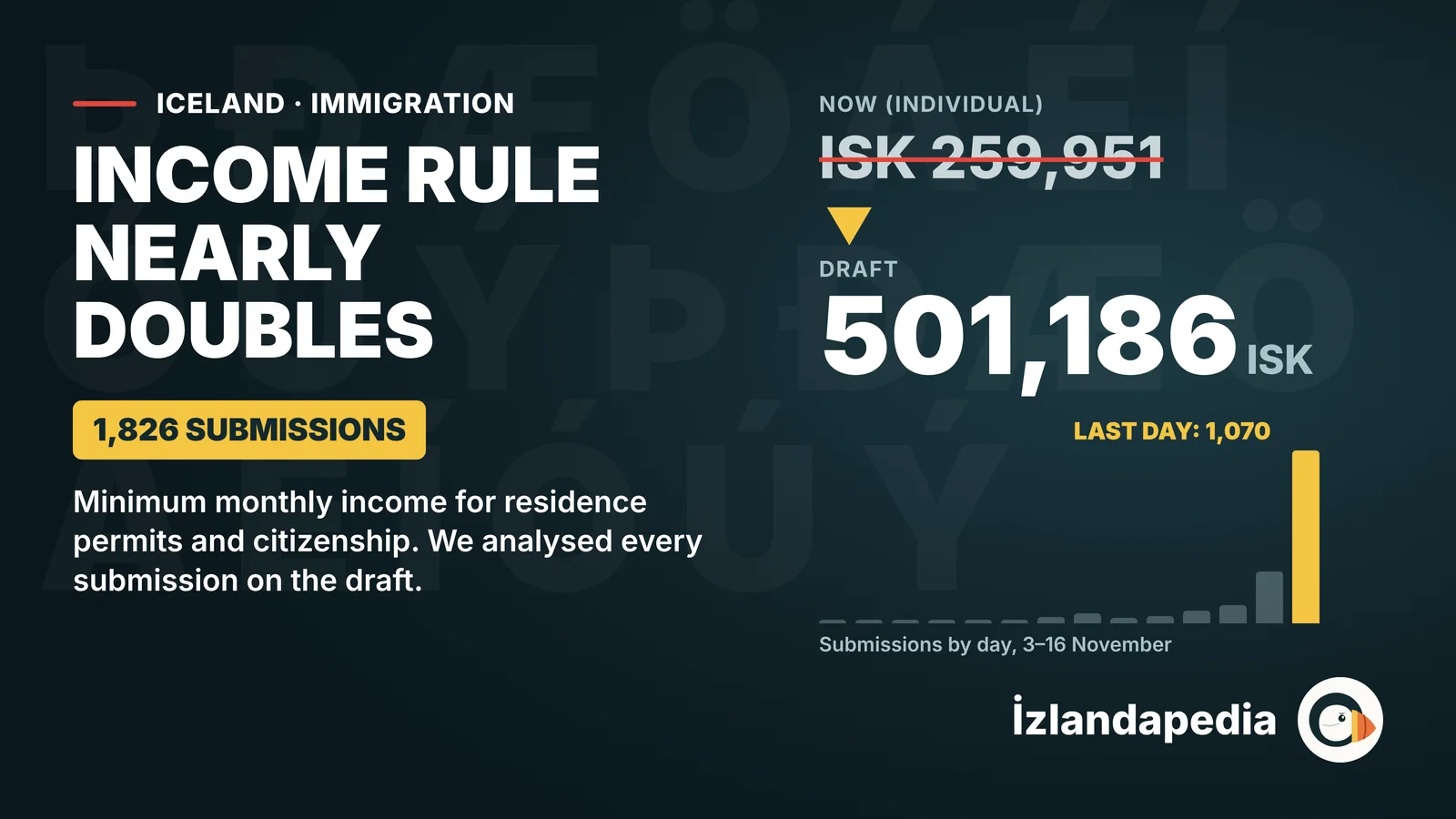
The Ministry of Justice wants to raise the minimum monthly income required for residence permits and citizenship from ISK 259,951 to ISK 501,186. The draft drew 1,826 public submissions in two weeks. İzlandapedia downloaded and analysed all of them: the objections centre on students, families and wages, and more than half arrived in the final 12 hours.
Consultation: 3–16 November 2026 · Case: S-225/2026 · Data: 19 November 2026
What does the draft change?
People from outside the EU/EEA must show that they can support themselves to obtain a residence permit or citizenship in Iceland. Until now, the Directorate of Immigration (Útlendingastofnun) has used the basic social assistance amount of the City of Reykjavík, ISK 259,951 a month, as its benchmark. [3]
The draft published by the ministry on 3 November would change that. The new base amount is the average of three figures from the welfare system: the income exemption limit for housing benefits, the full disability pension with household supplement, and the income level at which child benefits for single parents start to be reduced. [2][3] The result is ISK 501,186 a month for an individual, an increase of about 93 per cent. For families, the amount rises further with the number of children:
| Household | Now | Draft | Change |
|---|---|---|---|
| Individual | 259,951 | 501,186 | +93% |
| Single parent, 2 children | 259,951 | 801,897 | +208% |
| Couple, no children | 415,922 | 801,897 | +93% |
| Couple, 3 children | 415,922 | 1,252,964 | +201% |
| Students and doctoral students | 259,951 | 375,890 | +45% |
According to the ministry, the aim is to ensure that people who settle in Iceland can support themselves and their families without relying on social assistance. It also argues that financial capacity can be a strong indicator that a person has integrated and formed genuine ties to the country. Existing permits would not automatically lapse, but the rules would apply to pending applications decided after they take effect. Permits based on international protection or humanitarian grounds are not covered. [3][1]
The last day: 1,070 submissions
Comments could be submitted from 3 to 16 November. During the first ten days, no more than 59 submissions arrived on any single day. Then the numbers climbed fast: 114 on 14 November, 322 on 15 November and 1,070 on the final day, 16 November, alone. More than half of all submissions (961, or 53 per cent) were sent in the last 12 hours before the deadline. [1]
Seventy per cent of the submissions are written in Icelandic and 28 per cent in English. Among those writing in Icelandic are Icelanders who introduce themselves as having a foreign spouse, daughter-in-law or son-in-law. Artists, teachers and health workers also write on behalf of foreign colleagues. [1]
How many are against?
Of a random sample of 120 submissions, 119 oppose the draft or ask for the amounts to be changed. A few of them say they support clear rules in principle but object to the size and speed of the increase. Only one submission in the sample clearly supports the draft, and it asks for even stricter rules. [1]
About 11 per cent of submissions (199) are word-for-word identical to others. The largest group is the same English letter about students, sent by 22 people. The vast majority of the rest are original texts in which people tell their own stories. [1]
What are the objections about?
A third of the submissions mention students, universities or research, and about another third mention spouses, children or family reunification. One in four compares the new amount with wages in Iceland. Then come the economy and labour, citizenship, discrimination and the arts. [1]
The most frequent argument is that the new amount exceeds what many full-time workers earn. The Icelandic Confederation of Labour, ASÍ, says the same in its formal submission: the individual amount is higher than the lowest full-time wages in collective agreements, so a person working full time on a collectively agreed wage would not count as having “secure means of support”. ASÍ calls this unacceptable and argues that such a major change should be debated in Alþingi rather than made by regulation. [4] The public-sector federation BSRB makes the same point and notes that the draft does not explain why the average of these three welfare figures was chosen. [5]
Universities: “Our own salaries fall short”
The most striking calculation came from the University of Iceland (HÍ). It set the gross base salaries in its own pay scales against the amounts in the draft. The draft allows spouses’ incomes to be combined; the family examples below show a household with only one earner:
- A married postdoctoral researcher with no children (base salary ISK 749,218) falls ISK 52,679 short of the amount required for a couple.
- A married assistant professor (lektor) with two children (ISK 842,496) falls ISK 260,113 short.
- A doctoral student employed at 70 per cent (ISK 378,319) clears the student threshold by only about ISK 2,400. [6]
HÍ also notes that the draft does not say whether the amounts are before or after tax. Reykjavík University (HR), the University of Akureyri (HA), the Iceland University of the Arts (LHÍ) and the research fund Rannís all warn that Icelandic universities would lose ground in the competition for international students and researchers. [6][7][8][9][10]
The University of Iceland Student Council (SHÍ) points out that students from outside the EU may only work up to 60 per cent while studying, and calculates that full-time study is a workload of 47–56 hours a week. [11] According to FeDoN, the association of doctoral students and postdocs at HÍ, only about a third of doctoral students have funding. [12]
Families, women, disabled people
The children’s rights organisation Barnaheill (Save the Children Iceland) writes that a single parent with two children would have to show ISK 801,897 a month, while the state pays the same family about ISK 414,000 in unemployment benefits. It asks the ministry to withdraw the draft until its effect on children has been assessed. [13]
The Icelandic Women’s Rights Association (KRFÍ) says the draft contains no gender impact assessment. Citing data from the labour market research institute Varða, it notes that 45 per cent of immigrant women have a monthly income below ISK 499,000, compared with 28 per cent of other women. [14] The disability rights organisation ÖBÍ welcomes the draft’s exemption for disabled people but asks for it to be broader. [15]
What happens next?
The consultation has closed, and the case now has the status “results in preparation”. The regulation does not need to pass Alþingi; the final decision lies with Minister of Justice Þorbjörg Sigríður Gunnlaugsdóttir. [1][16]
The draft is separate from the government’s bill tightening the rules on residence permits. That bill has been submitted to Alþingi and includes, among other changes, six years of residence instead of four before a permanent permit can be granted. [17][19] It has also been decided that bachelor’s and master’s students from outside the EU/EEA will pay annual tuition fees of ISK 1.45–3.25 million, starting with students admitted next academic year; doctoral students are exempt. On 18 November, students and academics marched from the University of Iceland to Alþingi chanting “Ég vil læra” (“I want to study”). [18]
Sources
- Samráðsgátt stjórnvalda — Mál S-225/2026 og 1.826 birtar umsagnir
- Dómsmálaráðuneytið — Drög að reglugerð um framfærslu (PDF)
- Stjórnarráðið · 3.11.2026 — Raunhæf framfærsluskilyrði fyrir umsóknir um dvalarleyfi
- Alþýðusamband Íslands (ASÍ) · 16.11.2026 — umsögn
- BSRB · 16.11.2026 — umsögn
- Háskóli Íslands · 16.11.2026 — umsögn
- Háskólinn í Reykjavík — umsögn nr. 180 (samráðsgátt)
- Háskólinn á Akureyri · 16.11.2026 — umsögn
- Listaháskóli Íslands · 16.11.2026 — umsögn
- Rannís — umsögn
- Stúdentaráð Háskóla Íslands (SHÍ) · 16.11.2026 — umsögn
- FeDoN — umsögn nr. 1143 (samráðsgátt)
- Barnaheill – Save the Children á Íslandi · 16.11.2026 — umsögn
- Kvenréttindafélag Íslands · 16.11.2026 — umsögn
- ÖBÍ réttindasamtök · 16.11.2026 — umsögn
- mbl.is · 17.11.2026 — Hátt í 2.000 umsagnir bárust um framfærslu útlendinga
- Stjórnarráðið · 1.10.2026 — Skilyrðum breytt og ríkari kröfur gerðar til umsækjenda
- Iceland Review · 18.11.2026 — “Stop the Madness”: Protesters Challenge Proposed Rules for Non-EU Students
- AMSIS · 16.11.2026 — umsögn