
Höfn · Residents’ vote
A small fishing town’s big decision: Höfn puts its harbour to a vote
About 2,600 people live in Hornafjörður, and from 5 to 15 December they go to the polls. The vote is on an agreement that leases council-owned lots at Höfn harbour to the developer Landsbyggð for decades. In return, the harbour would get a hotel, flats, shops and squares. The documents we obtained give no total cost, no ground rent and no answer on whether the flats will be sold or rented.
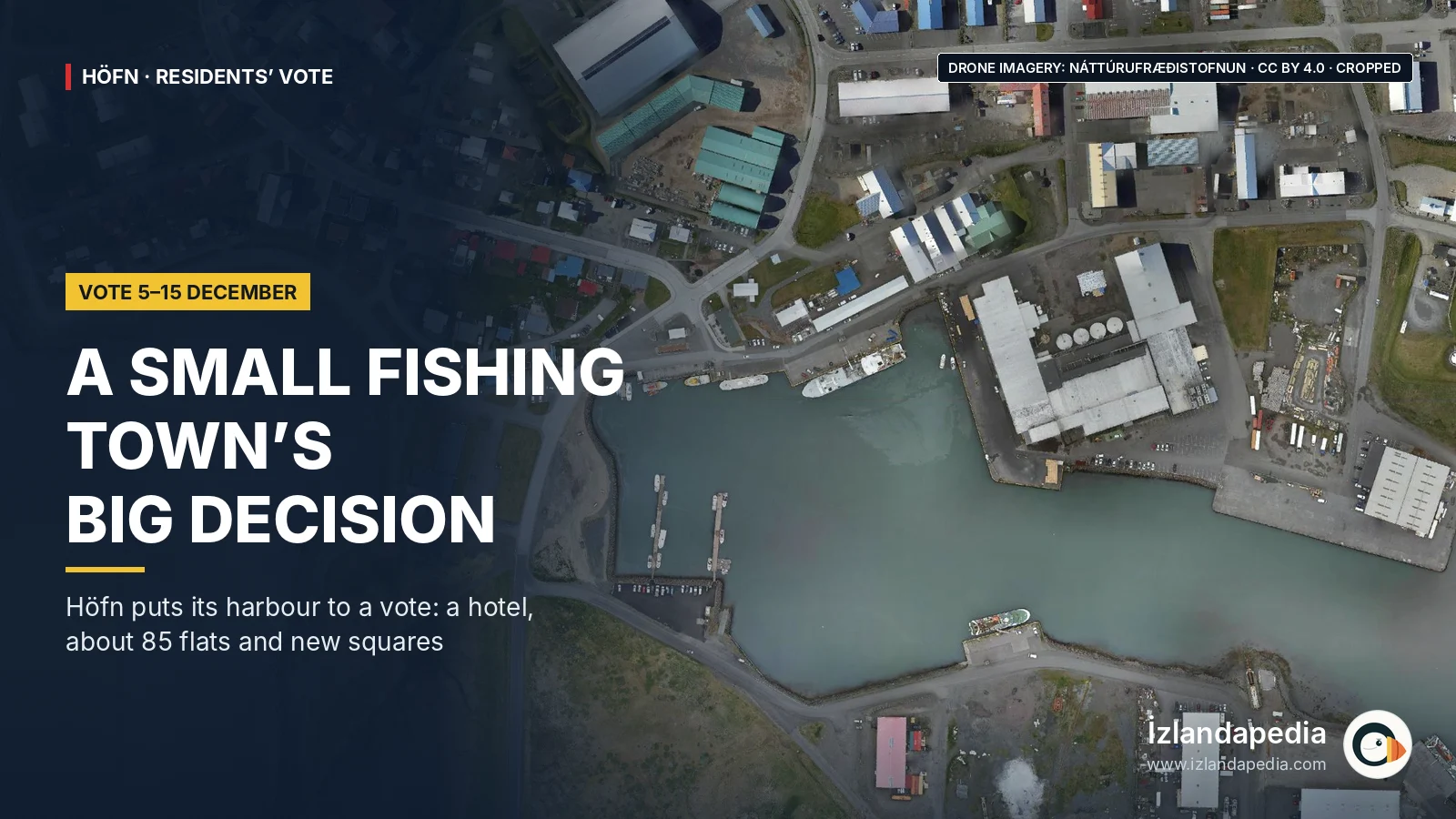
On 3 November the Hornafjörður town council approved the draft agreement 7–0 and decided to put it to residents. The developer, Landsbyggð, belongs to the same group that built the new town centre in Selfoss.
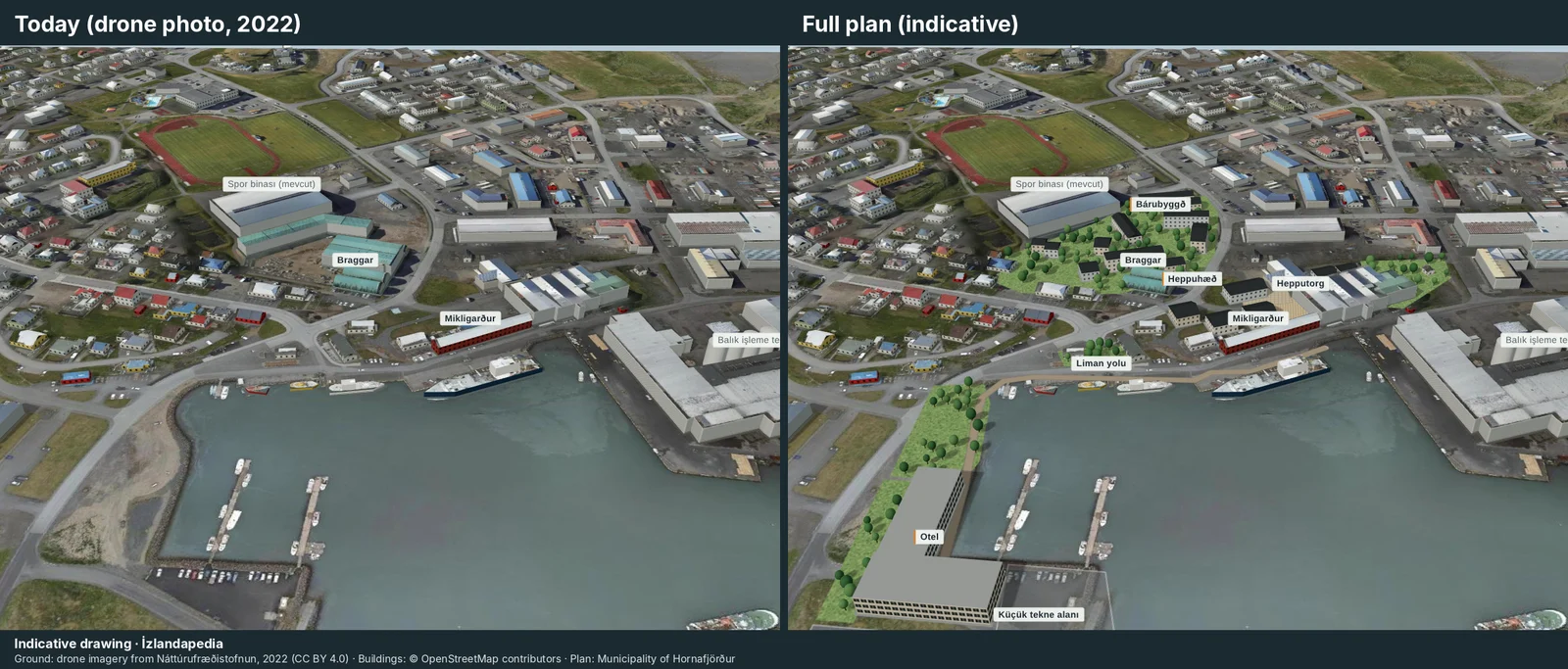
What would the harbour look like if the project goes ahead? To find out, we placed the municipality’s zoning plan sheet on a drone photo taken in 2022 and built a 3D model. Use the “Today”, “2030 target” and “Full plan” buttons to compare the harbour as it is with what is planned, and click on buildings for details.
Open the model full screen ↗
In this story
What is on the ballot?
The ballot asks one question: “Do you approve the proposal regarding the agreement with Landsbyggð?” The answers are “Yes” and “No”.
The vote is advisory, not legally binding. The town council makes the final decision.
Who can vote, and how?
- Voting runs from 5 to 15 December, every day including weekends, from 09:00 to 15:00.
- The polling station is the Town Hall (Ráðhús) in Höfn. Residents of Öræfi can vote at Hofgarður on 5 December.
- Voting is in person only; there is no postal vote.
- The voting age is 16, and the voting notice says participation follows the legal conditions for voters. Under Icelandic election law, foreign citizens can vote in municipal elections after three years of continuous legal residence; Danish, Finnish, Norwegian and Swedish citizens can vote without that wait. How this rule applies to this vote is for the municipality to clarify.
- The voting notice was published only in Icelandic. Yet 806 of the municipality’s 2,631 residents, about 31%, are foreign citizens. Nearly one resident in three is probably unable to read the notice in their own language.
What is planned for the harbour?
The figures in the agreement are indicative; the zoning plan will set the final numbers.
- Hotel: by the harbour, 6,500–7,000 m², up to three floors, up to 120 rooms and about 300 beds.
- Heppuhæð: about 3,050 m² of new buildings, including 950 m² of housing and 2,100 m² of shops and services, up to two floors, around a new square, Hepputorg.
- Bárubyggð: about 85 flats in two- and three-storey buildings, up to 7,150 m² in total.
- Public space: Hepputorg square, a park by the Bára, a continuous harbour walkway linking the hotel to the centre, and a new square on the weighing-station site. The small-boat harbour area grows from about 2,175 m² to 3,595 m².
- Old buildings: the old warehouses (braggar) in Bárubyggð are to be kept and may be adapted to new uses. Mikligarður may be recorded, demolished and rebuilt in a similar form. The weighing house can stay until construction starts.
The land is leased, not sold
The lots are leased for the long term: 75 years for housing and 50 years for commercial use. The agreement states no ground rent and no sale price.
The only fixed amount in the documents is a non-refundable confirmation fee of ISK 1 million per lot, credited against the street and infrastructure fee. That fee itself follows the municipality’s normal tariff.
The municipality first allocates the 9,360 m² hotel lot, several lots at Heppa and three parking lots totalling 4,748 m². The agreement also reserves six lots at Ósland, outside the planning area and totalling 28,080 m², for a later phase. That priority right can be extended until 31 December 2031 at the latest, and the documents do not say what the land will be used for.
Under the municipality’s rules, lots are normally advertised for at least four weeks. The council may grant a lot commitment without advertising “in special cases”; this project uses that exception.
Part of the project is private land. Landsbyggð controls seven lots (4,751 m²) owned by Skinney-Þinganes, the area’s largest fishing company. The agreement is conditional on those lots being transferred to Landsbyggð.
Who pays the bill?
The agreement gives no total investment or cost figure, only how costs are split.
Landsbyggð pays for: the zoning plan and all design, all construction inside its lots, its own parking, building and maintaining the public space at the Bára, and registration costs.
The municipality pays for (subject to budget approval):
- water, heating, sewer and street-lighting connections;
- moving Víkurbraut westwards and building a new road, Bárugata;
- turning Heppuvegur into a one-way street where pedestrians have priority;
- Hepputorg, the square at the weighing station and most of the harbour walkway;
- the small-boat harbour area and public parking on municipal land.
The documents do not say how much this will cost the municipality.
Will the municipality own a share?
No. The agreement gives the municipality no equity, no profit share and no flats. The one exception is Mikligarður, whose ownership and costs will be divided under a separate agreement later. In August the municipality’s culture committee found the building’s condition unacceptable and decided that the artists’ studios and museum storage inside must move out.
When will it be finished?
- The zoning plan must take effect by 1 September 2027 at the latest; otherwise either party may withdraw.
- The hotel and the Heppa area should be finished within five years of the plan taking effect, and no later than six. Lots where work has not started by then return to the municipality.
- The project schedule says critical works will be finished before summer 2030; building the hotel is expected to take 30 months.
- There is no completion date for the 85 flats in Bárubyggð. Their timing will be agreed once the first two phases are done.
Who is behind it?
According to Vísir, the idea came from Skinney-Þinganes, which was in talks with Landsbyggð about taking part. The same report said Landsbyggð is owned by Kristján Vilhelmsson, a co-founder of Samherji, and Leó Árnason. Skinney-Þinganes was Höfn’s largest employer in 2025, with 283 full-time equivalent jobs.
What the mayor says
Mayor Hjalti Þór Vignisson says the project will give Höfn “a new look”. In his view, a town where most tourists stop briefly could become a destination where people stay for several days.
He also acknowledged to mbl.is that the town is handing over many important lots in a good location and that opinions may differ. That, he said, is why he welcomes hearing from residents.
Questions still waiting for answers
Our review of the documents left these questions open:
- Can foreign citizens take part in this vote?
- Why are the lots allocated without public advertising or competition, and what is the annual ground rent?
- What is the total cost of the roads, utilities and squares the municipality is taking on?
- Will the 85 flats be sold or rented, and why is there no completion date?
- Who owns Landsbyggð today, and what is Skinney-Þinganes’s stake?
- What are the 28,080 m² at Ósland reserved for?
- Which old buildings will be demolished for the new ones, and where will the harbour weighing station move?
Residents heading to the polls may want these answers too. If the municipality responds, we will update this story.
About the model in this story
While preparing this story, we wondered whether the municipality’s plan sheet could be turned into a model, so we tried it. When the test worked, we developed it further: we placed the zoning plan sheet on a drone photo taken in June 2022 and raised today’s buildings in 3D from OpenStreetMap. The model shows one thing at first glance: if the project goes ahead, the look of the harbour area will change completely.
The model is an approximate drawing based on the municipality’s plan sheet, not the official design. Building heights and facades are indicative. We removed old buildings that stand where new ones are planned; the documents do not say which buildings will actually be demolished.
Presenting a story with an interactive model like this is a first for İzlandapedia. You can write to us with your thoughts on the experiment.
Sources
- Hornafjörður town council, minutes and attachments of meeting 355 (3 November 2026) ↗
- Draft agreement: Samningur um uppbyggingu á Höfn, draft 4 ↗
- Zoning plan report and planning terms (Greinargerð og skipulagsskilmálar) ↗
- Project schedule: Nýr miðbær á Höfn, framvinduáætlun ↗
- Letter of intent, 9 October 2025 (Viljayfirlýsing) ↗
- Rules on lot allocation (Reglur um úthlutun lóða) ↗
- Overview map: Yfirlitskort Höfn í Hornafirði ↗
- Voting notice (Auglýsing um íbúakosningu) ↗
- Economy and Culture Committee, meeting 90 (Mikligarður) ↗
- Environment and Planning Committee, meeting 118 ↗
- Hornafjörður rules on residents’ votes, no. 460/2023 ↗
- Elections Act 112/2021 (Alþingi) ↗
- Voting rights of foreign citizens in municipal elections (Ísland.is) ↗
- mbl.is: Höfn verði áfangastaður framtíðar (9 November 2026) ↗
- mbl.is: Samið um þróun miðbæjar á Höfn (15 October 2025) ↗
- Vísir: Sveitarfélagið og útgerðarmenn byggja nýjan miðbæ á Höfn ↗
- RÚV: Semja um að byggja nýjan miðbæ á Hornafirði (14 October 2025) ↗
- Eystrahorn: Áttatíu ára saga að baki (Skinney-Þinganes) ↗
- Guide to Iceland: Demographics of Iceland (population and share of foreign citizens) ↗
- Heimildin: the owners of Landsbyggð (background) ↗
- Náttúrufræðistofnun: drone imagery of Höfn, 15–16 June 2022 (CC BY 4.0) ↗
- OpenStreetMap contributors: building data (ODbL) ↗
Sources last accessed on 14 November 2026. The municipal documents were attached to the council meeting of 3 November 2026; figures in the agreement are indicative.