
Iceland · Tourism and law
Golden Circle fee reaches Alþingi as municipalities' legal opinion warns of EEA breach
A bill to charge visitors for entry to Þingvellir, Gullfoss and Geysir has had its first reading in parliament. An independent legal opinion commissioned by four local municipalities argues the fee may conflict with the EEA Agreement because it exempts everyone who is tax-resident in Iceland.
Bill: Alþingi document 418, case 328 · First reading: 18 November 2026
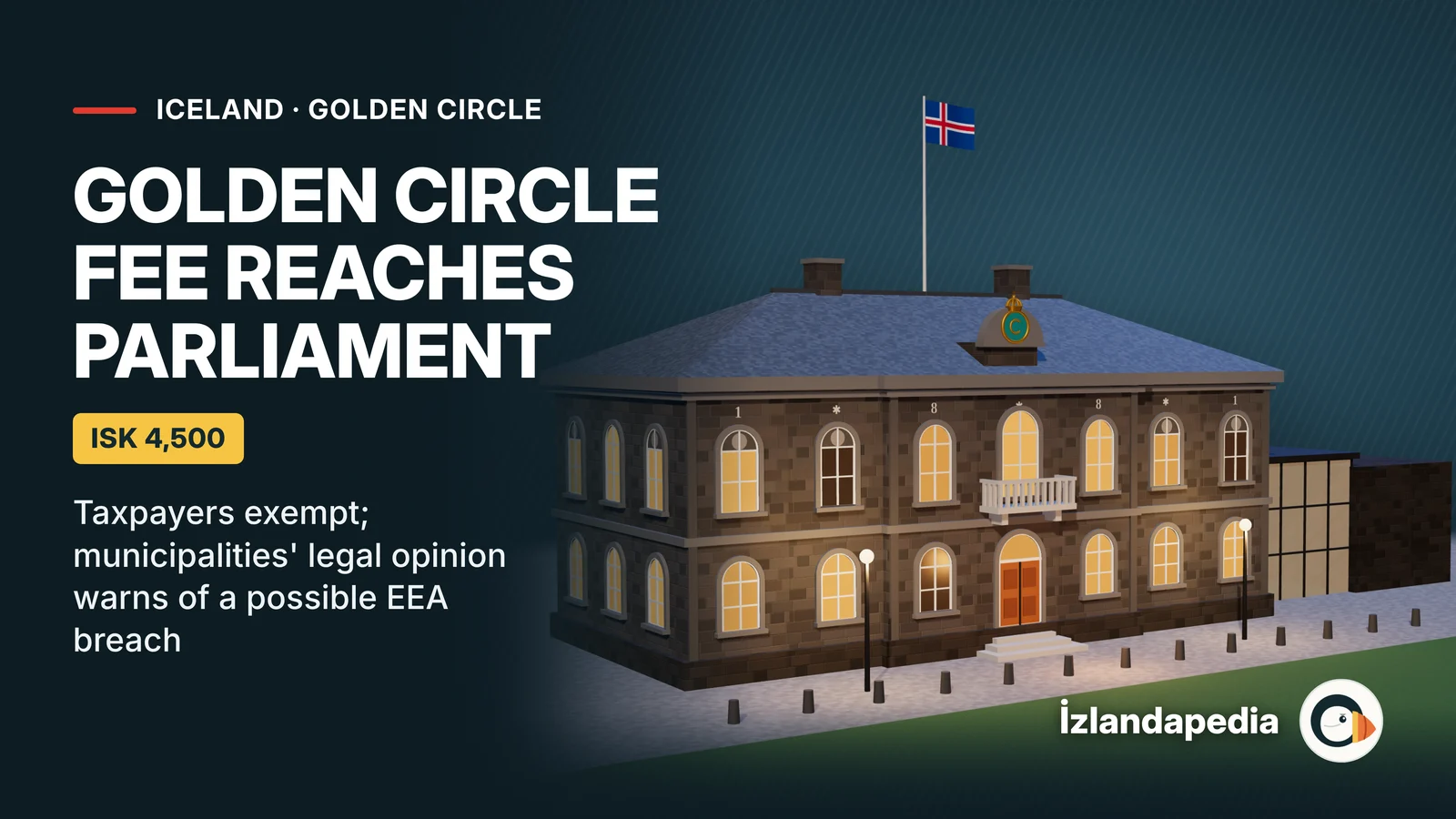
The nature and infrastructure fee (náttúru- og innviðagjald), proposed by Minister of Industries Hanna Katrín Friðriksson, had its first reading in Alþingi on 18 November. Under the bill, everyone aged 18 or over who is not tax-resident in Iceland would pay to visit the country's three most-visited sites. [1] [2]
The fee would be ISK 4,500 in summer and ISK 3,000 in winter, covering all three sites for one year. People who are tax-resident in Iceland, including foreign residents, would not pay. [3] [8]
The core question: who pays?
The four municipalities along the Golden Circle — Bláskógabyggð, Hrunamannahreppur, Grímsnes- og Grafningshreppur and Skeiða- og Gnúpverjahreppur — asked the law firm Forum lögmenn for an independent assessment. The opinion, written by Supreme Court attorney Stefán Geir Þórisson, finds a significant likelihood that the fee breaches provisions of the EEA Agreement. [4] [5]
Stefán Geir Þórisson was also among the lawyers for Erla María Sveinbjörnsdóttir before Iceland's Supreme Court, in the Sveinbjörnsdóttir case that set the precedent on state liability under EEA law. [11]
The opinion questions whether the fee is proportionate, since the same aim could be reached by a less restrictive, non-discriminatory measure. The municipalities also warn that the state could face liability for damages. [4] [5]
The four council leaders — Guðmundur Finnbogason, Haraldur Þór Jónsson, Helgi Kjartansson and Jón Bjarnason — issued a joint statement. They called on the government to reconsider the fee and to complete a proper legal and impact assessment first. Haraldur Þór Jónsson argues that for such a fee to hold, everyone would have to pay it, Icelanders included. [4] [5]
What the minister says
Hanna Katrín Friðriksson says the aim is not to reduce visitor numbers but to have foreign guests contribute directly to infrastructure at the nation's natural landmarks. She has said the government would review the fee if tourists react badly. [6]
Public in favour, industry opposed
A Gallup poll for the Social Democratic Alliance (Samfylkingin) found 62% of Icelanders in favour and 24.6% against. The tourism industry argues the fee will make organised Golden Circle day tours significantly more expensive. [7]
The bill now goes to committee, where the EEA question is expected to be central.
Opinion
The Golden Circle fee: a fair idea, poorly defended
An entry fee for Þingvellir, Gullfoss and Geysir is before parliament. The debate turns on exempting those who pay tax in Iceland. The exemption rests on a fair idea, but the government has not built the legal ground to defend it.
What happened?
The government wants to introduce a "nature and infrastructure fee" for entry to Iceland's three most-visited sites: Þingvellir, Gullfoss and Geysir. The bill from Minister of Industries Hanna Katrín Friðriksson had its first reading in Alþingi on 18 November. The fee would be ISK 4,500 in summer and ISK 3,000 in winter, covering all three sites for one year.
Everyone aged 18 or over who is not tax-resident in Iceland would pay. Those who are tax-resident, Icelanders and foreign residents alike, would not. The minister says the aim is not to reduce visitor numbers but to have foreign visitors contribute directly to infrastructure at these sites. A Gallup poll for the Social Democratic Alliance found 62% of Icelanders in favour.
The four municipalities in Uppsveitir, where the sites are located, commissioned an independent legal opinion. It argues that exempting residents may breach the EEA Agreement. The municipalities warn that unless everyone pays, the fee will create legal problems and could leave the state liable for damages. They also say its impact on local tourism businesses and day tours has not been properly assessed. Tour operators argue that Golden Circle tours will become significantly more expensive.
The heart of the debate is this: is it fair to exempt those who pay tax here, and can it survive legally?
The taxpayer's contribution
The income tax deducted from my payslip every month also pays for the paths at Þingvellir, the railings at Gullfoss and the safety measures at Geysir. Everyone who works in Iceland does the same: Icelanders and immigrants like me. It is not fair for a tourist who visits once a year to contribute nothing. But it is not fair either to charge someone who has paid for years the same as that tourist.
In that sense, the core idea of the bill is right. The problem is not the idea. It is the defence.
There is a serious legal objection
As a lawyer, I think this objection should not be dismissed. According to the opinion the municipalities commissioned, even though the test is residence rather than nationality, almost everyone who pays is a foreigner, which can amount to indirect discrimination.
The objection has serious case law behind it. In 2003 the EU Court of Justice ruled against Italy because some municipal museums gave reduced entry only to Italians and local residents (C-388/01). Iceland reached the same conclusion in its 2015 "nature pass" bill, which included Icelanders. And in E-1/03 the EFTA Court ruled against Iceland for taxing flights to Europe more heavily than domestic flights.
But the objection can be overcome
Case law is not a fixed set of rules; a good lawyer distinguishes precedent. There are three strong grounds here:
- A museum is not a waterfall. C-388/01 concerned a cultural service with no overriding public interest at stake. Here, what is protected is irreplaceable natural heritage. Environmental protection is one of the strongest justifications in European law; in PreussenElektra (C-379/98) the Court accepted a measure with discriminatory elements because of its environmental aim.
- Iceland's situation is exceptional. Iceland receives several times its own population in visitors every year. A small tax base cannot be expected to carry the burden of mass tourism alone. Proportionality must be judged in that context.
- The link between tax and site can be proven. Courts have rejected the "residents already pay taxes" argument because they saw no direct link between general taxes and a specific service. But that link can be shown in figures: if it is documented that these three sites have long been funded from the state budget, that is, from income tax, the reduction is not a privilege but a credit for a contribution already made.
The government has not made that case
The bill uses none of these openings:
- The rationale is about revenue. The government presents the fee as foreign visitors contributing to infrastructure. Under European law, raising revenue does not justify discrimination. The environmental case stays in the background.
- No funding link is shown. There is no account of how these sites have been financed from tax revenue so far.
- Full exemption, not a credit. Taxpayers pay nothing at all. A reduced fee that credits a contribution already made would be far easier to defend than a full exemption.
- The design does not manage crowds. A pass paid once and valid for unlimited visits for a year does not discourage peak-time visits. Venice, by contrast, charges its access fee only on peak days, between 8:30 and 16:00.
Who pays the bill?
A weak defence can be costly. A state that breaches EEA law must compensate the damage, a principle the EFTA Court established in an Icelandic case (E-9/97). On 23 September the Supreme Court ordered the state to pay a woman more than ISK 2.7 million for incomplete implementation of EEA rules. If the fee is collected for years and then struck down, the very taxpayers we want to protect will pay the bill.
What the committee should do
The bill can be strengthened without being killed:
- Document the funding link. Put the budget allocations to these three sites over the past decade into the explanatory notes.
- Turn the exemption into a credit. Instead of a full exemption for taxpayers, a reduced fee proportionate to the contribution already made.
- Earmark the revenue. Not for the general budget, but for protecting and securing these three sites.
- Lead with the environmental case. Back it with visitor numbers, carrying capacity, damage to nature and accident records.
- Link the fee to crowding and add a review clause. Measure the effect within two or three years.
- Talk to ESA in advance. It reduces the risk of infringement proceedings later.
The municipalities say the fee will cause legal problems unless everyone pays; the government wants only foreigners to pay. The right answer lies in between: recognise the contribution of those who already pay through their taxes, but put it on solid legal ground. Building that ground in Alþingi will cost far less than defending it years from now in a courtroom in Luxembourg.
The author is the founder and editor of İzlandapedia.
Sources
- Alþingi — Þingskjal 418, 328. mál: frumvarp til laga um náttúru- og innviðagjald
- Alþingi — 1. umræða, 34. fundur, 18.11.2026
- Alþingi — Þingskjal 196: svar ráðherra um gjaldtöku á ferðamannastöðum
- Sunnlenska · 16.11.2026 — Lögfræðiálit vekur alvarlegar spurningar um lögmæti náttúrupassa
- mbl.is · 5.11.2026 — Áform andstæð EES
- Vísir — Endurskoða gjaldtökuna ef ferðamönnum fækkar
- Vísir — Flestir hlynntir fyrirhugðu innviðagjaldi
- bb.is — Meirihluti landsmanna hlynntur innviðagjaldi á ferðamenn
- Court of Justice of the EU · 16.1.2003 — C-388/01 Commission v Italy (press release)
- EFTA Court — E-9/97 Erla María Sveinbjörnsdóttir v Iceland
- Hæstiréttur — mál nr. 236/1999
- Alþingi — Þingskjal 699 (144. löggjafarþing): frumvarp til laga um náttúrupassa, 2015
- EFTA Court — E-1/03 EFTA Surveillance Authority v Iceland
- mbl.is · 24.9.2026 — Fær bætur eftir lágmarksgreiðslur í fæðingarorlofi
- Comune di Venezia — Venice Access Fee